

Sustainability · 2025
In this section52 topics
- Sustainability Policy2 items
- Sustainability Goals & UN SDGs3 items
- Policy Review3 items
- Business Value Chain1 item
- Stakeholder Analysis1 item
- Environmental Policy & Guidelines3 items
- Environmental Policy Review3 items
- Energy — Plan & Guidelines2 items
- Energy — Electricity Consumption1 item
- Energy — Fuel Consumption1 item
- Energy — Targets2 items
- Energy — Performance & Outcomes2 items
- Water — Plan & Guidelines2 items
- Water — Withdrawal, Discharge & Consumption1 item
- Water — Targets2 items
- Water — Performance & Outcomes2 items
- Waste — Plan & Guidelines2 items
- Waste — Generation, Disposal & Recycling1 item
- Waste — Targets2 items
- Waste — Performance & Outcomes2 items
- GHG — Plan & Guidelines2 items
- GHG — Emissions1 item
- GHG — Emissions Verification3 items
- GHG — Principles & Standards1 item
- GHG — Targets1 item
- GHG Targets — Net Zero2 items
- GHG Targets — Carbon Neutrality1 item
- GHG — Performance & Outcomes2 items
- Environmental Legal Incidents1 item
- Other Environmental Management1 item
- Social Sustainability — Overview1 item
- Social Policy & Guidelines4 items
- Social Policy Review1 item
- Social — Principles & Standards Practised1 item
- Human Rights Due Diligence2 items
- Employees — Plan & Guidelines3 items
- Employees — Workforce3 items
- Employees — Remuneration & Provident Fund2 items
- Employees — Training & Development1 item
- Employees — Occupational Health & Safety1 item
- Employees — Labour Relations1 item
- Employees — Employee Representation2 items
- Employees — Targets2 items
- Employees — Performance & Outcomes2 items
- Customers — Plan & Guidelines3 items
- Customers — Satisfaction Results1 item
- Customers — Targets2 items
- Customers — Performance & Outcomes2 items
- Community & Social — Plan & Guidelines3 items
- Community & Social — Targets2 items
- Community & Social — Performance & Outcomes2 items
- Law Violation Incidents1 item
Sustainability Policy
Has a Sustainability Policy
Yes
Policy Description
The Company is committed to operating and fostering sustainable economic growth based on corporate governance that is responsible for the economy, society, and environment throughout the business value chain, by considering the impacts and co-creating value for all stakeholders under universal sustainability principles and in alignment with the United Nations Sustainable Development Goals (UN SDGs). This commitment guides the Company in conducting business to achieve growth targets and generate sustainable long-term returns for all stakeholders, in accordance with the sustainable organizational development policy that aims to create results through business processes for long-term growth. Furthermore, the Company aims to develop excellent products and services through intelligent technology to deliver valuable experiences, and is committed to operating responsibly by managing to prevent or mitigate impacts on society and the environment throughout the business value chain. This includes promoting respect for human rights and labor practices based on personnel development and fostering a culture for sustainable organizational development, encompassing adaptive culture, mission-driven culture, and participatory culture, in line with changes in the business environment.
Sustainability Goals & UN SDGs
Has Sustainability Goals
Yes
Goals Description
In 2025 The Company has reviewed its sustainable organizational development policy and key sustainability issues as per the Board of Directors' Meeting No. 9/2025 on November 13, 2025. covering the sustainable development framework, comprising economic and governance dimensions, social dimensions, and environmental dimensions, as well as an analysis of risks that may affect business operations or organizational strategies in the short, medium, and long term. The Company also conducts analysis and assessment of key sustainability issues, leading to effective ESG risk management. Furthermore, the Company has sought opportunities arising from these risk issues by focusing on “adding value to the business through digital transformation” to support customers in conducting sustainable business in accordance with economic and governance dimensions, social dimensions, and environmental dimensions. This aims to promote and develop the livelihoods of communities and society to meet basic needs in line with the United Nations Sustainable Development Goals (SDG 1, SDG 3, SDG 4, SDG 5, SDG 6, SDG 7, SDG 8, SDG 9, SDG 10, SDG 12, SDG 13, SDG 16, and SDG 17), thereby creating sustainable value for stakeholders throughout the value chain in a balanced manner.
UN Sustainable Development Goals
| SDG Goal |
|---|
| Goal 1 No Poverty |
| Goal 3 Good Health and Well-being |
| Goal 4 Quality Education |
| Goal 5 Gender Equality |
| Goal 6 Clean Water and Sanitation |
| Goal 7 Affordable and Clean Energy |
| Goal 8 Decent Work and Economic Growth |
| Goal 9 Industry, Innovation and Infrastructure |
| Goal 10 Reduce Inequalities |
| Goal 12 Responsible Consumption and Production |
| Goal 13 Climate Action |
| Goal 16 Peace, Justice and Strong Institutions |
| Goal 17 Partnerships for the Goals |
Policy Review
Policy Reviewed This Year
Yes
Policy Changed This Year
Yes
Review Details
The Company reviews information received from stakeholders regarding its vision, mission, and strategic direction for business operations, encompassing both internal and external contexts concerning risks and opportunities that may impact business operations. This information is utilized to continuously consider, improve, and develop material sustainability issues. Stakeholders' expectations, concerns, and feedback are incorporated to refine approaches for engaging with them, thereby identifying material issues and appropriately addressing stakeholders' expectations on each issue to drive sustainable business growth.
Business Value Chain
Value Chain Description
The company prioritizes the development and management of its business value chain from upstream to downstream, including its treatment of all stakeholder groups throughout the business value chain. An analysis of the business value chain reveals four key activities: 1) Technology and Business Solution Development (Smart Solution), which focuses on developing new service models to meet the needs of target market customers; 2) Responsible Procurement and Sourcing (Smart Sourcing), which emphasizes the quality of goods and services, including partner management to ensure operations align with sustainability practices and mitigate risks that may affect quality, quantity, and delivery of goods and services; 3) Smart Operation, which aims to create customer satisfaction and loyalty through experiential value perception; and 4) Smart Technology Services (Smart Service), which focuses on efficiency and accuracy in providing diverse services tailored to each customer, leading to continuous long-term growth, alongside improving the quality of life in society and optimizing resource utilization. to suit the business size
|
Key Activities ( Value Chain) |
Work Process (Work Process) |
|
1. Technology and Business Solution Development (Smart Solution) |
|
|
2. Responsible Procurement and Sourcing (Smart Sourcing) |
|
|
3. Smart Operation |
|
|
4. Smart Technology Services (Smart Service) |
|
Stakeholder Analysis
Stakeholder Analysis
| Stakeholder Type | Stakeholders | Stakeholder Expectations | Response to Expectations | Communication Activities |
|---|---|---|---|---|
| External stakeholders | 2923 · Description: Customers | – Secure, convenient, and accessible services – Rapid and efficient problem resolution – Protecting confidential information and the privacy of service recipients | – Develop innovative services that promote a good quality of life and high-quality services equally and without discrimination.– Real-time problem reporting system.– Special task force for emergency problem resolution.– Establish standards for the protection and safeguarding of customer personal data. | 2941 · Description: Online Communication · 2945 · Description: Complaint Reception · 2947 · Description: Satisfaction Survey |
| External stakeholders | 2900 · Description: Business partners | – Comply with terms, conditions, and obligations fairly. – Develop service innovations and address limitations in the use of systems and equipment for service provision to ensure they are secure and modern. – Manage operations to maximize benefits and generate profit. | – Comply with commercial terms and fulfill contractual obligations to business partners fairly. – Adhere to business ethics. – Improve work processes and innovation in service areas. – Review and exchange opinions mutually in creating shared value. – Analyze and review pricing regularly according to economic conditions. | 2938 · Description: Visit · 2941 · Description: Online Communication · 2943 · Description: External Meeting · 2947 · Description: Satisfaction Survey |
| Internal stakeholders | 2921 · Description: Employees | – Provide appropriate and fair compensation, welfare, and benefits – Develop a good and safe working environment – Promote career advancement – Develop adequate skills and potential necessary for performing duties | – Provide appropriate compensation and welfare comparable to similar businesses.– Create a good, safe, and conducive working environment.– Develop capabilities and career advancement.– Conduct business with responsibility for environmental, social, and economic aspects, and corporate governance (ESG) in line with sustainable development.– Provide training according to courses related to job responsibilities and develop personnel for career advancement.– Organize training to develop employees' necessary skills and knowledge for work.– Support employees in pursuing higher education.– Provide a good and safe working environment. | 2938 · Description: Visit · 2941 · Description: Online Communication · 2942 · Description: Internal Meeting · 2945 · Description: Complaint Reception · 2946 · Description: Employee Engagement Survey · 2947 · Description: Satisfaction Survey · 2948 · Description: Training / Seminar |
| External stakeholders | 2894 · Description: Creditor | – Analysis of the company's credibility – Operating results and future projects – Debt repayment capability | – Disclose information required to be reported periodically (Periodic Reports), such as quarterly and annual financial statements. – Comply with the terms and conditions of loan agreements. | 2938 · Description: Visit · 2941 · Description: Online Communication · 2943 · Description: External Meeting · 2945 · Description: Complaint Reception |
| External stakeholders | 2899 · Description: Suppliers | – Support and elevate partners' operations in knowledge development, environmental care, and workplace safety.– Operate with integrity, transparency, and fairness. | – Operate business with responsibility in environmental, social, and economic aspects and corporate governance (ESG) in accordance with sustainable development guidelines. – Establish a partner code of conduct to promote cooperation in social and environmental development. | 2938 · Description: Visit · 2941 · Description: Online Communication · 2943 · Description: External Meeting · 2945 · Description: Complaint Reception · 2948 · Description: Training / Seminar |
| External stakeholders | 2902 · Description: Community · 2928 · Description: Society | – Enhance the quality of life and foster the well-being of communities and society. – Disclose information and the company's operational results accurately and in a timely manner. | Organize social activities, including both CSR after process activities and CSR in process activities. Disclose the company's information and operational results accurately and promptly. | 2940 · Description: Social Event · 2941 · Description: Online Communication · 2945 · Description: Complaint Reception · 2948 · Description: Training / Seminar |
| External stakeholders | 2931 · Description: Government agencies and Regulators | – Collaboration for the management of mutually beneficial knowledge – Collaboration for environmental resource management -Mutual information exchange -Joint personnel development | – Strictly adhere to relevant laws and regulations.– Participate in community and environmental care.– Provide accurate and timely information.– Cooperate and propose effective approaches for sustainable development. | 2938 · Description: Visit · 2941 · Description: Online Communication · 2943 · Description: External Meeting · 2945 · Description: Complaint Reception · 2948 · Description: Training / Seminar |
| External stakeholders | 2913 · Description: Shareholders | Operational performance, business growth, and value creation for the company through new investment channels Conducting business with environmental, social, and economic responsibility and governance (ESG) in accordance with sustainable development guidelines Transparency in business operations | – Manage the business for sustainable growth and reduce operational risks.– Prioritize sustainable operations, considering the impact on stakeholders.– Manage transparent corporate governance and social and environmental responsibility. | 2938 · Description: Visit · 2939 · Description: Press Release · 2941 · Description: Online Communication · 2942 · Description: Internal Meeting · 2944 · Description: Annual General Meeting (AGM) |
| External stakeholders | 2898 · Description: Competitors | Conduct business with transparency and fair competition | Revise and amend policies and practices related to corporate governance, anti-corruption, and business ethics in accordance with international standards. | 2941 · Description: Online Communication · 2949 · Other name: Comply with regulations and laws related to fair competition. · Description: Others |
Environmental Policy & Guidelines
Has an Environmental Policy
Yes
Policy Description
The Company aims to create value through its business operations by reducing negative environmental impacts, promoting the judicious use of resources, emphasizing energy conservation, the use of renewable energy, the reduction of greenhouse gas emissions, the reduction of operational waste, and efficient water management in accordance with circular economy principles based on the 4 Rs, comprising Reduce, Reuse, Recycle, and Replacement. Furthermore, the Company places importance on fostering collaboration with all stakeholder groups, both internal and external, in protecting and conserving natural resources, caring for the environment, promoting efficient resource utilization, and adapting to climate change, as well as strictly adhering to environmental laws and participating in supporting the Sustainable Development Goals (SDGs) of the nation and the world, specifically SDG 3, SDG 6, SDG 7, SDG 12, and SDG 13, to create a balance between economic growth and sustainable environmental stewardship.
Environmental Guidelines
| Guideline |
|---|
| Electricity Management |
| Water Management |
| Waste Management |
| Greenhouse Gas and Climate Change Management |
Environmental Policy Review
Policy Reviewed This Year
Yes
Review Details
The company recognizes the importance of addressing climate change and the impacts of greenhouse gas emissions across Scopes 1, 2, and 3 related to its business operations. The company is committed to continuously reducing its organizational greenhouse gas emissions through process improvements, enhanced energy efficiency, support for renewable energy, and investment in environmentally friendly digital technologies. This includes integrating climate-related risks and opportunities into business strategy formulation and incorporating environmental targets as part of the corporate strategy, as well as utilizing them in investment decisions at all levels.
Furthermore, the company prioritizes the cost-effective and efficient use of electricity, water, materials, and other resources at every stage of its operations. Systematic monitoring of water usage and waste management is implemented, including e-waste management and recycling, along with promoting paper reduction. Concurrently, the company encourages a Green Digital Workplace model to foster an organizational culture that sustainably minimizes environmental impact.
In the past year, the company conducted training and communicated environmental management policies to employees, covering 100% of all employees to enable employees to apply environmental conservation principles in their daily operations, as well as to promote efficient resource utilization, energy consumption reduction, and the mitigation of environmental impacts from the company's business operations.
Policies & Guidelines Changed
| Change |
|---|
| Electricity Management |
| Fuel Management |
| Water Management |
| Waste Management |
| Greenhouse Gas and Climate Change Management |
Energy — Plan & Guidelines
Has an Energy Management Plan
Yes
Plan Description
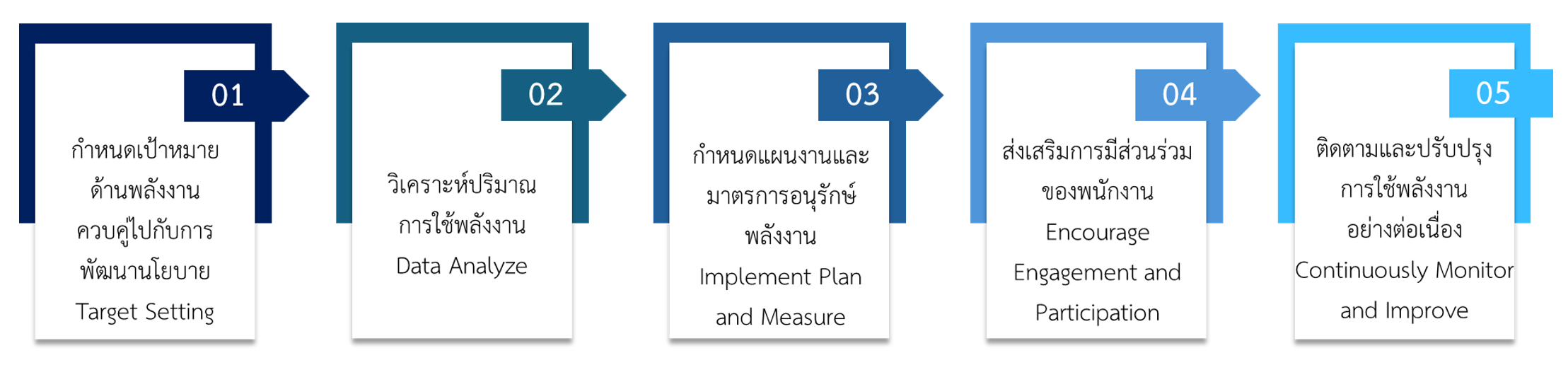
The Company promotes sustainable energy conservation, considering it a crucial mission that all parties must adhere to until it becomes an organizational culture. This is achieved by setting energy targets in conjunction with developing clear policies, analyzing energy consumption in each area, and studying the feasibility of utilizing renewable energy. Participatory energy conservation plans and measures are established, such as turning off lights during lunch breaks, using air conditioning only when necessary, setting air conditioners to automatically switch off half an hour before closing time, reducing elevator use for single-floor ascents/descents, selecting energy-efficient and environmentally friendly electronic equipment, regularly inspecting and maintaining electrical equipment, continuous maintenance of air conditioners according to the energy conservation plan, as well as campaigning to raise awareness among employees and stakeholders throughout the business value chain. Furthermore, energy consumption is continuously monitored and improved through collaboration with stakeholders for efficient energy utilization, aiming for cost-effective and sustainable energy use in the long term.
Energy — Electricity Consumption
Electricity Consumption
| Metric | Current Year | Previous Year | Two Years Ago |
|---|---|---|---|
| Total electricity consumption within the organization (Kilowatt-Hours) | 691,466 | 685,506 | 656,763 |
| Electricity purchased for consumption from non-renewable energy sources (Kilowatt-Hours) | |||
| Electricity purchased or generated for consumption from renewable energy sources (Kilowatt-Hours) |
Energy — Fuel Consumption
Fuel Consumption
| Metric |
|---|
| Crude oil (Barrels) |
| Coal (Metric tonnes) |
| Jet fuel (Litres) |
| Diesel (Litres) |
| Gasoline (Litres) |
| Fuel oil (Litres) |
| Natural gas (Standard cubic feet) |
| LPG (Kilograms) |
| Steam (Metric tonnes) |
Energy — Targets
Has Set Targets
Yes
Targets
| Target | Base Year | Base Year Value | Target Year | Target Change (%) | Unit | Per Unit (Intensity) | Per Unit — Please Specify |
|---|---|---|---|---|---|---|---|
| Reduction of electricity purchased for consumption | 2,023 | 3,300 | 2,029 | 5 | Kilowatt-hour | Person(employee) | Person(employee) |
Energy — Performance & Outcomes
Has Performance Results
Yes
Performance Description
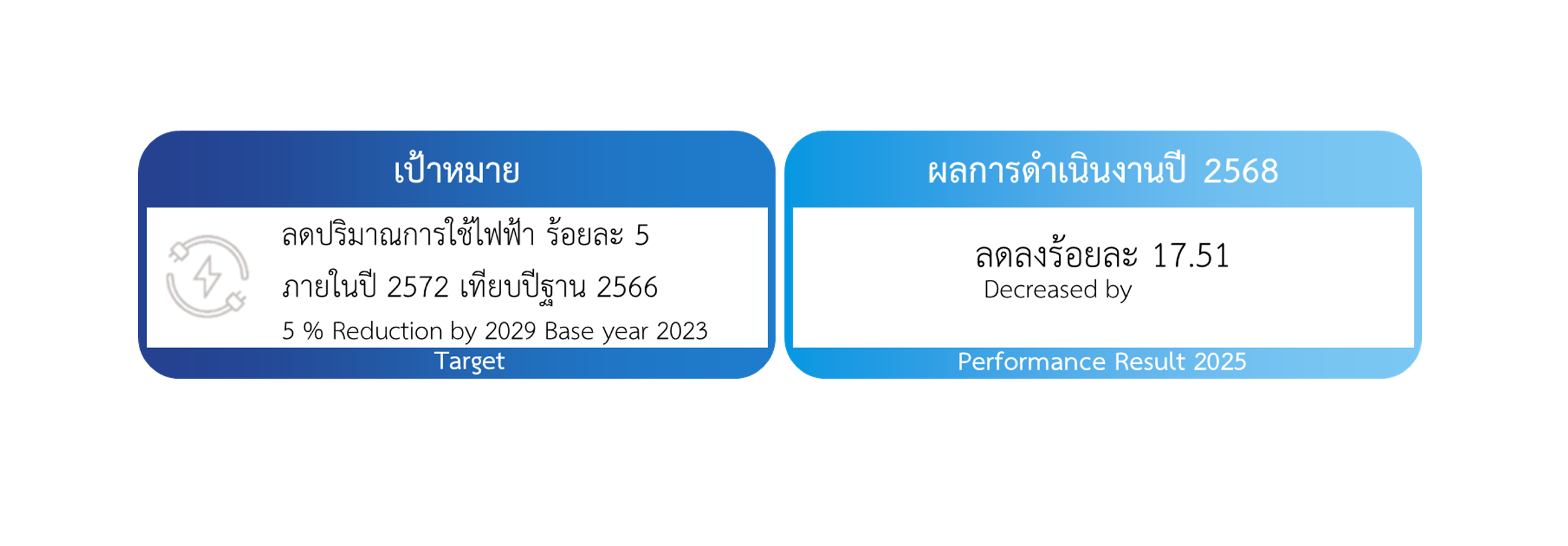
The Company has adjusted its quantitative targets for electricity and energy consumption under the concept of efficient resource utilization, in line with the organization's overall environmental goals. The target states that Aim to reduce electricity consumption per person by 5% by 2029, compared to the base year 2023. (permanent employees only), which is part of the efficient resource utilization target (the Company has increased it from the original target of 2.5% by 2028, as the 2024 operations have already met the target).
Note The Company chose to use the indicator Average electricity consumption per permanent employee as it aligns with the nature of operations in the head office building and leased office spaces where electricity is the primary resource. This indicator allows for appropriate comparison of energy efficiency within the organizational context.
In 2025, the Company continuously collected and monitored overall electricity consumption data. Energy cost data, combined with employee headcount data, was used as the basis for calculating the average electricity consumption per person indicator, as shown in the table below.
Item | Unit | 2023 | 2024 | 2025 |
Electricity Consumption | kWh | 656,763 | 685,506 | 691,466 |
Electricity Consumption / Permanent Employee | kWh / Person | 3,300 | 3,088 | 2,722 |
Number of permanent employees of the Company only | Persons | 199 | 222 | 254 |
Rate of Change | Base Year | -6.4% | -17.5% | |
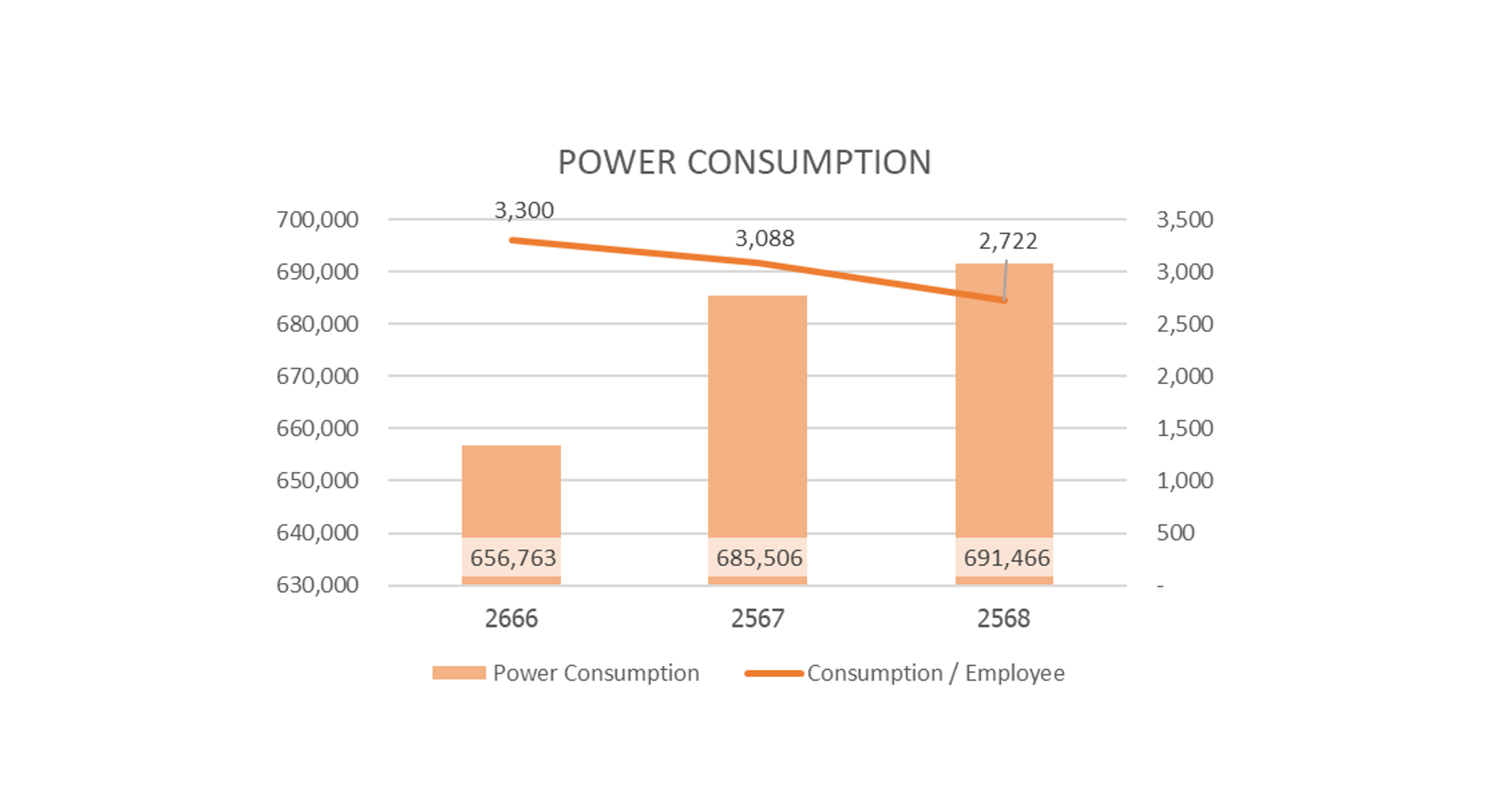
The Company has set a target to reduce electricity consumption per employee. 5% from base year 2023 In 2025, electricity consumption per employee decreased by 17.5% compared to the base year which is higher than the set target. Although total electricity consumption increased with the expansion of employee numbers, this reflects improved energy efficiency and the promotion of energy conservation in the Company's operations.
Water — Plan & Guidelines
Has a Water Management Plan
Yes
Plan Description
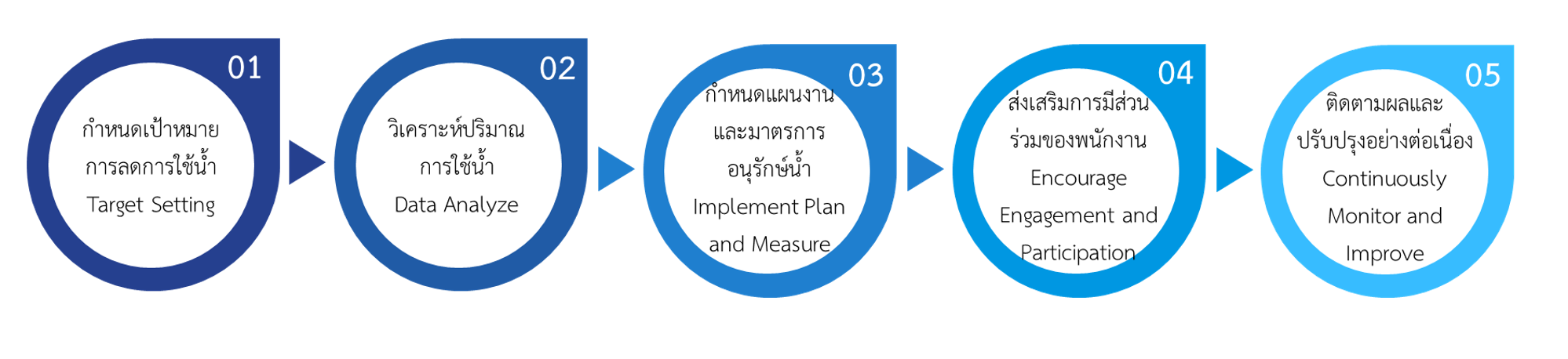
The Company prioritizes water resource conservation and supports the most efficient water usage. This is achieved by establishing comprehensive water management guidelines that cover all internal and external organizational activities, including setting targets to reduce water consumption, continuous analysis of water usage volumes for improvement and efficiency enhancement, and planning and implementing water conservation measures. Examples of these measures include the adoption of sensor-based faucet technology and regular inspection and maintenance of water-using equipment. Furthermore, the Company promotes the participation of employees at all levels in water conservation within the organization through public relations and training sessions on efficient water usage, aiming to instill a consciousness of valuable water use and foster sustainable water resource management in the long term.
Water — Withdrawal, Discharge & Consumption
Water Withdrawal, Discharge & Consumption
| Metric | Current Year | Previous Year | Two Years Ago |
|---|---|---|---|
| Total water withdrawal (Cubic meters) | 3,456 | 2,006 | 4,113.5 |
| Total water withdrawal by third-party water (Cubic meters) | |||
| Total water withdrawal by surface water (Cubic meters) | |||
| Total water withdrawal by groundwater (Cubic meters) | |||
| Total water withdrawal by seawater (Cubic meters) | |||
| Total water withdrawal by produced water (Cubic meters) | |||
| Percentage of wastewater treated before discharge (%) | 100 | 100 | 100 |
| Total water discharge (Cubic meters) | |||
| Total water discharge to third-party water (Cubic meters) | |||
| Total water discharge to surface water (Cubic meters) | |||
| Total water discharge to groundwater (Cubic meters) | |||
| Total water discharge to seawater (Cubic meters) | |||
| Total water consumption (Cubic meters) | 3,456 | 2,006 | 4,113.5 |
| Recycled water (Cubic meters) |
Water — Targets
Has Set Targets
Yes
Targets
| Target | Base Year | Base Year Value | Target Year | Target Change (%) | Unit | Per Unit (Intensity) | Per Unit — Please Specify |
|---|---|---|---|---|---|---|---|
| Reduction of water withdrawal | 2,023 | 20.67 | 2,029 | 5 | Cubic meters | Person(employee) | Person(employee) |
Water — Performance & Outcomes
Has Performance Results
Yes
Performance Description
To support the achievement of these goals, the company has continuously monitored water usage, utilizing data from main water meter systems and sub-water meters in areas with intensive water consumption. This data enables the company to analyze water usage trends, identify areas for improvement, and evaluate the effectiveness of water reduction measures implemented previously.
Furthermore, the company has systematically commenced operations to achieve its target of reducing water consumption per employee. This involves implementing efficient water usage guidelines across all company operations, including communicating targets to employees, promoting water-saving behaviors, and coordinating with building management to maintain and improve water systems. The company continuously monitors water usage to assess progress towards the established goals.
In 2025, the company is in the process of enhancing the completeness and detail of water usage data, particularly through the installation of additional sub-water meters in the canteen area, which will enable more accurate site-specific monitoring of water usage.
|
Item |
Unit |
2023 |
2024 |
2025 |
|
Water consumption volume |
cu.m. |
4,114 |
2,006 |
3,456 |
|
Water consumption / Permanent employee |
cu.m. / person |
20.67 |
9.04 |
13.61 |
|
Number of permanent employees specific to the company |
Persons |
199 |
222 |
254 |
|
Rate of change |
Base year |
-56.3% |
-34.2% |
|
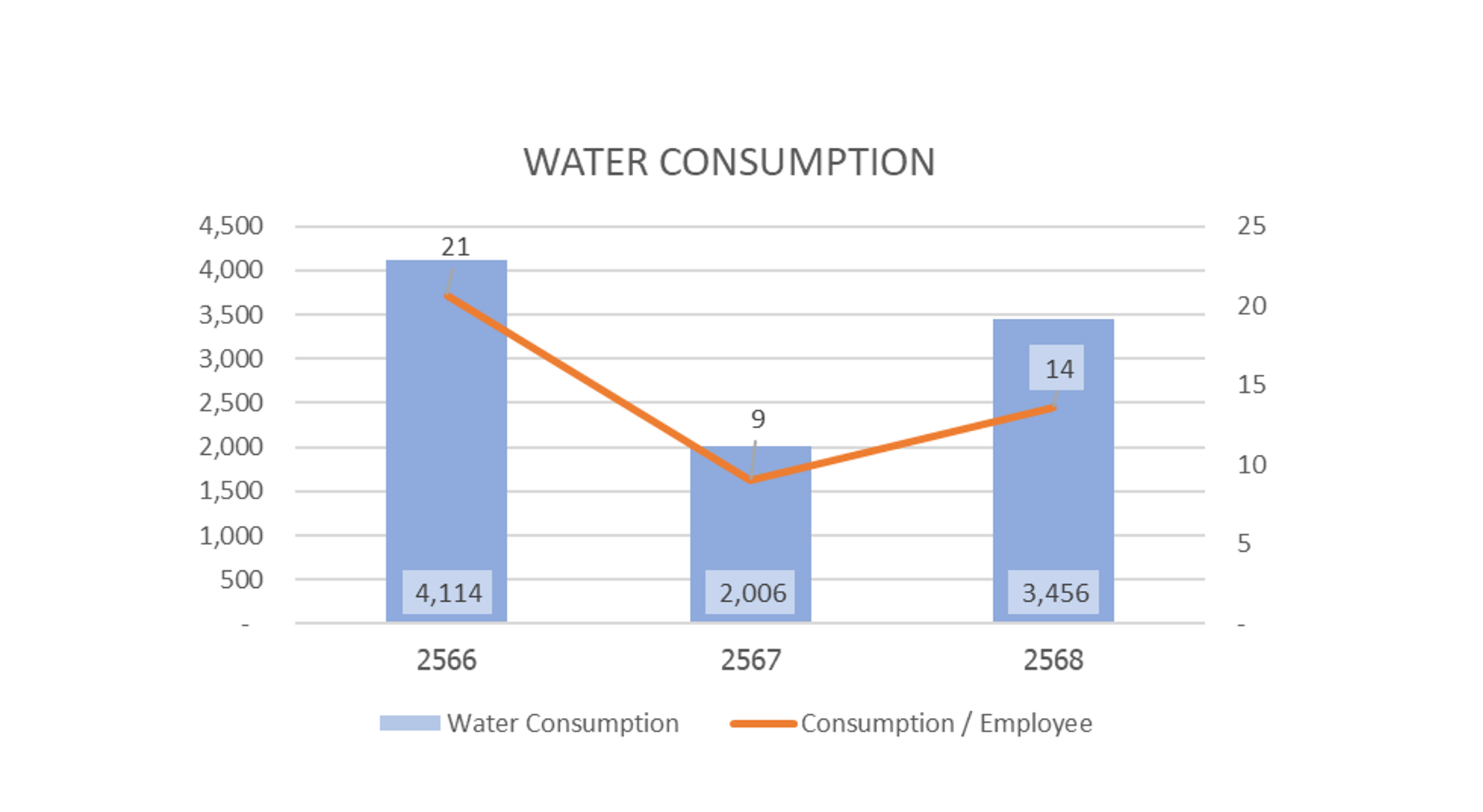
In 2025, water consumption per employee decreased 34.2 percent compared to the base year which is higher than the set target. Despite a continuous increase in the number of permanent employees, these operational results reflect the efficiency of water resource management and the promotion of efficient water use within the organization.
Waste — Plan & Guidelines
Has a Waste Management Plan
Yes
Plan Description
The Company prioritizes the management of waste and refuse generated from its activities to mitigate impacts on the environment and communities, as well as to reduce resource scarcity. This is achieved by applying the 4Rs principle, comprising Reduce, Reuse, Recycle, and Replacement. The Company sets targets to reduce resource consumption and waste generation within its offices. It promotes awareness of efficient resource utilization through public relations and the provision of segregated waste bins in all office areas. Resource usage is monitored and evaluated, along with continuous improvement to ensure that resource utilization within the organization is as cost-effective and sustainable as possible.

Waste — Generation, Disposal & Recycling
Waste Generation, Disposal & Recycling
| Metric | Current Year | Previous Year | Two Years Ago |
|---|---|---|---|
| Total waste generated (Kilograms) | 28,431 | 21,019 | 25,387 |
| Non-hazardous waste (Kilograms) | 28,431 | 21,019 | 25,387 |
| Non-hazardous waste - Landfilling (Kilograms) | |||
| Non-hazardous waste - Incineration (with energy recovery) (Kilograms) | |||
| Non-hazardous waste - Incineration (without energy recovery) (Kilograms) | |||
| Non-hazardous waste - Other disposal operations (Kilograms) | |||
| Hazardous waste (Kilograms) | |||
| Hazardous waste - Landfilling (Kilograms) | |||
| Hazardous waste - Incineration (with energy recovery) (Kilograms) | |||
| Hazardous waste - Incineration (without energy recovery) (Kilograms) | |||
| Hazardous waste - Other disposal operations (Kilograms) | |||
| Total reused/recycled waste (Kilograms) | |||
| Reused/Recycled non-hazardous waste (Kilograms) | |||
| Reused non-hazardous waste (Kilograms) | |||
| Recycled non-hazardous waste (Kilograms) | |||
| Reused/Recycled hazardous waste (Kilograms) | |||
| Reused hazardous waste (Kilograms) | |||
| Recycled hazardous waste (Kilograms) |
Waste — Targets
Has Set Targets
Yes
Targets
| Waste Type | Disposal Approach | Target | Base Year | Base Year Value | Target Year | Target Change (%) | Unit | Per Unit (Intensity) | Per Unit — Please Specify |
|---|---|---|---|---|---|---|---|---|---|
| Non-hazardous waste | 2758 · Description: Reuse · 2759 · Description: Recycle · 2760 · Description: Landfilling | Reduce waste volume | 2,023 | 127.6 | 2,029 | 5 | Kilograms | Person(employee) | Person(employee) |
Waste — Performance & Outcomes
Has Performance Results
Yes
Performance Description
In 2025, the company achieved measurable and evaluable performance in non-hazardous waste management. It has consistently maintained practices for waste reduction and source separation from the previous year. Concurrently, the company has implemented concrete projects to reduce the volume of waste entering landfills by diverting certain types of waste for further utilization.
These operational results reflect an elevation of waste management from impact control to systematic management. The company has compiled performance data on waste volume, waste utilization, and landfill reduction. Furthermore, the company monitors and discloses waste volume data in accordance with the guidelines of GRI 306: Waste to transparently reflect the impacts and to analyze this data to improve waste management measures and resource utilization efficiency in line with future waste reduction targets.
|
Items |
Unit |
2023 |
2024 |
2025 |
|
Volume of non-hazardous waste |
Kilograms |
25,387 |
21,019 |
28,431 |
|
Non-hazardous waste volume / employee |
Kilograms / person |
127.6 |
94.7 |
111.9 |
|
Number of permanent employees of the company |
Persons |
199 |
222 |
254 |
|
Rate of change |
Base year |
-25.78% |
-12.30% |
|
Waste Management Year 2025
|
Items |
Unit |
2025 |
|
Volume of non-hazardous waste landfilled |
Kilograms |
18,937 |
|
Volume of hazardous waste |
Kilograms |
2,712 |
|
Volume of recycled waste |
Kilograms |
9,493 |
|
Total waste volume |
Kilograms |
31,143 |
|
Percentage of non-hazardous waste landfilled |
60.8% |
|
|
Percentage of recycling |
30.5% |
|
Waste Reduction and Utilization
One of the key achievements in 2025 is the reduction of waste landfilling through the project to convert unused employee uniform clothing into Refuse Derived Fuel (RDF). This helps reduce the amount of waste that needs to be disposed of by landfilling and adds value to waste materials from the organization's operations. This approach exemplifies the application of circular economy principles in the company's waste management.
|
Items |
Unit |
2025 |
|
Volume of uniforms sent for RDF |
Kilograms |
127 |
|
Volume of recycled waste |
Kilograms |
9,493 |
|
Total waste volume |
Kilograms |
31,143 |
|
Percentage of RDF to recycled waste volume |
1.34% |
|
|
Percentage of RDF to total waste volume |
0.41% |
|
GHG — Plan & Guidelines
Has a GHG Management Plan
Yes
Plan Description
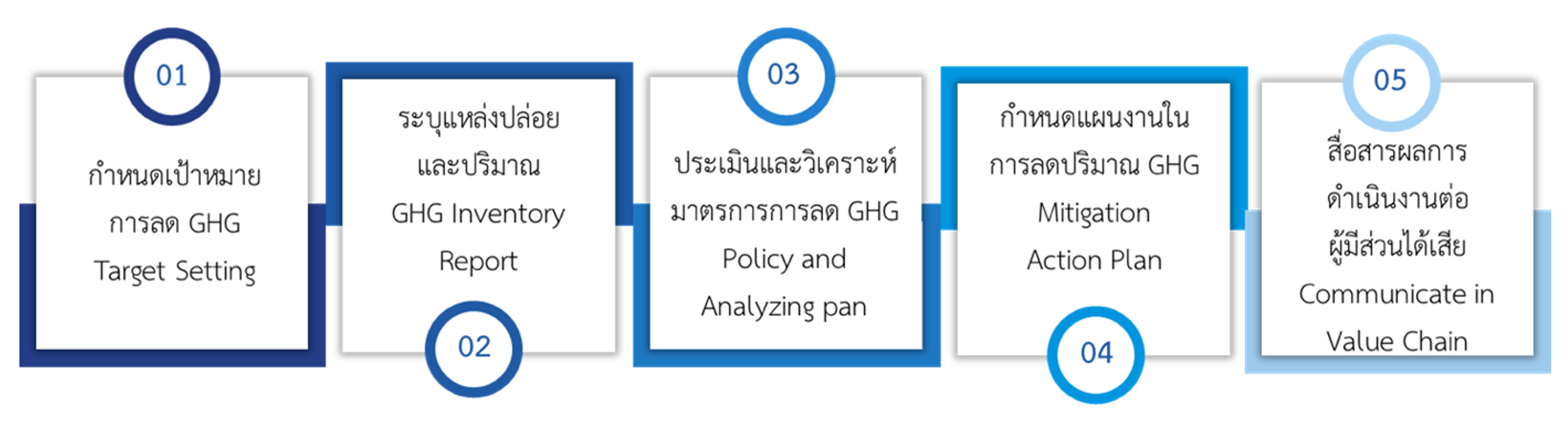
The company has established guidelines for reducing its organizational greenhouse gas emissions, including mitigating risks from business operations that may contribute to greenhouse gas emissions. This involves setting greenhouse gas reduction targets based on an assessment of emissions throughout the business value chain, coupled with evaluating potential and analyzing greenhouse gas reduction measures. The objective is to formulate a plan for reducing greenhouse gas emissions and continuously communicate the results of these reduction efforts to stakeholders.
GHG — Emissions
GHG Emissions
| Metric | Current Year | Previous Year | Two Years Ago |
|---|---|---|---|
| Total GHG emissions (Metric tonnes of carbon dioxide equivalent) | 5,239.17 | 325.62 | 311.96 |
| Total greenhouse gas emissions 1 (Metric tonnes of carbon dioxide equivalent) | 46.92 | ||
| Total greenhouse gas emissions 2 (Metric tonnes of carbon dioxide equivalent) | 328.45 | 325.62 | 311.96 |
| Total greenhouse gas emissions 3 (Metric tonnes of carbon dioxide equivalent) | 4,863.8 |
GHG — Emissions Verification
Emissions Verified by a Third Party
Yes
Verifying Body
2656
Verifying Body — Please Specify
BSI Group (Thailand) Company Limited
GHG — Principles & Standards
Principles & Standards Applied
| Standard |
|---|
| 2671 |
GHG — Targets
Has Set GHG Targets
Yes
GHG Targets — Net Zero
Introduction
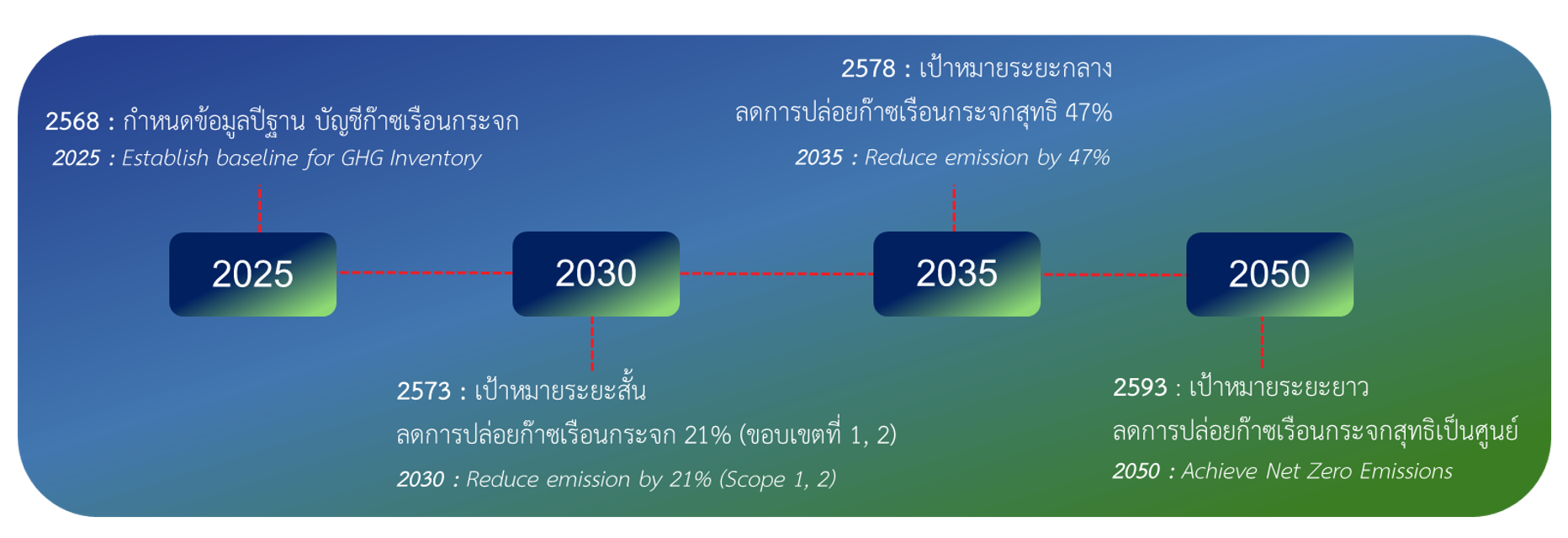
The Company has reviewed its past climate change goals and operations, considering the Company's operational data, direct and indirect greenhouse gas emission and removal data, as well as various related environmental factors that the Company has implemented by 2025. Furthermore, based on the Company's greenhouse gas inventory data, the Company has reviewed and set both quantitative and process-based climate change targets to support the strategy for achieving Net Zero and create sustainability in business operations, as well as align with material issues, with the following details:
Net Zero Targets
| Emission Scope | Base Year | Base Year Emissions | Near-term Target Year | Near-term Target Change (%) | Long-term Target Year | Long-term Target Change (%) | Target Year | Target Change (%) | Unit |
|---|---|---|---|---|---|---|---|---|---|
| 2716 | 2,025 | 5,239.17 | 2,030 | 21 | 2,035 | 47 | 2,030 | 21 | Metric tonnes of carbon dioxide equivalent |
GHG Targets — Carbon Neutrality
Carbon Neutrality Targets
| Emission Scope | Carbon Neutrality Certified | Base Year | Base Year Emissions | Target Year | Unit |
|---|---|---|---|---|---|
| 2716 | N | 2,025 | 5,239.17 | 2,039 | Metric tonnes of carbon dioxide equivalent |
GHG — Performance & Outcomes
Has Performance Results
Yes
Performance Description
1. "Green Hardware for Energy Smart Office Project": Transitioning to an energy-efficient office with high-performance IT equipment.
This project was established to encourage internal departments to select energy-efficient and environmentally friendly IT equipment. The primary goals are to reduce electricity consumption in the office and decrease indirect greenhouse gas emissions (Scope 2) resulting from electricity use in employees' daily operations.
The project also aims to establish environmentally conscious procurement practices (Green Procurement) and extend the lifespan of equipment to reduce electronic waste (E-waste). This aligns with the organization's ESG policy, which emphasizes sustainable business operations.
2. "Green Cloud for Sustainable IT Project"
This project was established to reduce energy consumption and greenhouse gas emissions from the organization's internal server systems by migrating some core workloads to carbon-neutral certified cloud service providers, as follows:
-
Reduce energy consumption from internal server systems.
-
Reduce indirect greenhouse gas (GHG) emissions (Scope 2).
-
Support Green IT approaches based on sustainable development principles.
-
Modernize, enhance flexibility, and improve the efficiency of IT systems.
3. "ORBIT ZERO Project": Reduce Paper, Reduce Carbon, Towards a Carbon-Neutral Organization.
The company has developed the "ORBIT" application for internal use to fully digitize internal processes that relied on paper and manual document handling, such as timekeeping, leave requests, IT repair notifications, or equipment requisitions. The use of the ORBIT app supports the following ESG goals:
-
Reduce paper consumption (paper reduction).
-
Reduce indirect GHG emissions.
-
Promote paperless office practices.
-
Serve as a Green IT infrastructure.
4. "Zero Waste Computing Project: Reduce Machines, Increase Efficiency"
The Zero Waste Computing Project involves restructuring the organization's server system, focusing on maximizing resource utilization and reducing energy waste in line with the Green IT concept. This directly aligns with the organization's environmental policy (Environmental Pillar of ESG Strategy) and is linked to the company's goal of reducing Scope 2 greenhouse gas emissions. The project aims to enhance IT resource efficiency, decrease the number of physical servers, and reduce electricity consumption by transitioning from numerous traditional servers to virtualization (VM) on a Hypervisor system, which can efficiently consolidate resources from multiple machines.
5. "Green Workplace Project"
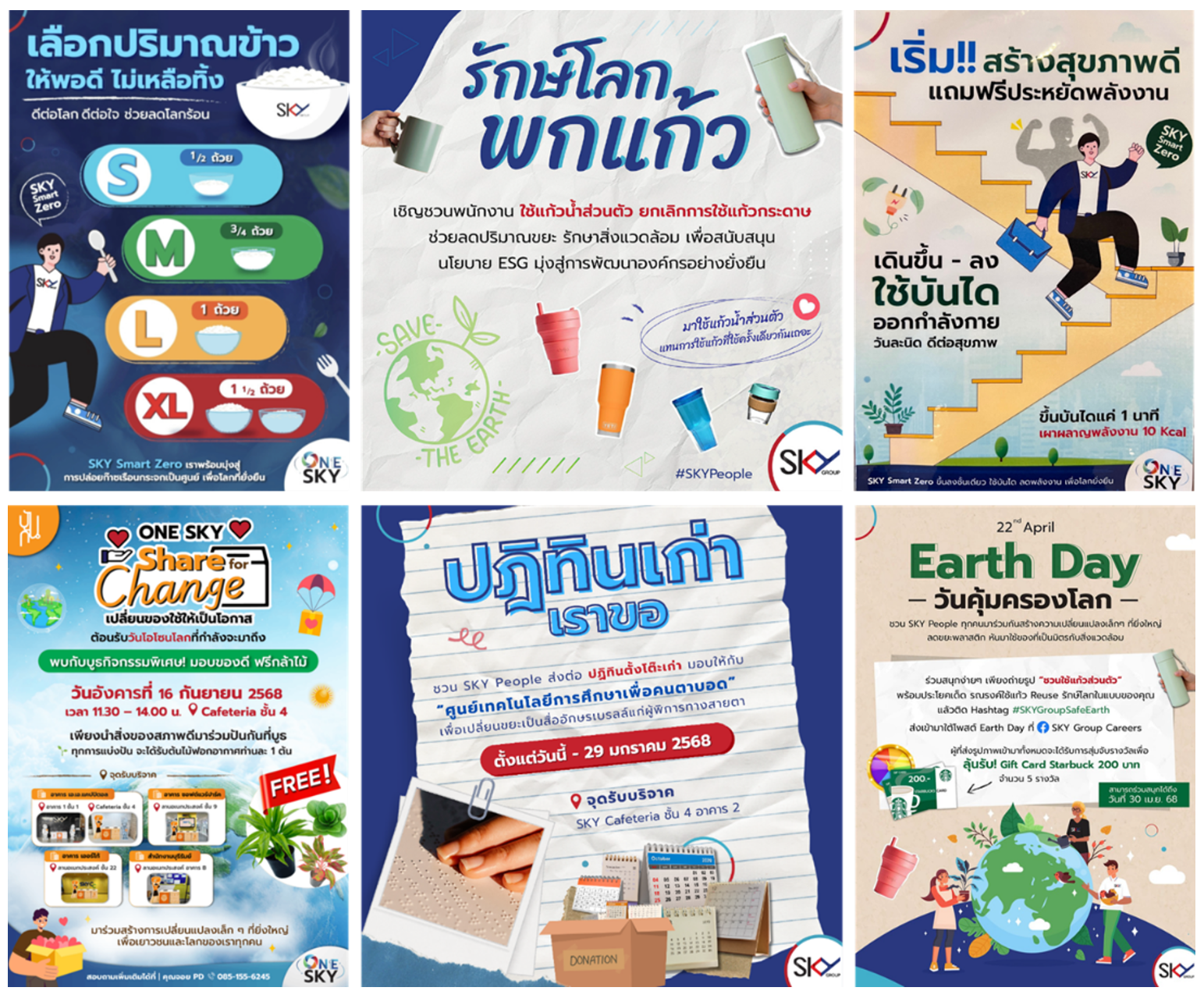
This project was established to promote energy and water saving measures, waste separation, personal cup usage, and the reduction of single-use materials, along with internal communication campaigns to modify behavior. The project's expectations are as follows:
-
Enhance organizational resource flexibility.
-
Reduce excess waste that may increase due to extreme events.
-
Promote a culture of sustainability at the operational level within the organization.
6. "Waste-to-Energy Collaboration Program"
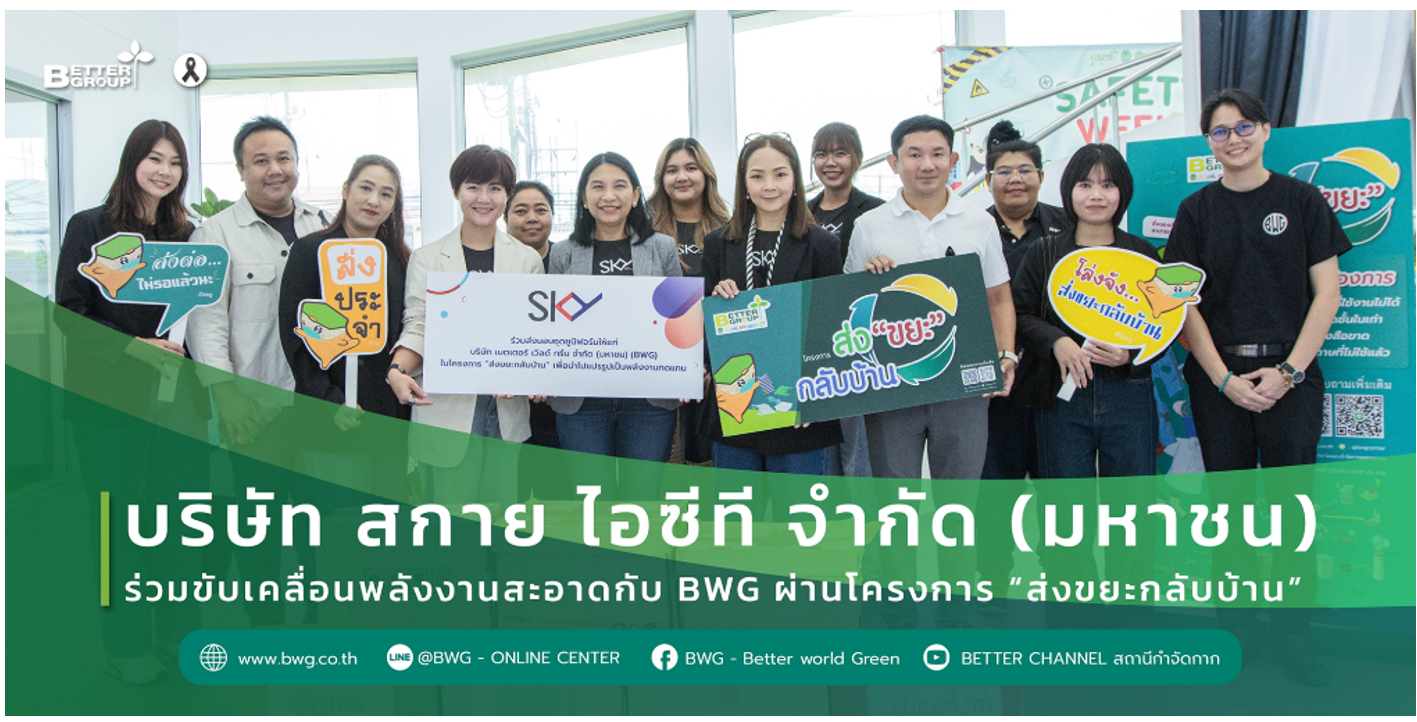
The company has collaborated with Better World Green Public Company Limited to convert unused uniforms into renewable energy, reducing the need for landfill disposal. The company sent 126.85 kilograms of uniforms to be processed into energy pellets, resulting in a reduction of 0.1 tCO2e in greenhouse gas emissions compared to landfilling.
7. "Carbon Insight System Project": Integrated Greenhouse Gas Data System
The company has developed a system for collecting, verifying, and reporting comprehensive greenhouse gas emission data. Scope 1–3 systematically, to adhere to the principles of relevance, completeness, consistency, accuracy, and transparency in reporting greenhouse gas emissions and removals related to climate governance. Key actions include:
-
Systematically record and compile activity data from all internal departments.
-
Conducted calculations of the organization's greenhouse gas emissions and removals in accordance with the GHG Protocol, TGO's CFO guidelines, and ISO 14064-1 standard.
8. "Flexible Work Collaboration Project for Climate Impact Reduction" (WFH Climate Adaptation Partnership)
To enhance organizational resilience, the company has adopted flexible and remote working concepts as a tool for climate risk adaptation. In November 2025, the company joined the WFH Climate Network under the Bangkok Metropolitan Administration's Department of Environment. This membership allows the company to receive climate adaptation guidelines and measures from government agencies and integrate WFH measures with summer energy management, as well as adapt work models to accommodate future extreme weather conditions.
Further details of the projects undertaken by the company in 2025 can be found in the company's 2025 Sustainability Report.
Company's Greenhouse Gas Data for 2025 The company has prepared an inventory of greenhouse gas emission and removal sources from organizational activities, using relevant activity data from January 1, 2025 – December 31, 2025, in accordance with ISO 14064-1:2018 monitoring guidelines, and verified by an external verifier, BSI Group (Thailand) Co., Ltd. The company's greenhouse gas emissions and removals are detailed as follows:
|
Item |
Greenhouse Gas Emission Sources |
|
Scope 1 : Direct Emissions |
Company's fuel combustion |
|
LPG combustion |
|
|
Refrigerant leakage |
|
|
Scope 2 : Indirect Emissions |
External electricity consumption |
|
Scope 3 : Indirect Emissions significant to the company. |
Purchased goods and services |
|
Type of Emission |
Unit |
2023 |
2024 |
2025 |
|
Direct GHG emissions (Scope 1) |
tCO 2 e |
- |
- |
46.92 |
|
Indirect GHG emissions (Scope 2) |
tCO 2 e |
311.96* |
325.62* |
328.45 |
|
Indirect GHG emissions (Scope 3) |
tCO 2 e |
- |
- |
4,863.80 |
|
Total GHG emissions (Scope 1 and 2) |
tCO 2 e |
- |
- |
375.36 |
|
Total GHG emissions (Scope 1, 2 and 3) |
tCO 2 e |
- |
- |
5,239.17 |
|
GHG Intensity (Scope 1 and 2) |
tCO 2 e / Revenue (MB) |
- |
- |
0.0945 |
|
GHG Intensity (Scope 1, 2 and 3) |
tCO 2 e / Revenue (MB) |
- |
- |
1.3163 |
Note *Emission factors are adjusted according to the announcement of greenhouse gas emission values from Thailand's electricity grid system, February 2026.
Environmental Legal Incidents
Legal Violation Incidents
| Metric | Current Year | Previous Year | Two Years Ago |
|---|---|---|---|
| Number of cases or incidents of legal violations or negative environmental impact (cases) | 0 | 0 | 0 |
Other Environmental Management
Plan Description
Paper Management
The company has implemented resource management to reduce waste according to the 3Rs principle. This includes adopting a policy to reduce paper usage by utilizing digital systems for internal document operations, encompassing both document workflow systems and the use of various digital evidence documents. Furthermore, the company promotes the reuse of paper on both sides through campaigns in the Green Workplace project, such as encouraging the use of electronic document systems (Paperless) in work processes, establishing guidelines for printing only necessary documents, using recycled or environmentally friendly paper, and separating used paper for recycling.

The company monitors overall paper consumption to inform improvements in resource management approaches for greater efficiency. This operation aligns with the disclosure guidelines of GRI 301: Materials and GRI 306: Waste (2020) and supports long-term waste reduction and sustainable resource utilization goals.
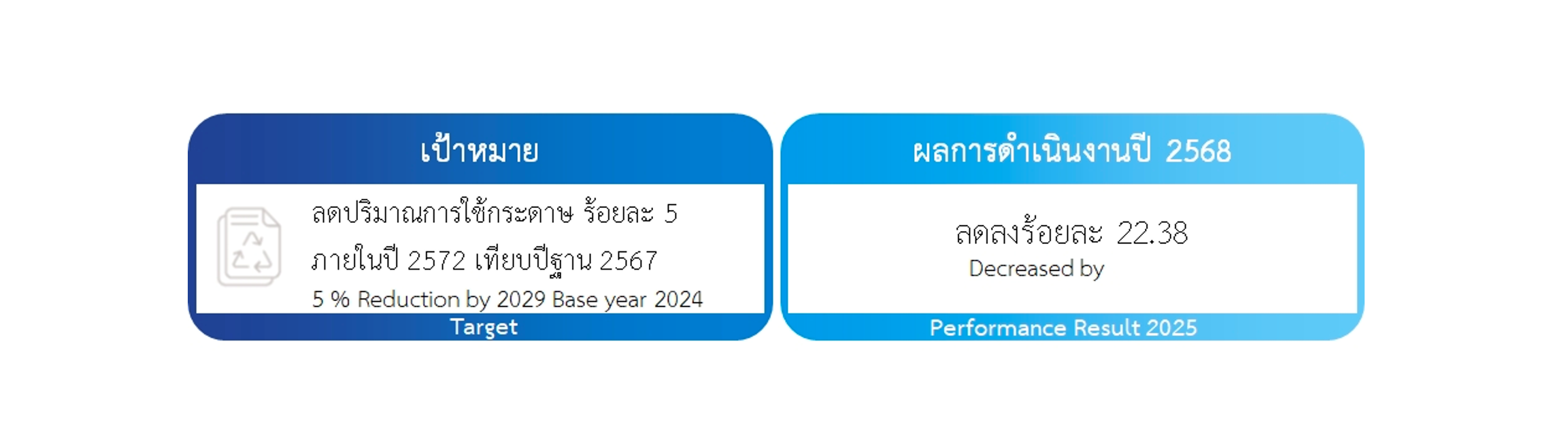
Paper management goals and performance
The company has set a target to reduce paper consumption. 5 percent per person by 2029, compared to the 2024 base year. By 2025, the company was able to reduce paper consumption by 22.4 percent compared to the base year which is higher than the set target, reflecting the effectiveness of promoting electronic document usage and efficient paper utilization in the company's operations.
|
Item |
Unit |
2024 |
2025 |
|
Paper consumption |
Kilograms |
2,896 |
2,248 |
|
Paper consumption / employee |
Kilograms/person |
13 |
9 |
|
Number of the company's permanent employees |
222 |
254 |
|
|
Rate of change |
Base year |
-22.38% |
|
Human Rights Due Diligence
Conducts Human Rights Due Diligence
Yes
Due Diligence Description
The Company recognizes the importance of human rights in business operations. Therefore, it has initiated the implementation of a comprehensive human rights due diligence process to enhance human rights management to be comprehensive and systematic. It has announced human rights policies and principles through its Human Rights Policy and has established a Human Rights Risk Assessment (HRRA) process to identify and evaluate human rights risks related to the Company's operations, both existing and potential, covering labor rights, customer rights, business partner rights, and community and environmental rights. Furthermore, the assessment results are integrated into internal organizational management to find ways to prevent and reduce human rights risks, provide for monitoring and reporting of operational results, as well as establishing channels for whistleblowing and complaints, and appropriate remedies in the event of human rights violations, as follows:
To support the implementation of human rights policies, labor standards, and community engagement, the Company has established guidelines for considering and reviewing human rights risks appropriate to the business context. This applies to both the Company's operations and activities involving business partners. This process covers the identification and assessment of potential human rights risks to employees, business partners, communities surrounding operational areas, and relevant stakeholders. The information and issues derived from human rights risk considerations are used for risk management, defining preventive and mitigating measures, and appropriately improving related operational guidelines.
The Company considers and monitors human rights, labor, and community risks appropriately within the business context. This process is integrated into the organization's existing management systems, such as human resource management, procurement, risk management, and safety and legal compliance oversight.
Risk consideration covers issues that may affect employees, on-site workers, business partners, and communities surrounding operational areas, such as working conditions, safety and occupational health, discrimination, personal data protection, and labor practices in the supply chain. The Company uses data from routine operations, stakeholder feedback, and complaint mechanisms as part of identifying and assessing risk issues.
In the event of issues or complaints related to human rights, the Company has a process for investigation and appropriate, fair, and transparent corrective actions. The results of these considerations are also used to review operational guidelines and risk management in the subsequent period.
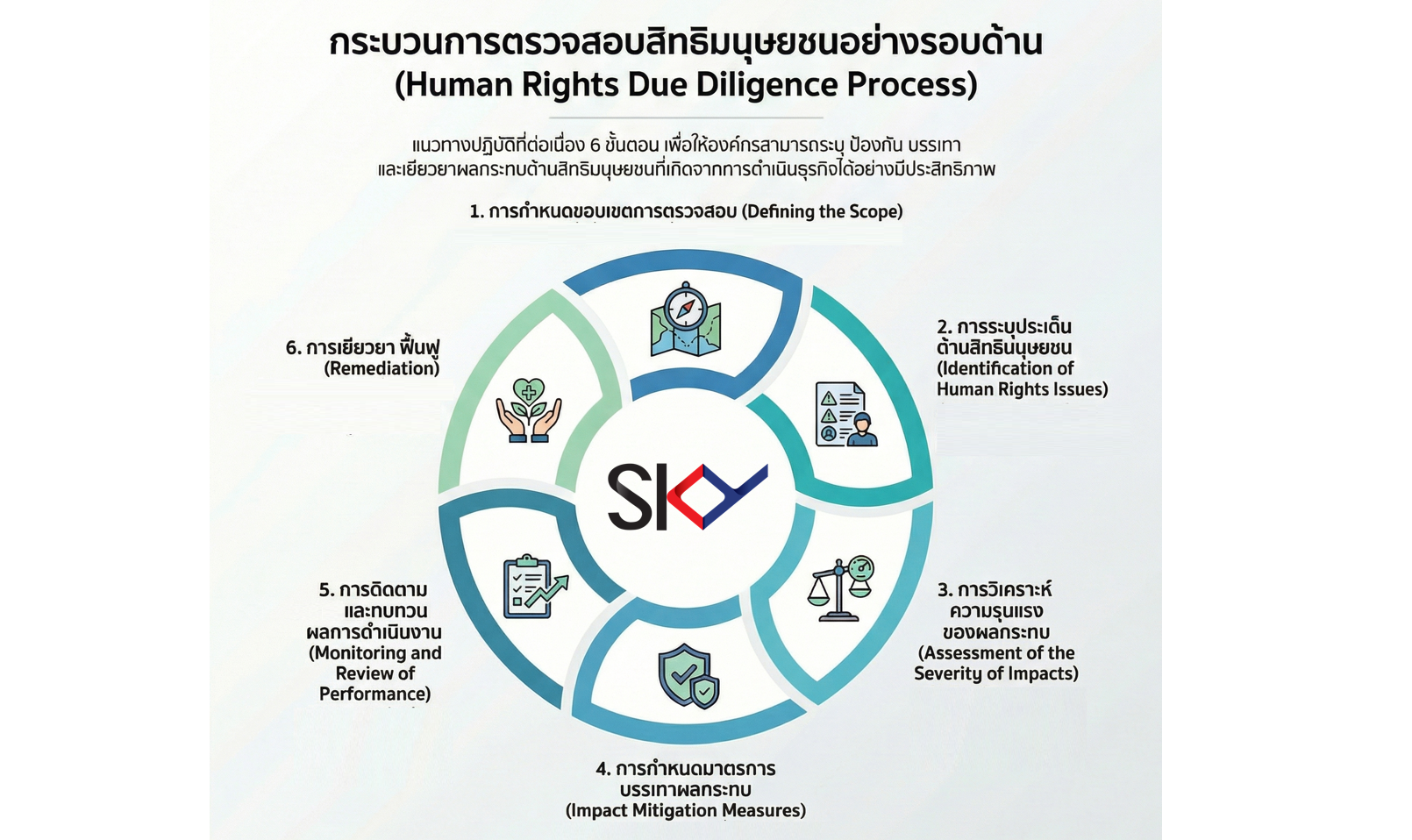
Defining the Scope of Operations
The Company defines the scope of human rights due diligence to cover all operations of the organization, including subsidiaries, business partners, and contractors involved in business operations. Special emphasis is placed on activities with high risks to labor, communities, and stakeholders. This scope definition is under the supervision of the Board of Directors and is part of the organization's risk management process.
Employees — Plan & Guidelines
Has an Employee Management Plan
Yes
Plan Description
Non-Discrimination and Equal Opportunity
The Company promotes employment and human resource management based on principles of equality and fairness, without discrimination in any form, whether based on race, religion, gender, age, sexual orientation, disability, nationality, or any other status protected by human rights principles. Consideration of compensation, performance evaluation, and career advancement are primarily based on individual ability, potential, and performance, to create an open and diversity-respecting work environment.
This policy is applied in human resource management throughout the entire process of recruitment, development, performance evaluation, and promotion. It also fosters an organizational culture that is open, respects diversity, and provides fair opportunities. The Company continuously communicates this policy to employees and has a complaint mechanism to prevent and address all forms of discrimination or harassment.
Freedom of Association and Collective Bargaining
The Company respects employees' rights to association, expression, and participation as stipulated by labor laws, and supports constructive communication and negotiation between employees and management, to foster mutual understanding, engagement, and appropriate and fair resolution of labor issues.
Working Hours and Prevention of Excessive Overtime
The Company strictly adheres to labor laws regarding working hours and overtime. Overtime work must be voluntary and compensated according to legal requirements, coupled with appropriate workload management to reduce the risk of excessive working hours and promote work-life balance, which is a crucial factor for employees' health, safety, and work efficiency.
Wages, Welfare, Employment Fairness, and Working Environment
The Company sets wage rates and compensation in accordance with relevant labor laws, ensuring that wages are not less than the legally mandated minimum wage. Compensation is also considered appropriate for the nature of the work, responsibilities, skills, abilities, and performance of employees, to ensure fairness and sustainable work motivation.
The Company is committed to promoting the principle of "Equal Pay for Equal Work" by ensuring that wages, compensation, and various benefits are appropriate, fair, and equitable, without discrimination based on gender, age, race, nationality, religion, disability, sexual orientation, or any other personal characteristics unrelated to job performance.
In addition, the Company provides basic welfare benefits and additional benefits as appropriate, such as social security, health or life insurance based on job position, various types of leave entitlements, and other benefits according to the Company's policy, to support employees' long-term quality of life, security, and well-being.
The Company regularly reviews its compensation and welfare structure to align with labor laws, industry best practices, and labor human rights principles, as well as to prevent inequality and promote equality within the organization.
Occupational Health and Safety
In terms of health and safety, the Company prioritizes providing a safe, hygienic, and conducive working environment for quality work. This includes providing personal protective equipment when necessary, regular safety and accident prevention training, and establishing channels for employees to report accidents or safety risks anonymously, to enable continuous prevention, correction, and improvement of working conditions.
Employee Development
The Company prioritizes the continuous development of employees' knowledge, abilities, and skills, making personnel development an integral part of human resource management to support career growth and enhance employees' long-term work capabilities.
Employee skill development covers training in job-related skills (Technical Skills), enhancing personal and collaborative skills (Soft Skills), as well as training in safety, health, and work ethics. Furthermore, the Company encourages employees to participate in training, seminars, or development activities both within and outside the organization, and provides opportunities for employees to take leave for training or skill development according to established regulations.
These approaches help enhance employees' potential to adapt to changes in technology and work patterns, as well as support the sustainable growth of the organization.
Local Employment and Community Development
The Company recognizes its role in creating shared value with communities by prioritizing the employment of personnel in areas where the Company operates, developing the skills and potential of local people through training, pre-employment preparation, and collaboration with local agencies and educational institutions.
Employment of Underprivileged Groups
The Company prioritizes supporting employment and capacity building for underprivileged groups in society ( Under-privileged Groups) Specifically, for people in areas lacking educational opportunities, with skill limitations, or without formal educational qualifications, by providing employment opportunities, basic skills training, and learning through practical work, to promote stable income, reduce inequality, and enhance the quality of life for communities surrounding the Company's operational areas.
Youth Employment
The Company supports creating opportunities for youth, students, and those entering the labor market through internships, knowledge transfer, and skill development activities, to help reduce inequality, create career opportunities, and promote sustainable economic and social growth.
In addition, the Company has collaborated with several educational institutions through Memoranda of Understanding (MOU) to provide opportunities for new graduates to gain real-world work experience, develop skills aligned with business sector needs, and increase sustainable employment opportunities.
This collaboration includes accepting interns, transferring knowledge from the Company's experts, and considering employment for qualified graduates, to support career path development for youth, reduce unemployment among new graduates, and strengthen a skilled workforce for the information technology industry in the long term.
Prevention of Child Labor and Respect for Children's Rights
The Company has strict measures to prevent child labor, setting a minimum age for employment, verifying age-confirming documents of job applicants, and extending oversight to partners and subcontractors, while adhering to the principles of children's rights according to international practices, to ensure that children are protected from all forms of rights violations.
Communication of Labor Policies
The Company's labor standards policy is established as part of its human rights and community policy, serving as a framework for fair and responsible treatment of employees and stakeholders. The Company communicates this policy to all levels of employees comprehensively through internal communication channels such as the organizational website, internal communication systems, and dissemination through supervisors, to ensure consistent implementation across all departments.
Furthermore, the Company ensures that policy content is conveyed in formats and languages appropriate to the employees' context, to promote accurate and comprehensive understanding, taking into account the diversity of personnel within the organization. This is to ensure that all employees can access, understand, and effectively comply with labor standards and human rights policies.
Further details regarding the Company's human rights and labor standards policies can be found on the Company's website > https://cms.skyict.co.th/wp-content/uploads/2025/12/SKY02-06-_-Human-Rights-Policy-_-13.11.25.pdf
Plan Areas
| Plan Area |
|---|
| Fair employee compensation |
| Employee training and development |
| Promoting employee relations and participation |
| Occupational health and safety in workplace |
Employees — Workforce
Workforce — Introduction
The Company prioritizes human resource management. The number of permanent employees within the Group, including those of the Company and its subsidiaries, at the end of the fiscal year, is detailed as follows:
Employees with Disabilities — Introduction
The Company is committed to promoting equality in employment and supporting the quality of life for persons with disabilities, by fully complying with relevant laws, both through direct employment and support via funds. The number of persons with disabilities employed by the Group, comprising the Company and its subsidiaries, at the end of the fiscal year is detailed as follows:
Workforce Data
| Metric | Current Year | Previous Year | Two Years Ago |
|---|---|---|---|
| Total number of employees (Persons) | 1,243 | 1,192 | 794 |
| Number of male employees (Persons) | 595 | 590 | 473 |
| Number of female employees (Persons) | 648 | 602 | 321 |
| Total employment of disabled persons (people) | 17 | 16 | 6 |
| Total disabled employees (people) | |||
| Total male disabled employees (people) | |||
| Total female disabled employees (people) | |||
| Total disabled workers who are non-employee (people) | |||
| Contributions to the fund for promoting and improving the quality of life for disabled persons | 1 | 1 | 1 |
| Total number of male employees in operational level (Persons) | 476 | 480 | 378 |
| Total number of male employees in management level (Persons) | 107 | 100 | 87 |
| Total number of male employees in executive level (Persons) | 12 | 10 | 8 |
| Total number of female employees in operational level (Persons) | 523 | 499 | 261 |
| Total number of female employees in management level (Persons) | 113 | 94 | 58 |
| Total number of female employees in executive level (Persons) | 12 | 9 | 2 |
Employees — Remuneration & Provident Fund
Introduction
Employee compensation of the company (excluding subsidiaries), encompassing all employee categories, including permanent and other types of employees, for the past 3 years, is detailed as follows.
Remuneration & Provident Fund
| Metric | Current Year | Previous Year | Two Years Ago |
|---|---|---|---|
| Total disabled employees (people) | 335,267,619 | 289,869,334 | 264,214,554.88 |
| Total male employee remuneration (Baht) | |||
| Total female employee remuneration (Baht) | |||
| Number of employees eligible to participate in PVD (persons) | 1,243 | 0 | 0 |
| Total number of employees joining employee provident fund (Persons) | 678 | 0 | 0 |
| Percentage of total number of employees joining employee provident fund to total number of employees (%) | 54.55 | 0 | 0 |
| Number of PVD members / Total eligible employees (%) | 54.55 | 0 | 0 |
| Total amount of provident fund contributed by the Company (Baht) | |||
| Total amount of provident fund contributed by employee (baht) |
Employees — Training & Development
Training Data
| Metric |
|---|
| Average employee training hours (Hours / Person / Year) |
| Employee development and training expenses (baht) |
Employees — Occupational Health & Safety
Occupational Health & Safety Data
| Metric | Current Year | Previous Year | Two Years Ago |
|---|---|---|---|
| Total number of lost time injury incidents by employees (Cases) | 0 | 0 | 0 |
Employees — Labour Relations
Labour Relations Data
| Metric | Current Year | Previous Year | Two Years Ago |
|---|---|---|---|
| Total voluntary resignations (Persons) | |||
| Male employees who voluntary resigned (Persons) | |||
| Female employees who voluntary resigned (Persons) | |||
| Percentage of employee turnover leaving the Company voluntarily (%) | |||
| Evaluation result of employee engagement | 1 | 1 | 1 |
Employees — Employee Representation
Employees Are Represented Collectively
Yes
Forms of Representation
| Form |
|---|
| Welfare committee |
Employees — Targets
Has Set Employee Targets
Yes
Targets
| Indicator | Target Areas | Base Year | Base Year — Description | Target Year | Target Year — Description |
|---|---|---|---|---|---|
| Average training hours of at least 6 hours per person per year | 2984 · Description: Employee training and development | 2,025 | 39.4 hours per person per year | ||
| 1. Total Recordable Injury Rate (TRIR) 2. Lost Time Injury Rate (LTIR) 3. Lost Day Injury Rate (LDIR) 4. Occupational Disease Rate (ODR) 5. Number of Work-Related Fatalities (Fatality) | 2988 · Description: Safety and occupational health at work | 2,025 | 0 | ||
| Human capital potential to increase revenue by 20% | 2990 · Other name: Human capital potential to increase revenue by 20% · Description: Others | 2,024 | 30.4 million Baht | 2,025 | 40.3 million Baht, increased by 32.5% |
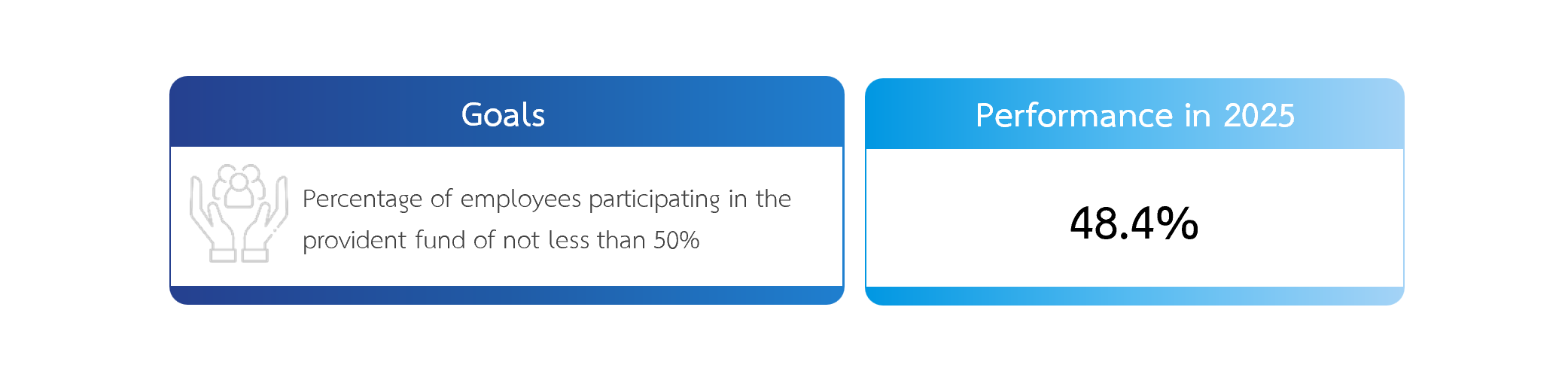
| The proportion of employees participating in the provident fund is not less than 50%. | 2990 · Other name: Proportion of employees participating in the provident fund · Description: Others | 2,025 | 48.4% | ||
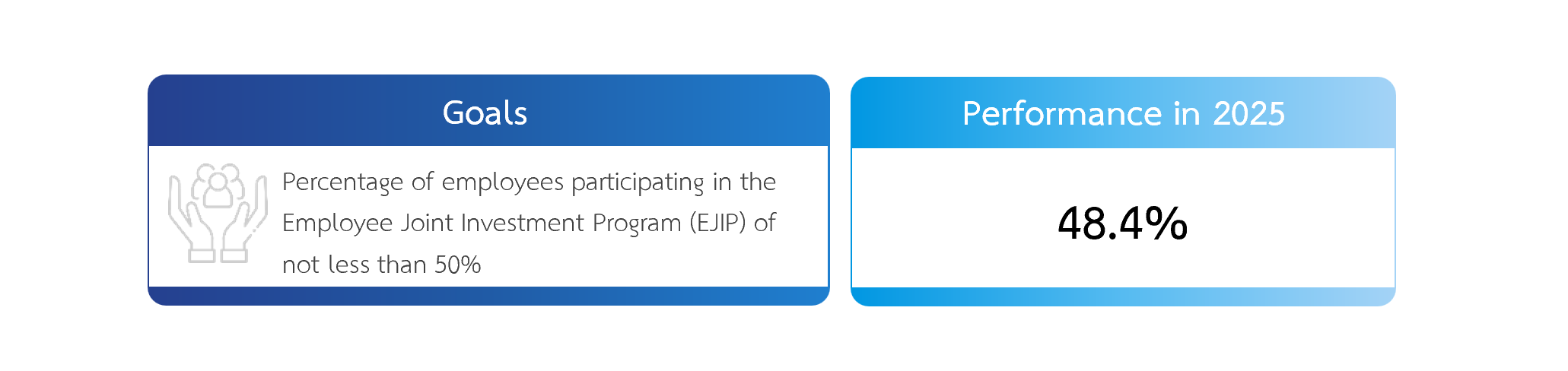
| The proportion of employees participating in the EJIP program is not less than 50%. | 2990 · Other name: Proportion of employees participating in the EJIP program · Description: Others | 2,025 | 48.4 | ||
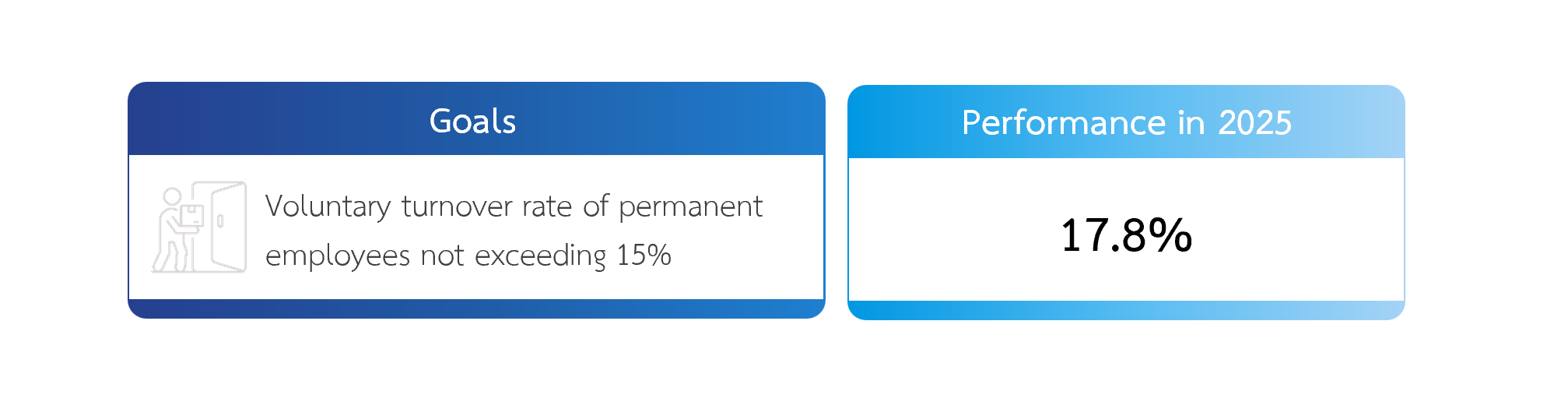
| Voluntary turnover rate of permanent employees not exceeding 15%. | 2990 · Other name: Voluntary turnover rate of permanent employees · Description: Others | 2,025 | 17.8% | ||
| Employee engagement level with the organization not less than 80% | 2985 · Description: Promoting employee relations and participation | 2,025 | 87% |
Employees — Performance & Outcomes
Has Performance Results
Yes
Performance Description
Diversity, Equity, and Inclusion (DEI)
The Company prioritizes gender equality and fairness, including fair employment practices. It considers employment without discrimination based on gender or sexual identity, primarily hiring based on knowledge, skills, and qualifications relevant to the job. Wages are determined without unlawful discrimination or bias. The Company provides work skills training, appropriate and fair compensation, and has workplace safety and occupational health policies, among others.
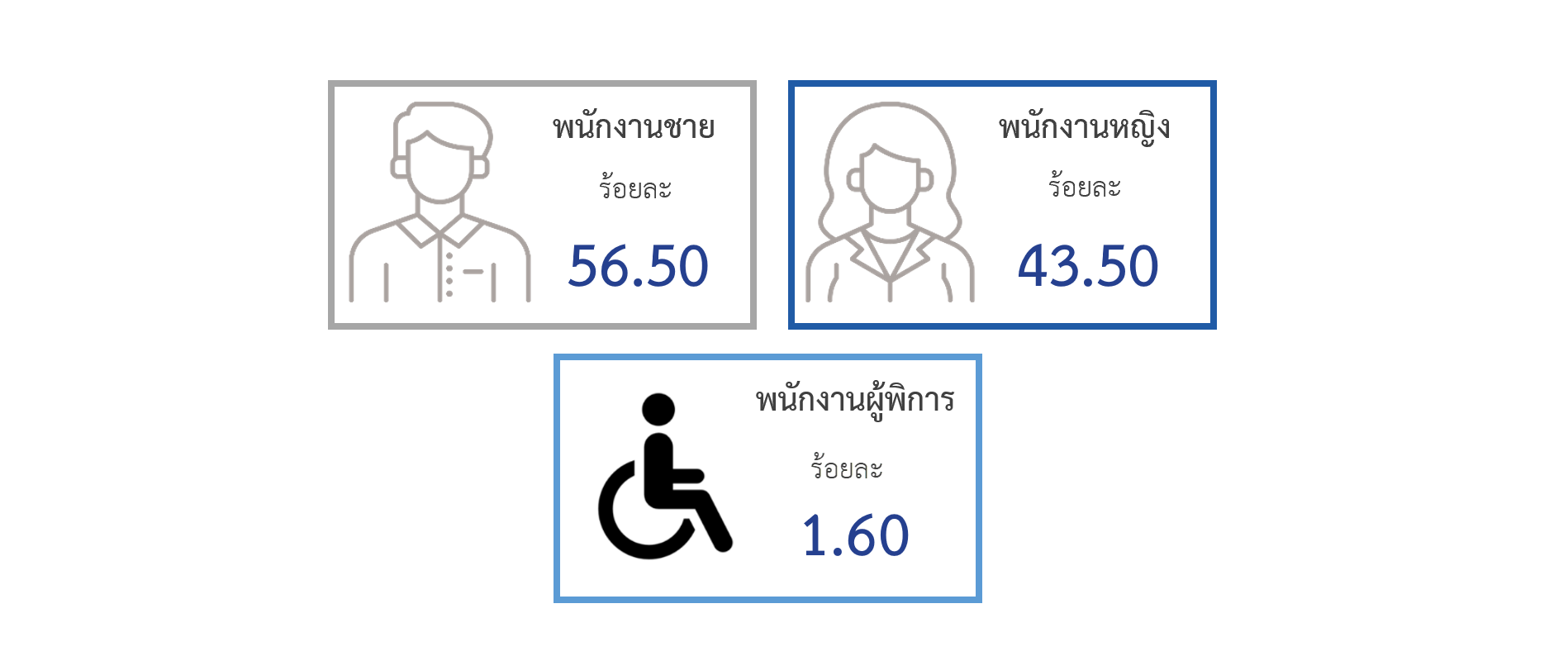
In 2025, the Company had 317 male employees, representing 56.5%, and 244 female employees, representing 43.5%. Additionally, 9 disabled individuals were employed, accounting for 1.60%, meeting the legally required quota.
Human Capital Development
Conducting Training Needs Analysis
The Company places importance on the continuous development of its personnel's potential. Therefore, it has conducted a Training Needs Analysis (TNA) to identify the skills, knowledge, and competencies that employees at each level and position should develop to align with their roles and responsibilities, as well as to respond to the future business direction of the organization. The objectives are as follows:
To systematically plan the development of personnel skills and capabilities.
To ensure that investments in learning and development are effective.
To prepare personnel to adapt to business changes, such as digital transformation and international business expansion.
The Training Needs Analysis was conducted based on 5 key factors:
Skill Gap Analysis: Analyzed from performance appraisal results.
Future Trend: Analyzed from future skill trends, such as emerging technologies, AI, ESG.
Business Goal: Analyzed from vision, mission, strategies, and business trends, such as business expansion, entry into new markets.
Training Need Survey: Analyzed from the results of training needs surveys for employees at each level.
Functional Competency: Analyzed by job function, such as Technical, Finance, Sales, HR.
The Company has developed a Training Needs Analysis Metric to illustrate the sources of development needs and link them to employee position levels, enabling the design of tailored training courses as follows:
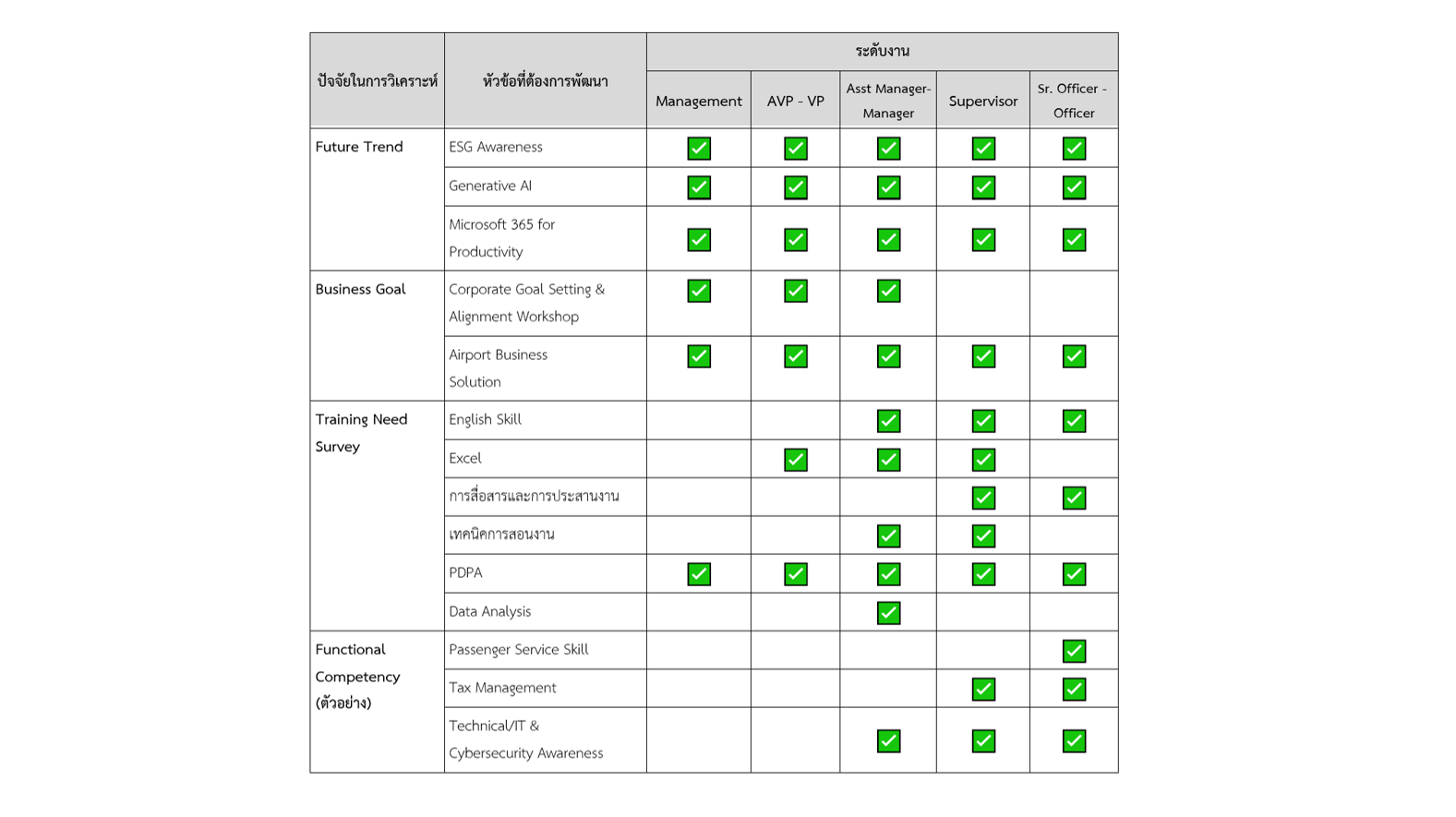
Human Capital Development Framework
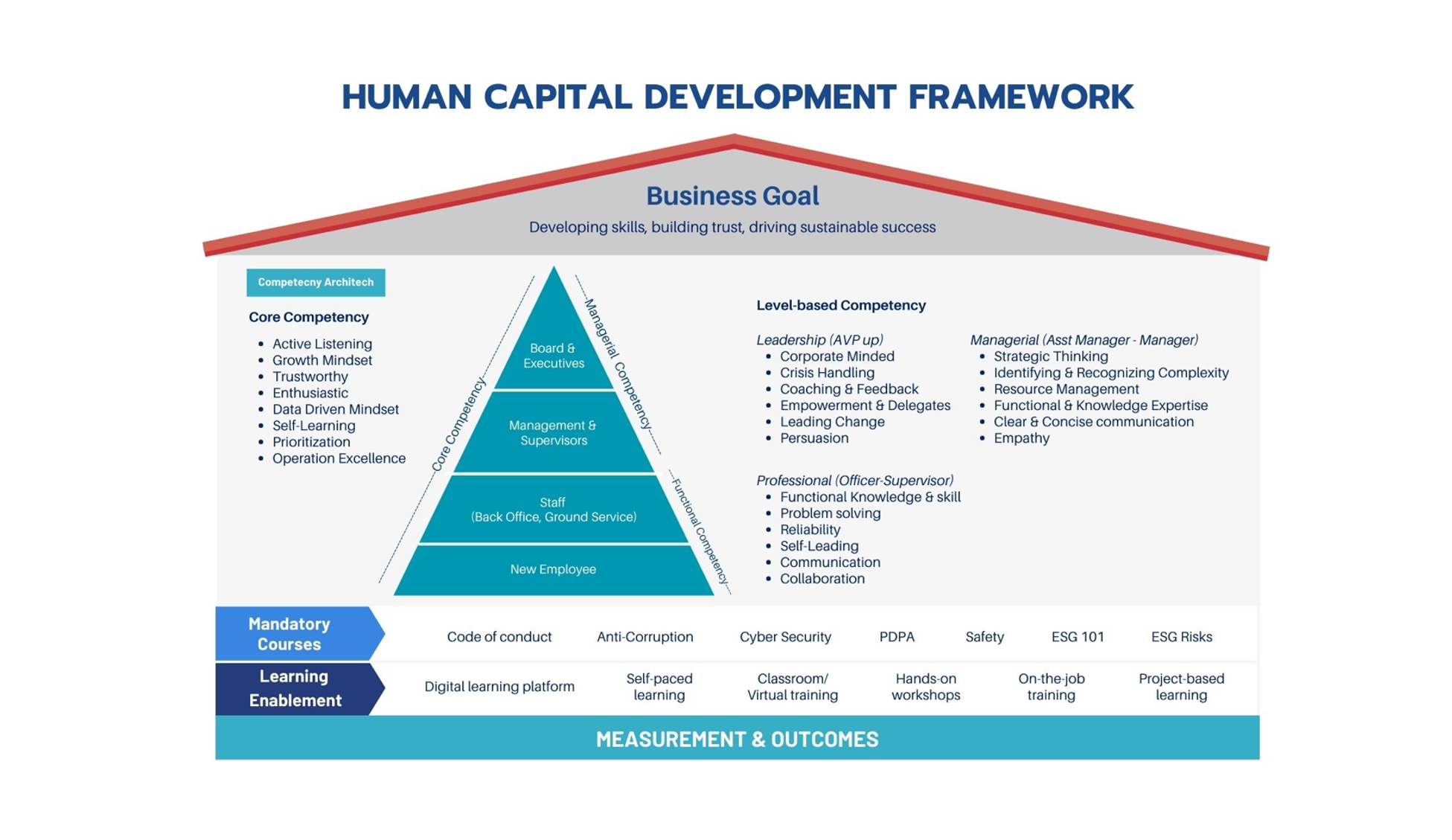
The Human Capital Development Framework was established to enhance skills, build trust, and support the sustainable growth of the organization. This framework is linked to strategic goals, risk management, and value creation for all stakeholder groups.
In 2025, the Company implemented employee skill development and training programs in various areas, totaling 176 courses, to enhance potential and readiness for future challenges. Development was categorized according to the Human Capital Development Framework.
Further information on training courses can be found in the Company's 2025 Sustainability Report.
Measurement & Outcomes
The Company monitors human capital development outcomes through key indicators such as training participation rates, employee coverage levels, role-based competency enhancement, workplace safety, and ethical compliance, which reflect the readiness of personnel to support the organization's sustainable growth.
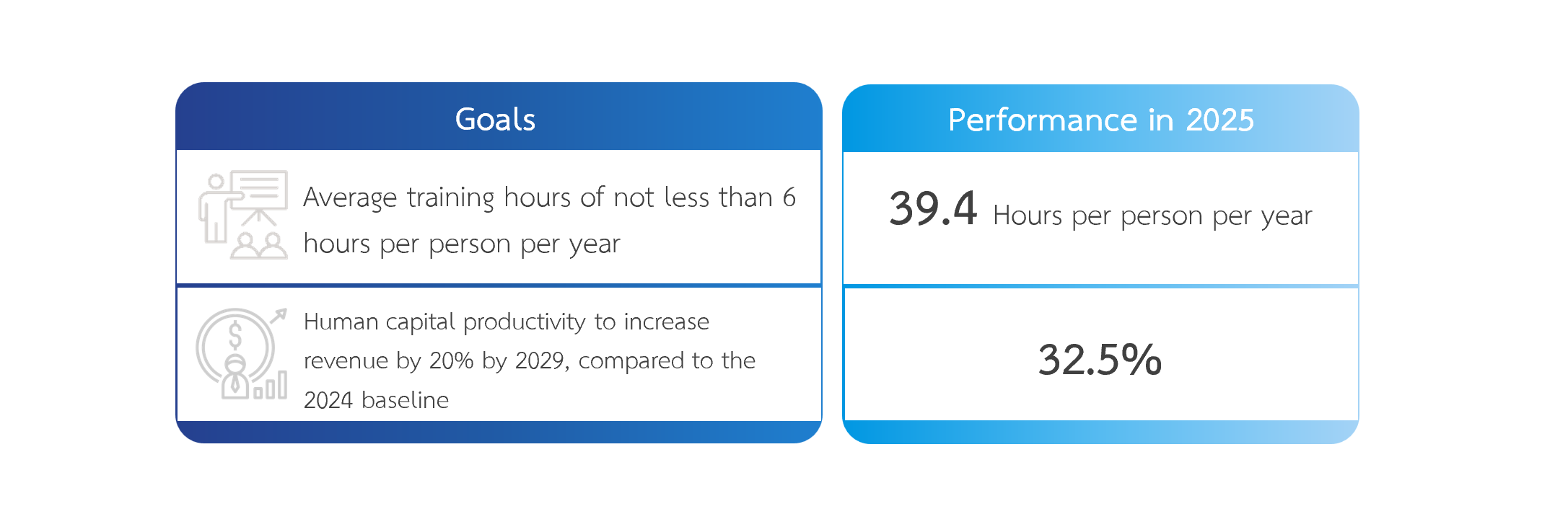
Mandatory Training (Mandatory Training)
To establish uniform work standards across the organization and mitigate regulatory, operational, and reputational risks, the Company mandates compulsory training for employees at all levels. This training serves as a fundamental basis for personnel skill development and a crucial mechanism for fostering an organizational culture committed to ethics, responsibility, and safety.
The Company's mandatory training is designed to cover topics related to Governance, Social, and Safety linked to the roles and responsibilities of employees at each level and aligned with the nature of the information technology and airport services business.
Mandatory Training Course Framework
The Company mandates compulsory training courses that all employees must attend at least once a year or upon commencing new employment, covering the following key topics:
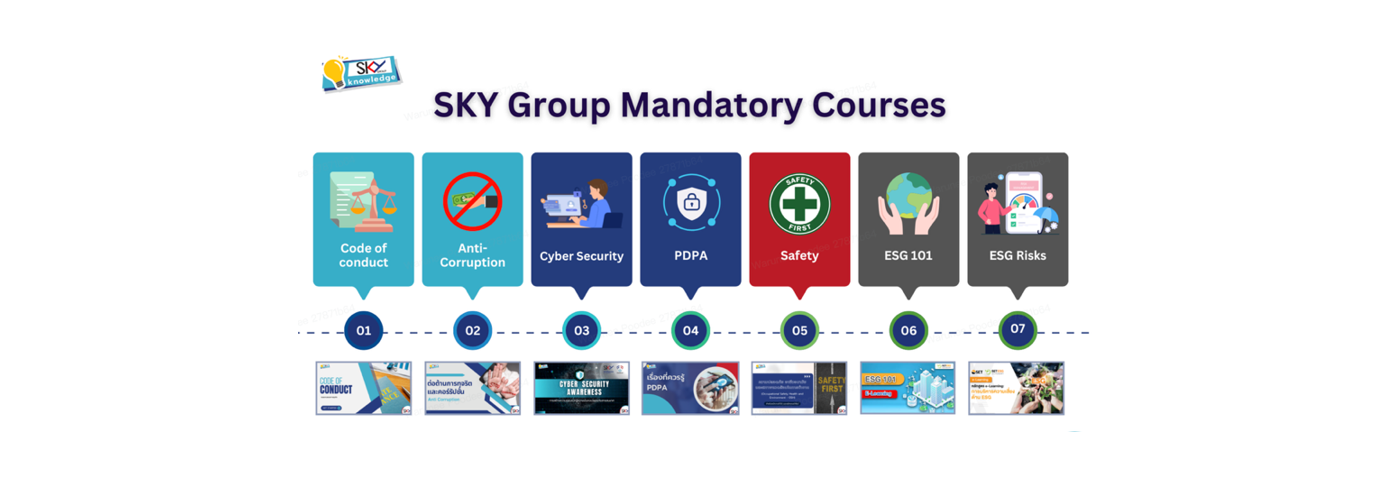
ESG Awareness
To foster understanding of employees' roles in supporting sustainable development, social and environmental responsibility, and stakeholder engagement, as well as connecting daily work with the organization's sustainability goals.Ethics and Business Conduct (Code of Conduct)
To ensure all employees understand appropriate work practices, how to interact with colleagues, customers, partners, and stakeholders, and how to avoid behaviors that could lead to conflicts of interest.Anti-Corruption
To foster a transparent work culture, instill zero tolerance for all forms of corruption, and mitigate legal and reputational risks for the organization.Safety & Occupational Health
To equip employees with the knowledge and skills to perform their duties safely, especially ground service staff and employees working in airport areas, who face specific risks.Cyber Security Awareness
To enhance knowledge of data protection, information systems, and secure technology usage, reducing risks from cyber threats that could impact business operations and customers.Training on Personal Data Protection Principles (PDPA)
To enhance awareness, reduce data breach risks, and support responsible business operations in compliance with relevant laws.
Human Rights
To raise awareness regarding respect for the rights of employees, partners, and stakeholders, including preventing discrimination, harassment, and rights violations in all forms. The Company integrates issues of preventing bullying and harassment in the workplace as part of human rights training, especially for managers, who play a crucial role in receiving reports and handling complaints.
Further information on mandatory training courses can be found in the Company's 2025 Sustainability Report.
In 2025, 596 employees participated in all 7 mandatory training courses, representing 100% of all employees. Additionally, 20 managers attended the human rights course, accounting for 3% of all employees.
Employee Retention
The Company is committed to retaining employees by fostering engagement and growth within the organization. It provides a variety of welfare benefits beyond legal requirements to enhance employees' quality of life and work efficiency, such as installing water purifiers, providing canteen services for employees, and ensuring clean and sufficient restrooms, as well as group health insurance, financial assistance for various occasions, sports benefits, lunch benefits, a provident fund, and a housing loan program, among others.
Fair and Sustainable Compensation Management Approach
The Company is committed to creating social sustainability through human resource management based on human rights, equality, and the promotion of employee quality of life, particularly regarding fair and sufficient compensation for a dignified living, under the "Living Wage" policy. This aligns with Sustainable Development Goal 8 (SDG 8): Promote sustained, inclusive, and sustainable economic growth, full and productive employment, and decent work for all.
The Company sets compensation to be competitive with the national technology industry, considering both starting salaries and salary structures for each position to align fairly with responsibilities and job value. Salaries are paid monthly by the last working day of each month.
The Company conducts annual salary adjustments, taking into account key factors such as:
Organizational performance and achievement of work objectives.
Inflation Rate
Data from peer companies in the technology industry.
Performance evaluation results for each employee.
The annual salary adjustment aims to exceed the inflation rate each year to continuously enhance employees' potential for a better quality of life. In cases where employees receive a promotion, the Company adjusts compensation to reflect the increased level of duties and responsibilities.
To promote employee participation, the Company provides channels for feedback, such as annual engagement and satisfaction surveys, as well as communication mechanisms with Human Resources and management. The results are continuously used to develop and improve labor and compensation policies.
Through fair, transparent, and human rights-compliant compensation management, the Company is confident that it can ensure long-term stability for employees while driving organizational growth based on social responsibility and sustainability.
In addition, the Company promotes discipline in saving and investment, which is the foundation of long-term financial stability, through the following projects:
Provident Fund
The Company established a provident fund on September 30, 2010, which is currently managed by the SCB Master Fund Provident Fund. Its objectives are to boost employee morale and encourage long-term employment with the Company. The Company aims for at least 50% employee participation in the provident fund. In 2025, the proportion of employees participating in the provident fund was 48.4%, an increase of 4.3% from 2024.
Employee Joint Investment Program (EJIP)
To provide employees with the opportunity to participate in company ownership, the Company aims for at least 50% employee participation in the program. In 2025, the proportion of employees participating in the Employee Joint Investment Program (EJIP) was 48.4%, a decrease of 2.1% from 2024, due to some employees resigning and others prefer to invest independently.
In 2025, the Company also provides welfare benefits for employees' physical and mental health, as follows:
Group Health Insurance
The Company places great importance on employee welfare and quality of life, with a policy to provide comprehensive health care suitable for the current work environment. The Company offers group health insurance for employees at all levels, enabling them to access medical treatment quickly and with high standards.
This coverage includes inpatient (IPD) and outpatient (OPD) cases, as well as other medical expenses, according to the insurance company's terms. The objective is to help reduce the healthcare burden on employees and their families, as well as to create security and peace of mind in their work.
Furthermore, the Company continuously reviews its coverage annually to ensure that health benefits align with employee needs and market trends in employee welfare.
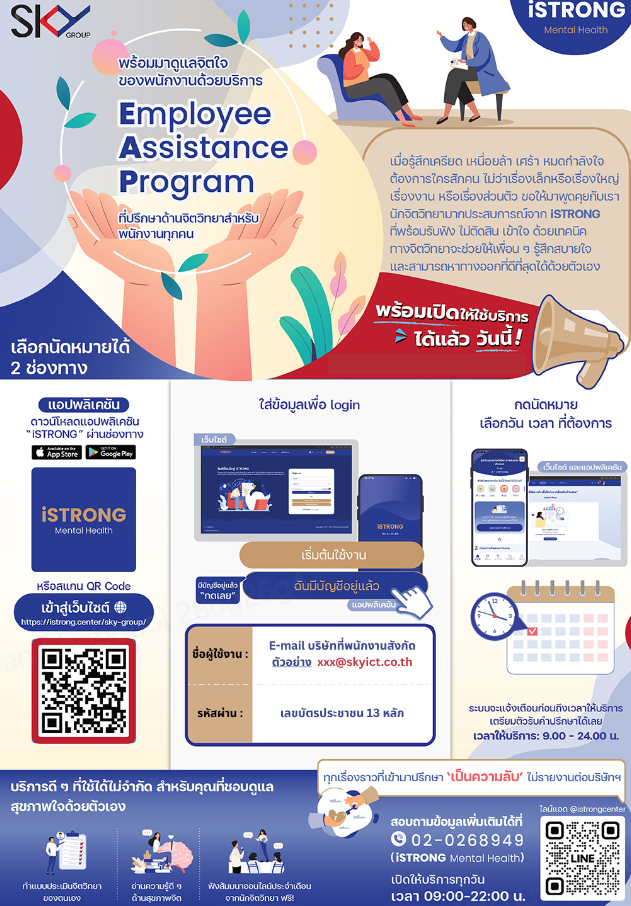
Online Mental Health Counseling Service by Psychologists (iSTRONG)
iSTRONG promotes and develops employees' mental well-being, fostering good mental health and resilience against potentially impactful environments. It assists employees facing stress, distress, and various life problems by providing accurate and timely advice from specialized experts to prevent the onset of psychiatric disorders. This service helps treat and heal individuals with mental health issues or those seeking counseling and recovery through the iSTRONG online mental health counseling service by psychologists. Evaluations show that employees' mental health improved by up to 70%, absenteeism and turnover decreased, and employees experienced greater job satisfaction.
Employee retention through these programs and benefits not only enhances employees' quality of life but also significantly strengthens engagement and career stability. Furthermore, it creates incentives that encourage employees to continue working with the organization, supporting the Company's goal of maintaining a voluntary permanent employee turnover rate of no more than 15%. In 2025, the employee turnover rate was 17.80%, which was 2.8% higher than the set target. This performance occurred during a period of rapid organizational growth and business expansion, encompassing operational scope, organizational structure, and the elevation of operational standards to an international level. This transition led to a continuous increase in demand for new skills and competencies, particularly in the highly competitive aviation services and specialized technology sectors. The observed turnover rate thus reflects structural challenges during the organization's growth phase.
Enhancing Employee Engagement
The Company recognizes that sustainable personnel development not only depends on professional training and skill development but also must be coupled with strengthening Employee Engagement, Collaboration, and Well-being To enable employees to perform effectively, be motivated, and grow with the organization in the long term.
Team Building and Relationship-Enhancing Activities
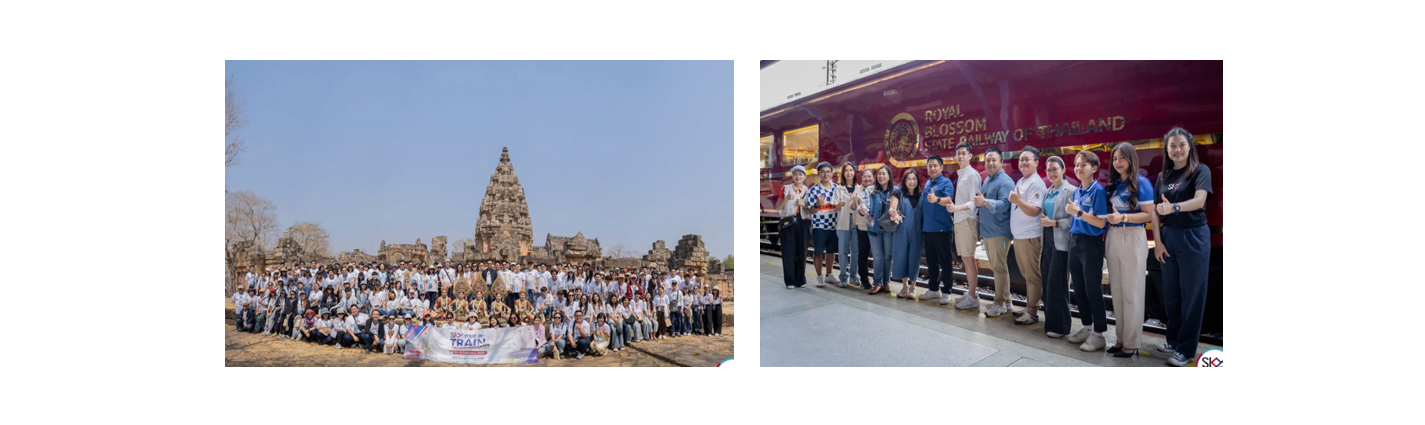
The Company organizes internal relationship-building activities appropriate to the diverse work contexts of each employee group to promote teamwork, communication, and mutual understanding, including:
Team Outing Activities To foster cooperation and relationships among employees in each department.
Activities to foster unity and exchange experiences beyond routine work.
These activities help foster a friendly working environment, reduce gaps between departments, and promote a collaborative work culture.
Annual Activities and Employee Care Based on Work Context
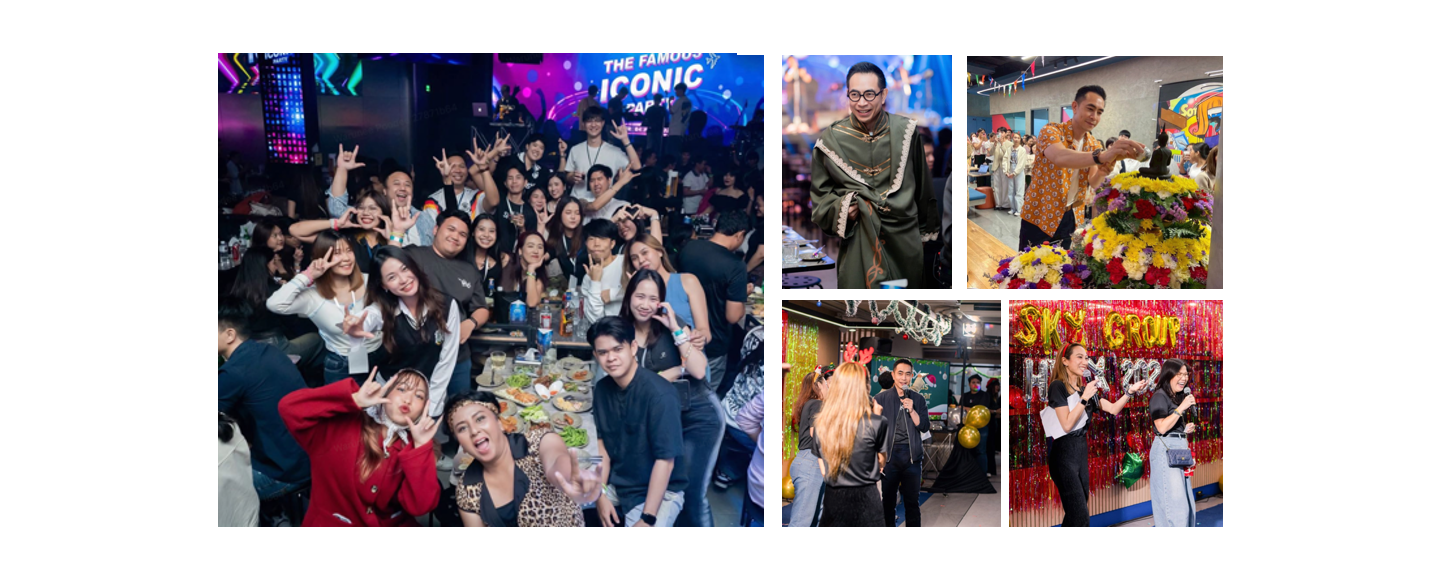
As the Company has both office staff and ground service staff who work in airport areas with time and distance constraints, the Company designs activities suitable for the context of each group, including:
Annual New Year's activities are organized separately for headquarters and ground staff to ensure all employee groups can participate comprehensively.
Organizing activities at times suitable for work schedules to avoid disrupting service continuity.
This approach reflects the Company's commitment to treating employees equally and considering their diverse job characteristics.
Organizational Culture Outcomes
Activities to enhance employee potential and engagement support
Sense of Belonging to the Organization
Inter-departmental Communication and Collaboration
Achieving work-life balance in an appropriate context.
The Company believes that employee engagement is a crucial factor in enhancing work efficiency, service quality, and the long-term sustainability of the organization. Organizing activities to strengthen employee potential and engagement is part of a holistic human resource management approach that integrates skill development, well-being care, and organizational culture building to support the sustainable growth of both employees and the organization.
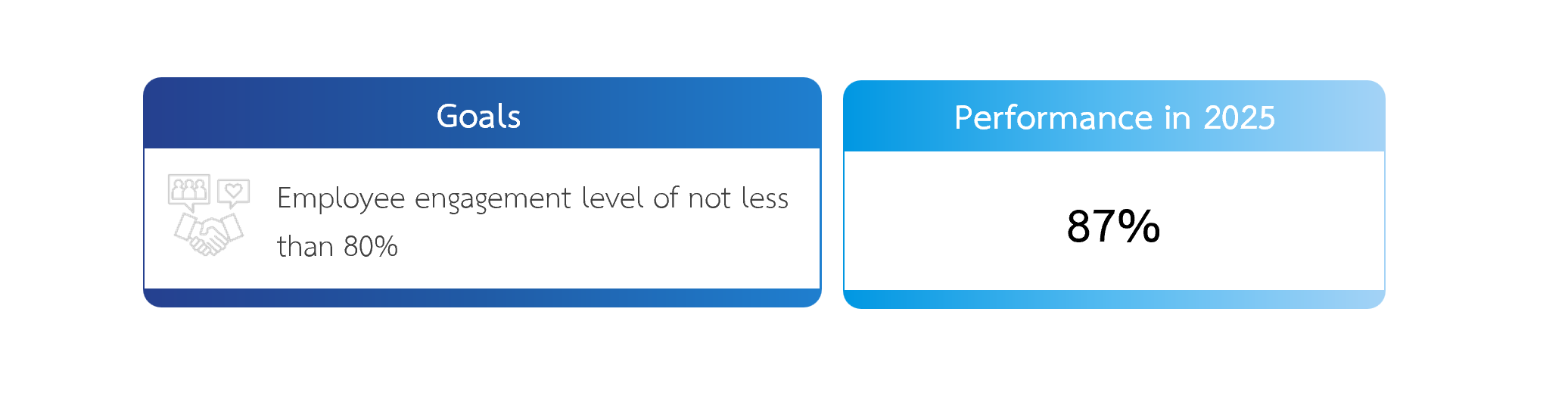
Employee Engagement Level
In 2025, the Company conducted an Employee Engagement Survey (EES) with the objective of surveying and monitoring the development of employee engagement, as well as understanding opinions on various factors affecting employees' work and quality of life. The collected data will be used to improve operations, deliver positive employee experiences, and strengthen the organization in the long term. The Company aims to maintain an employee engagement level of at least 80%.
Safety Training
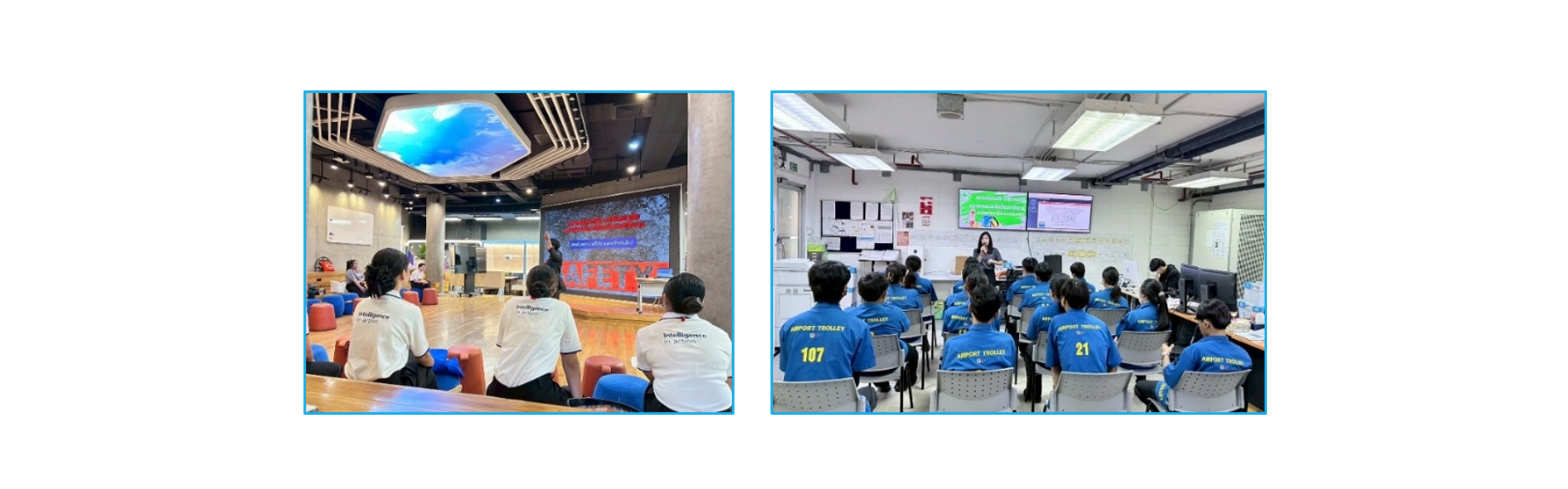
Safety Training for New Employees
New Employee Safety Training This training aims to provide employees with knowledge about hazards. and safe working methods through general safety knowledge training. Safety-related laws. and departmental regulations. To enable new employees to work safely and prevent accidents. Employees who have completed the training. Total 596 people representing 100%
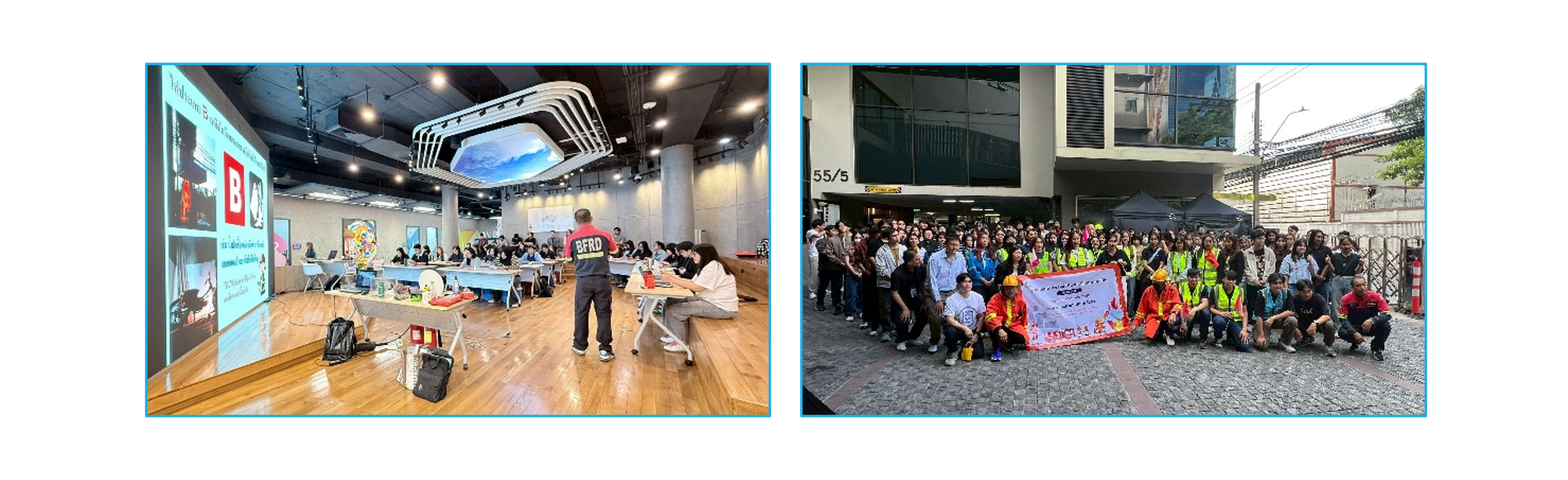
Basic Firefighting and Fire Evacuation Drill Training
Basic firefighting and fire evacuation training prepares employees to manage fire incidents. It equips employees with knowledge, understanding, and skills in using basic firefighting equipment and raises awareness about fire safety in the workplace or residential areas. 172 employees participated in the fire evacuation drill.
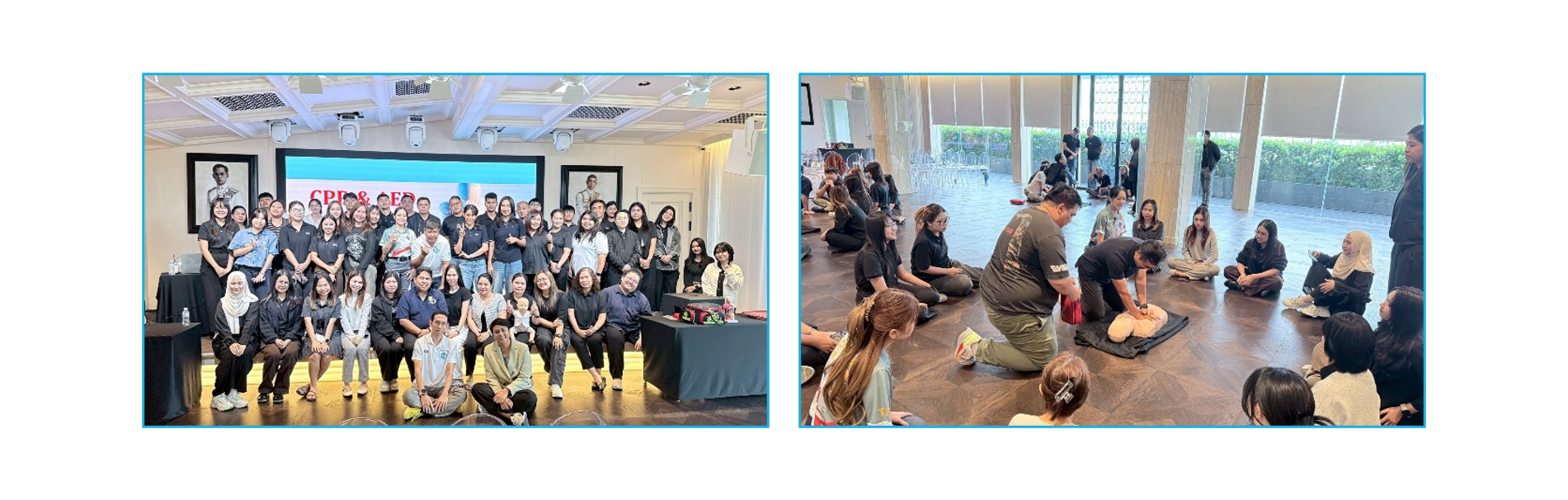
Basic First Aid Training Course
To promote knowledge and skills in workplace safety, including the ability to properly assist oneself and others in emergencies, the Company organized a "Basic First Aid" training course. This course helps employees understand basic first aid principles, cardiopulmonary resuscitation (CPR), and effective responses to emergency situations. A total of 45 employees participated in the training.
Environmental and Equipment Inspection
Measurement and Analysis of Working Conditions (Lighting)
Conducted workplace environmental inspections in accordance with the Ministerial Regulation on Standards for Administration, Management, and Operations concerning Safety, Occupational Health, and Working Environment related to Heat, Lighting, and Noise B.E. 2559 (2016). Measurements and analysis of light intensity in the office area were performed on May 5, 2025, on floors 6-7.
Measurement of general area (meeting room) at 1 point. Measurement results for the floor. below standard.
Measurement of employee work areas at 121 points. Measurement results for points that met the criteria. 108 points met the standard and 13 points were below standard.
The following corrective actions have been taken:
Clean light bulbs, increase the number of light bulbs, or use desk lamps.
Arrange seating to align with the direction of light from the lamps.
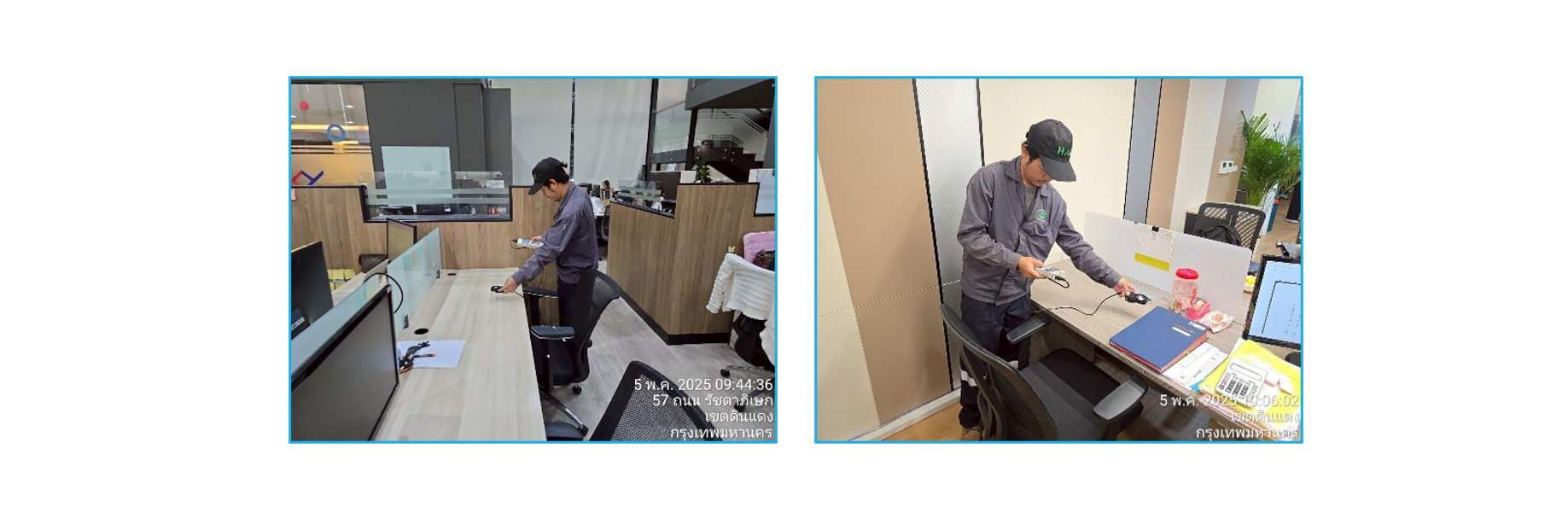
Inspection of Electrical Systems and Equipment
In accordance with the Ministerial Regulation on Standards for Administration, Management, and Operations concerning Safety, Occupational Health, and Working Environment related to Electricity B.E. 2558 (2015), employers must arrange for the inspection and maintenance of electrical systems and equipment to ensure safe operation at least once a year. Therefore, the Company conducted inspections on April 28, 2025, on floors 6-7, checking the main MDB switch, internal circuit breaker panels, and electrical equipment. The inspection results certified that they can be used safely.
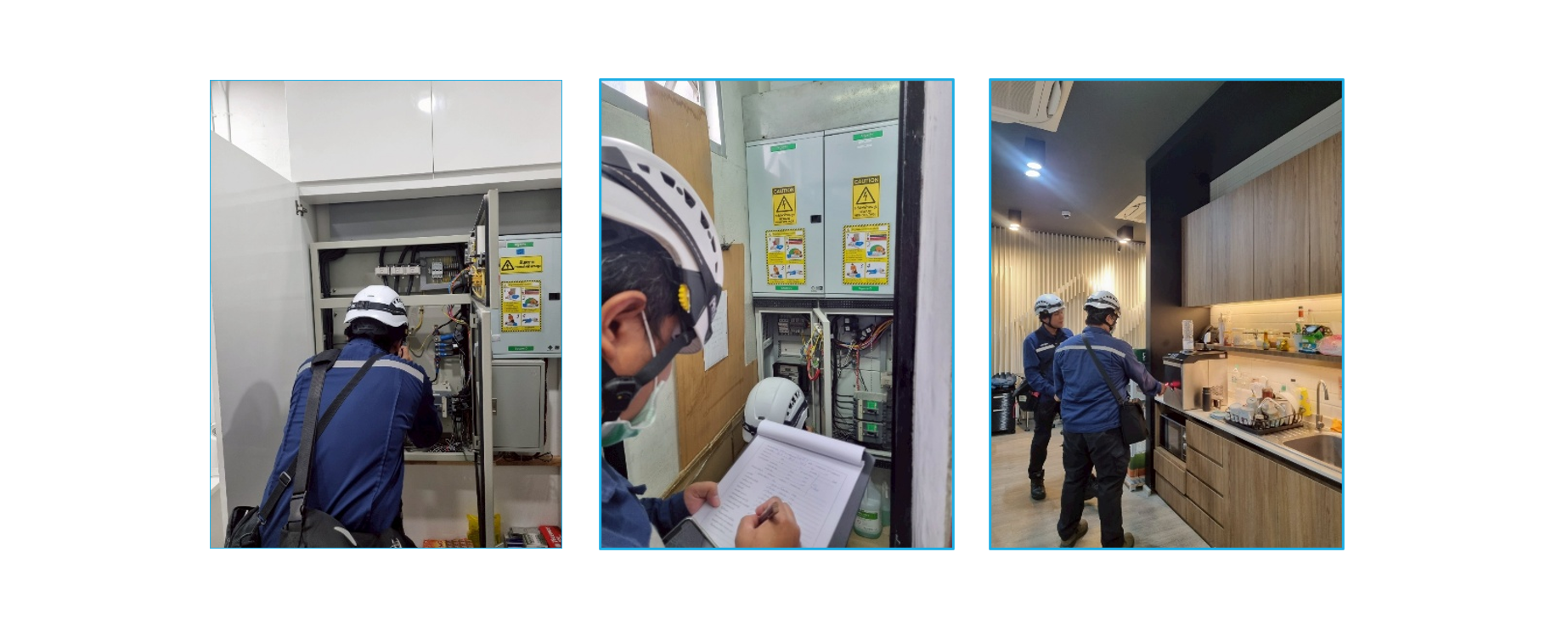
Management and Governance Mechanisms
The Company has established a Safety, Occupational Health, and Working Environment Committee (SHE Committee) to continuously promote and manage safety operations.
Supervisory-level Safety Officer Training Course
The Company organized training for Safety Officers at the supervisory level to comply with the Ministerial Regulation on the Provision of Safety Officers, Personnel, Agencies, or Committees for Safety Operations in Workplaces B.E. 2565 (2022) for supervisors. The Company conducted training for supervisory-level Safety Officers, with 30 participants divided into 2 sessions as follows:
July 8-9, 2025: 25 participants attended the supervisory-level safety officer training.
July 23-24, 2025: 5 participants attended the supervisory-level safety officer training.
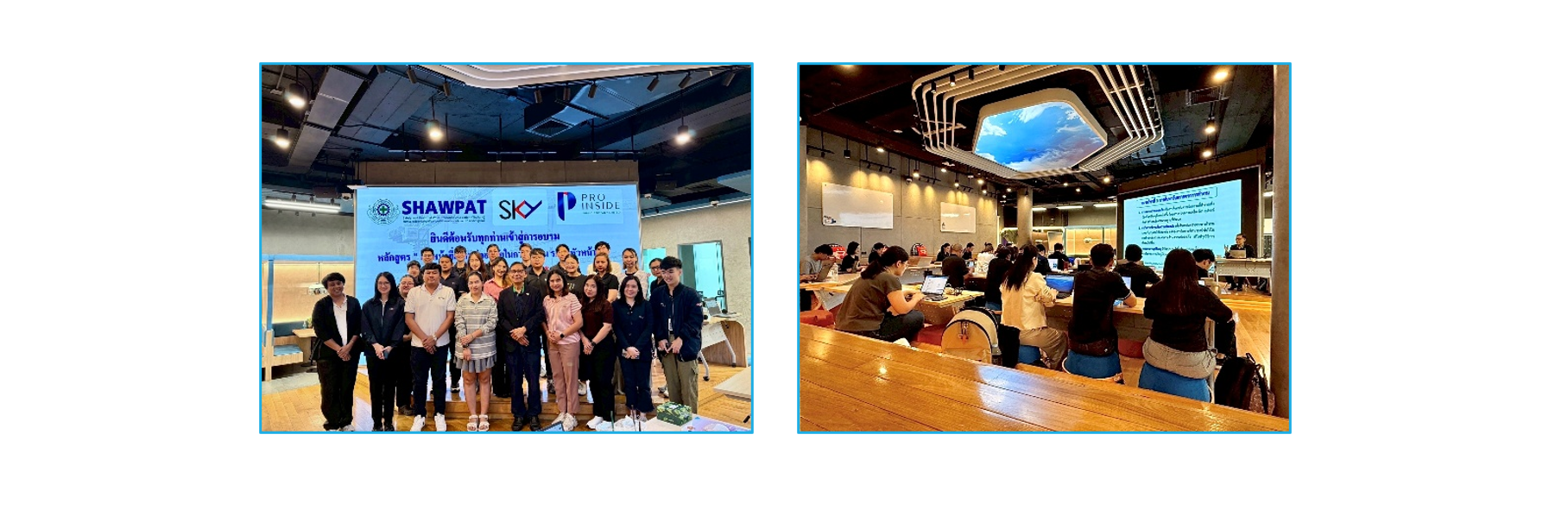
Executive-level Safety Officer Training Course
The Company organized training for executive-level safety officers to comply with Ministerial Regulation on the Provision of Safety Officers, Personnel, Agencies, or Committees for Safety Operations in Workplaces B.E. 2565 (2022), Article 10. Employers of establishments listed in Schedules 1 and 2 with 2 or more employees, and establishments listed in Schedule 3 with 20 or more employees, must appoint all executive-level employees as executive-level safety officers for the establishment. Training was conducted on September 9-10, 2025, with 29 employees participating.
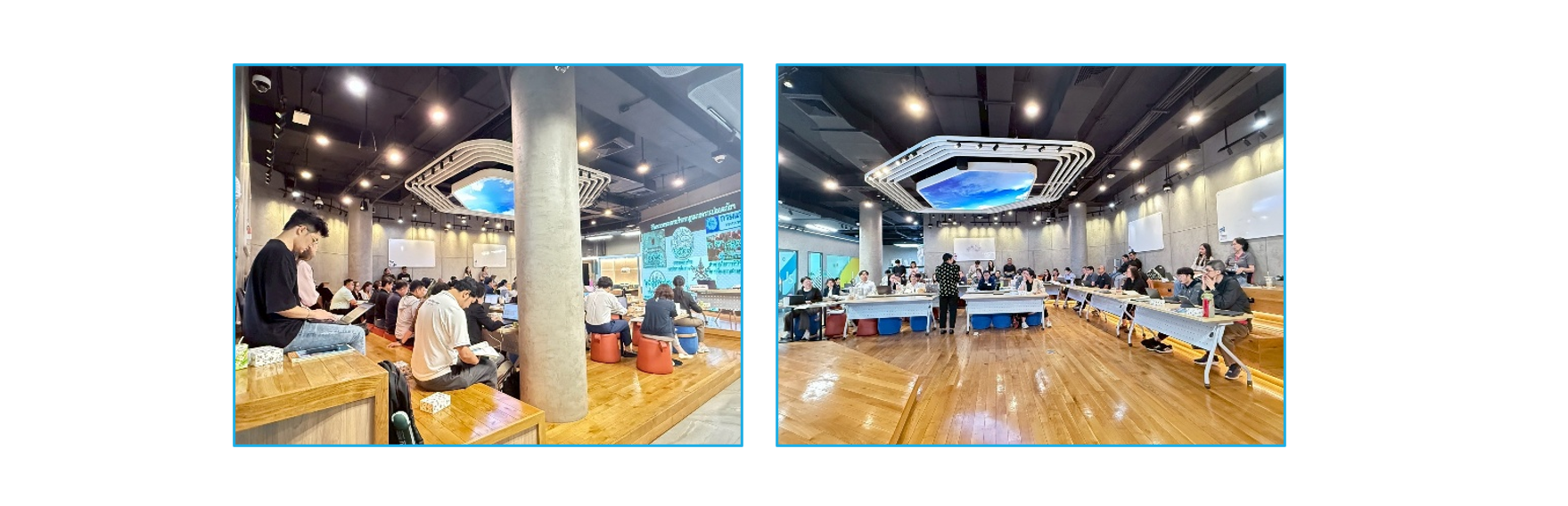
Operation of the Safety, Occupational Health, and Working Environment Committee (SHE Committee)
The Company has established a Safety, Occupational Health, and Working Environment Committee (SHE Committee) to operate and manage safety. The committee holds meetings once a month, and meeting minutes are prepared each time to update information, monitor safety performance, and continuously improve safety operations.
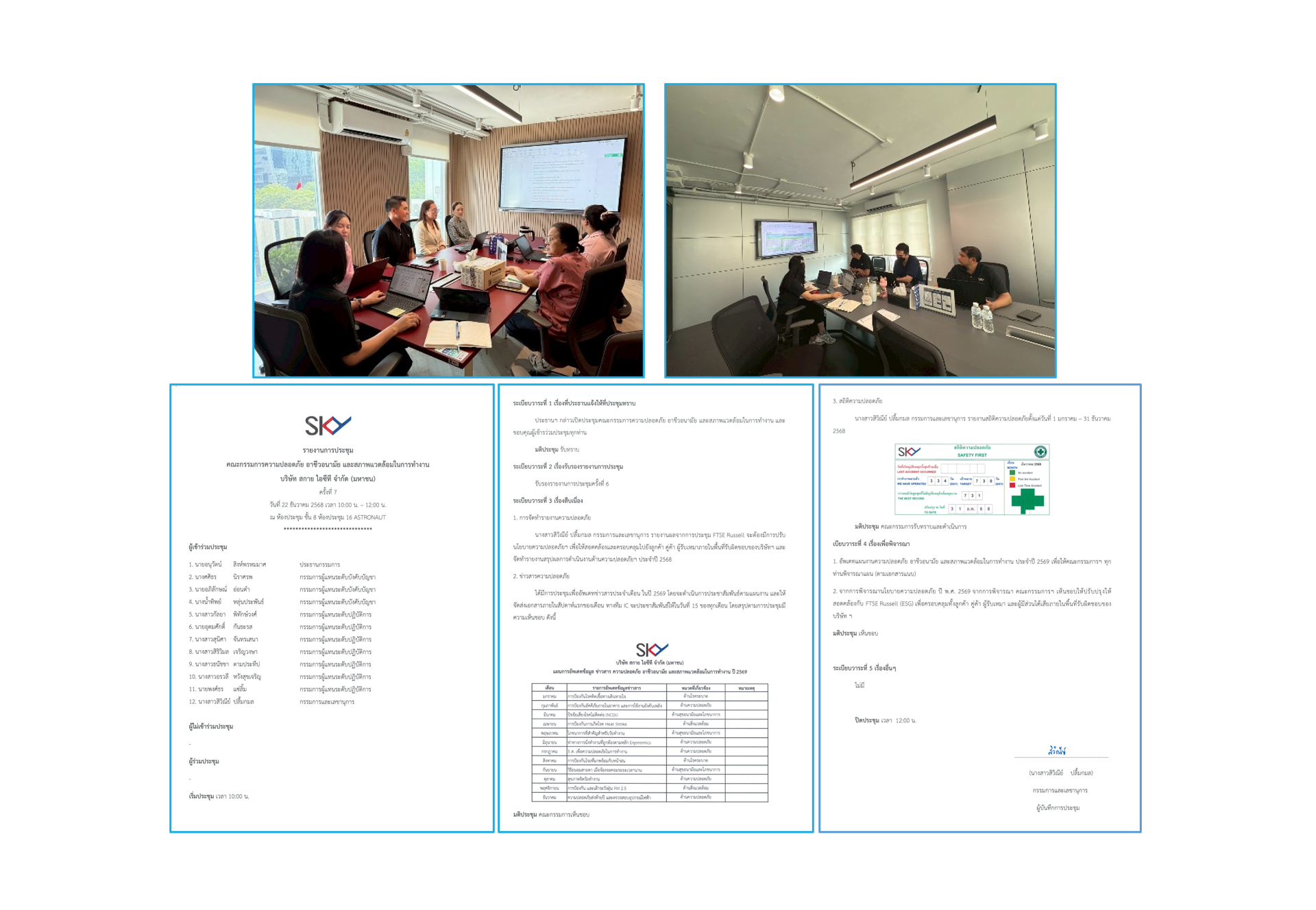
Employee Participation
All employees have channels to report safety concerns through "Speak Up Here" to enhance safety, occupational health, and working environment performance. This promotes the participation of all employees for everyone's workplace safety. In the past year 2025, No safety complaints were found.

Customers — Plan & Guidelines
Has a Customer Management Plan
Yes
Plan Description
The Company is committed to developing products and services under the concept of Green Digital Airport Solutions that can create benefits for all stakeholder groups, based on the principle of stakeholder-centricity.
Product and service development therefore focuses on meeting the needs of entrepreneurial customers, enabling them to solve problems and support their long-term business success, while also providing a positive experience and creating economic, social, and environmental value.
The Company has established a “Products & Services Development Framework” to design products and services that deliver maximum value to customers and all stakeholder groups. Emphasis is placed on building connections with customers through various methods to survey, evaluate, and analyze the needs of both current and potential future customers, both domestically and globally. This includes analyzing significant trends in the aviation business, using the gathered data to assess impact, urgency, and level of importance to define objectives for product and service development. It also involves preparing for marketing, collaborating with strategic business partners, and managing innovation to design products and services that create a competitive advantage. Feedback and suggestions are continuously monitored for ongoing development. The Company conducts studies and evaluates customer satisfaction with its products/services, which is a crucial step in developing and improving the quality of products and services to appropriately and effectively meet customer needs. Understanding customer satisfaction not only helps the Company improve product and service quality but also builds brand loyalty and trust, which will lead to long-term success.
The Company conducts studies and evaluates customer satisfaction with its products/services, which is a crucial step in developing and improving the quality of products and services to appropriately and effectively meet customer needs. Understanding customer satisfaction not only helps the Company improve product and service quality but also builds brand loyalty and trust, which will lead to long-term success.
The Company has implemented measures for the security of customer personal data, with details as follows: https://www.skyict.co.th/en/privacy-policy
Channels for complaints in case of customer data breaches
Measures in case of customer data breaches
In the event of a customer data breach, the Company will take urgent and stringent measures according to the following steps:
Immediately report the incident and assess its impact
Investigate the source and scope of the data breach
Immediately notify executives and the security team
Inform customers and relevant agencies
Transparently inform affected customers with recommendations for additional risk prevention
Notify regulatory authorities (e.g., Personal Data Protection Office – PDPO)
Immediately contain the incident and restore systems
Close technical vulnerabilities that lead to data breaches
Initiate data recovery procedures and re-test system security before re-deployment
Remedy and prevent harm to users
Offer assistance such as password changes, account monitoring, or appropriate compensation measures
Prevent misuse of data
Review systems and update security policies
Re-verify all vulnerabilities
Update security policies and train employees to prevent recurrence
In the past year 2025, the Company had no cases or incidents where it received complaints regarding customer personal data.
Customer Relationship Management
The Company recognizes that customers and users are key stakeholders vital to the success and sustainability of its business, especially in the information technology system services and airport ground services sectors, which directly impact the experience, safety, and trust of passengers, airlines, and relevant agencies. Therefore, the Company is committed to continuously developing high-quality, standardized services that meet customer expectations through establishing service management systems, soliciting feedback, and enhancing service quality in all dimensions.
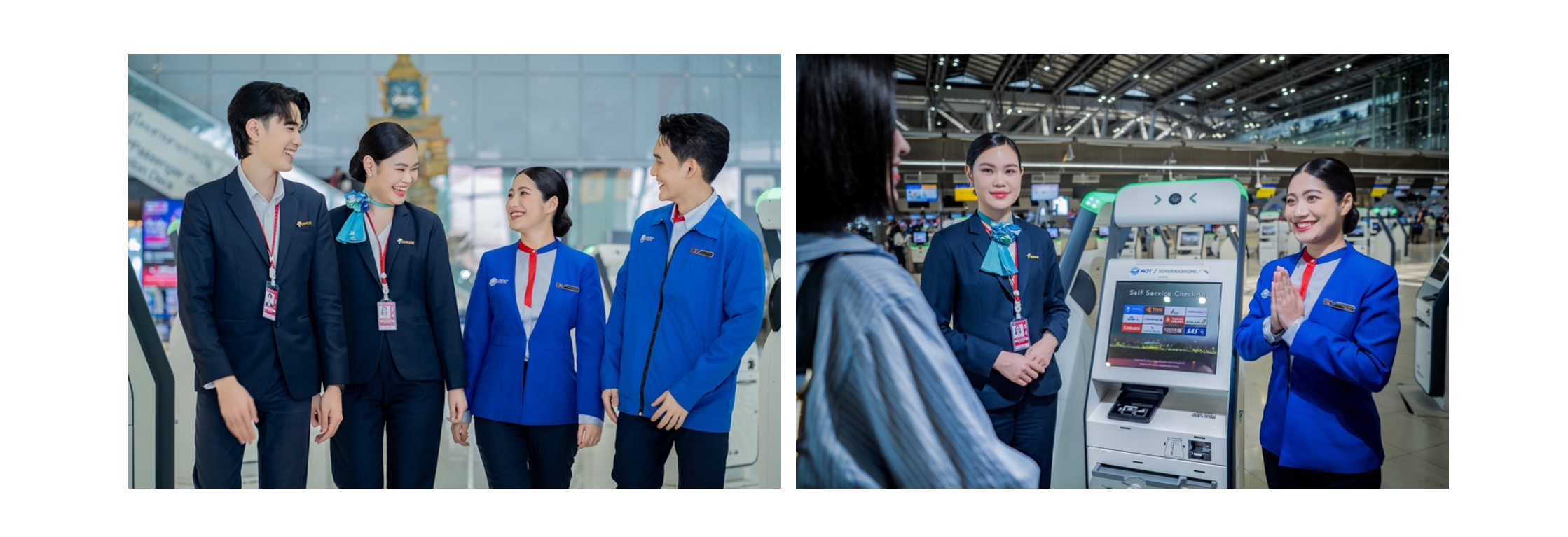
Quality Management Customer Service
The Company prioritizes systematic service quality management by establishing clear operational processes, covering planning, operations, monitoring, and continuous improvement, to ensure efficient, consistent, and customer- and user-centric service delivery.
Elevating Service Standards with International Standards
To elevate service quality and excellence, the Company has adopted international standards as a management framework. In the past year, the Company received ISO 23592:2021 – Service Excellence certification, which is a standard for managing excellence in airport ground services.
The Company is considered the first organization in the Asia Pacific (APAC) region to receive this certification, reflecting its commitment to developing international-standard quality services and systematic customer experience management. The implementation of ISO 23592:2021 helps the Company establish clear and verifiable service processes, systematically manage customer experience, enhance service consistency and security, and promote continuous improvement and development of services.
Customer Feedback and Satisfaction
The Company conducts studies and evaluates customer satisfaction (Customer Satisfaction Survey: CSAT) with its products/services, which is a crucial step in developing and improving the quality of products and services to appropriately and effectively meet customer needs. Understanding customer satisfaction not only helps the Company improve product and service quality but also builds brand loyalty and trust, which will lead to long-term success.
For employers, the Company conducts monthly satisfaction surveys to assess service quality, punctuality, responsiveness to complaints, and operational efficiency. The survey results are presented to relevant executives for their awareness and to establish continuous improvement guidelines.
Regarding airlines, the Company conducts annual satisfaction surveys to assess overall service quality, operational cooperation, and adherence to aviation industry operational standards. The satisfaction survey results from both groups are analyzed for trends and integrated into risk management and service quality development processes to support long-term relationships and sustainable organizational growth.
The Company's satisfaction survey results cover two stakeholder groups: employers and airlines. The annual satisfaction survey for 2025 shows the following satisfaction levels:
Plan Areas
| Plan Area |
|---|
| Responsible production and services for customers |
| Development of customer satisfaction and customer relationship |
| Protection of customer personal information |
Customers — Satisfaction Results
Customer Satisfaction Results
| Metric | Current Year | Previous Year | Two Years Ago |
|---|---|---|---|
| Evaluation results of customer satisfaction | 1 | 1 | 1 |
Customers — Targets
Has Set Customer Targets
Yes
Targets
| Indicator | Target Areas | Target Year | Target Year — Description |
|---|---|---|---|
| Customer satisfaction level of not less than 80 percent. | 3009 · Description: Development of customer satisfaction and customer relationship | 2,025 | 95.4 percent |
| Airline satisfaction not less than 80 percent | 3011 · Other name: Airline satisfaction not less than 80 percent · Description: Other | 2,025 | 84.2 percent |
Customers — Performance & Outcomes
Has Performance Results
Yes
Performance Description
From the customer satisfaction graph, it was found that in 2025, the satisfaction level of both Clients (Clients) and Airlines (Airlines) showed an improving trend compared to 2024, with clients increasing from 94.8% to 95.4% and airlines increasing from 80.2% to 84.2%. This trend reflects continuously improving service efficiency and the company's commitment to sustainably enhancing operational quality in line with stakeholder expectations.
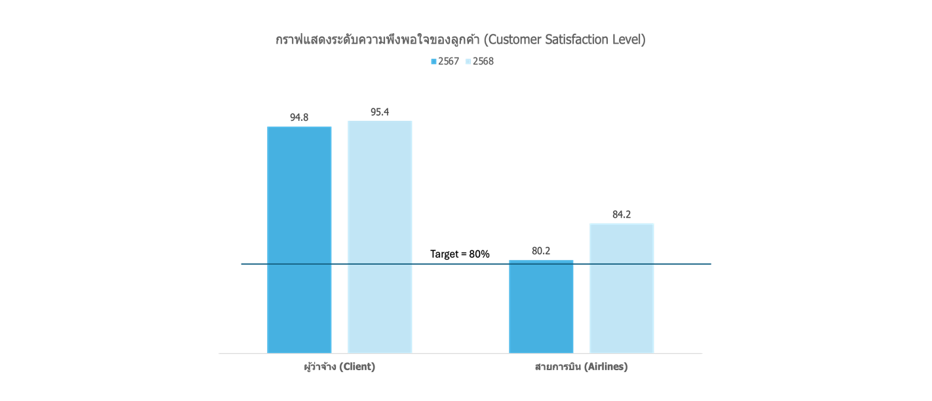
Enhancing Customer Satisfaction
From the 2024 annual satisfaction survey results, the company received significant feedback from airlines through 535 questionnaires. Key issues reflecting expectations included enhancing the printing efficiency of the CUTE system, speed in problem resolution, and continuous improvement of service quality.
In 2025, the company fully implemented its defined development plan, including improving printer equipment by replacing thermal heads to enhance the clarity of boarding passes and bag tags, managing manpower during peak hours with a standby system and close operational monitoring, as well as elevating service standards through ISO 23592:2021 certification and developing a Service Excellence Model under the concepts of Proactive Service, Personalized Service, and Continuous Improvement.
The results of these operations are tangibly reflected in the increased satisfaction level of airlines, demonstrating the company's commitment to listening to the Voice of Customer and systematically implementing improvements to build long-term relationships and sustainable trust.
Complaint and Suggestion Management
The company provides various channels for receiving complaints and suggestions, covering passengers, clients, and other stakeholders. Upon receipt, information is recorded into the system, facts are verified, and the matter is forwarded to relevant departments for appropriate resolution within the specified timeframe.
The company monitors progress, reports operational results back to complainants, and analyzes issues that arise to continuously improve work processes, thereby enhancing service quality and building long-term trust among stakeholders.
In 2025, there were a total of 44 complaints (10 valid complaints), with a 100% complaint closure rate and 100% resolution of complaints in accordance with SLA.
Prioritizing customers, clients, passengers, and system users reflects the company's social responsibility as a technology provider playing a crucial role in travel infrastructure. The company is committed to developing safe, reliable, and user-centric systems and services to support quality and sustainable travel experiences.
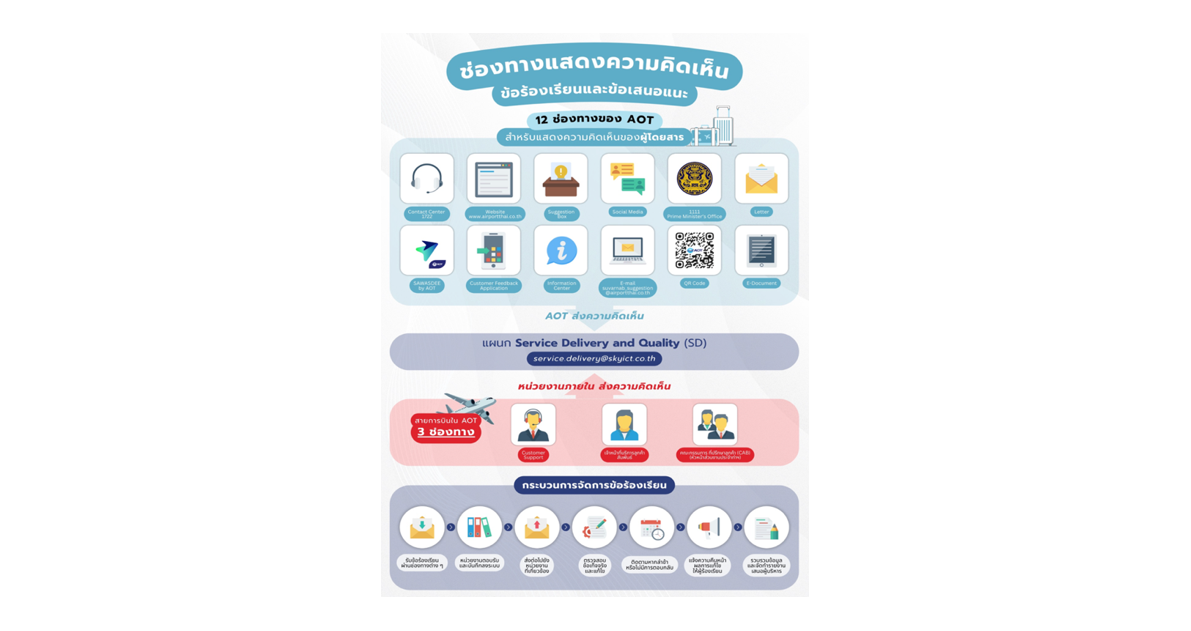
Responsibility for Products and Services
The company recognizes that its products and services, particularly information technology systems and ground services at airports, play a vital role in the safety, travel experience, and trust of numerous service users and passengers. Therefore, the company is committed to developing and providing high-quality, safe, and reliable services to support convenient, safe, and sustainable travel.
The company designs and provides services using a User-Centered Approach, including system testing before actual use, managing service-related risks, and preparing contingency plans to limit potential impacts on service users, airlines, and passengers, as well as supporting equitable access to quality services.
Furthermore, the company strictly adheres to relevant laws, regulations, and standards, and adopts international standards for safety, quality, and service continuity as a framework for operations to enhance stakeholder confidence and promote an efficient and resilient travel infrastructure.
In 2025, the company experienced service system disruptions accounting for 0.2% of total usage, which might have affected service users during certain periods. However, the company fully investigated and resolved all cases within the Service Level Agreement (SLA) framework, achieving a 100% SLA compliance rate. This reflects the company's readiness in system management, its ability to minimize impact on service users, and its responsibility for service quality and continuity.
The company continuously analyzes data from these disruptions to identify root causes and improve preventive measures, thereby enhancing system stability, reducing the risk of recurrence, and supporting the long-term development of technology and services that improve people's quality of life.
Community & Social — Plan & Guidelines
Has a Community & Social Plan
Yes
Plan Description
The company is committed to conducting business with responsibility towards communities and society, prioritizing the development of quality of life and enhancing the well-being of surrounding communities where the company operates. This is achieved by supporting job creation and income distribution to communities through the recruitment and employment of capable local personnel, as well as providing support for social projects and activities ( Corporate Social Responsibility: CSR), both in-process and after-process forms, to create career opportunities, generate value and social well-being, and enhance the quality of life for community members to live securely and sustainably.
Community engagement.
The company recognizes that sustainable business operations must consider the impact and relationships with communities and society surrounding its operational areas, as well as society at large, especially in the context of information technology business operations, which are connected to diverse people, communities, and areas.
The company therefore aims to promote engagement with communities and society through activities appropriate to the organizational context, focusing on providing relief, supporting quality of life, social development, and creating shared value with stakeholders, encompassing aspects of assistance, employee participation, and income distribution to communities.
Guidelines and principles for community and social engagement operations.
The company conducts community and social engagement activities under the principle of stakeholder responsibility, focusing on creating positive social impact appropriate to the organizational context and operational areas. The company prioritizes activities that align with community needs, employee participation, and efficient and transparent resource utilization.
The company's community and social operational guidelines cover key issues, including:
-
Supporting the transition to a digital society.
-
Providing assistance and relief in emergency situations or disasters.
-
Supporting the quality of life, health, and well-being of the populace.
-
Caring for and assisting vulnerable groups in society, such as children, the elderly, and the underprivileged.
-
Promoting youth development, education, and creative activities.
-
Supporting local economies and income distribution to communities.
The company conducts these activities with consideration for employee participation as representatives of the organization, to foster an organizational culture that recognizes the importance of society and the common good, while also linking social operations with long-term sustainable business operations.
Plan Areas
| Plan Area |
|---|
| Employment and professional skill development |
| Sports and recreation |
| Occupational health, safety, health, and quality of life |
| Disadvantaged and vulnerable groups |
| Water and sanitation management |
Community & Social — Targets
Has Set Community & Social Targets
Yes
Targets
| Indicator | Target Areas | Target Year | Target Year — Description |
|---|---|---|---|
| Local employment | 3036 · Description: Employment and professional skill development | 2,029 | 50% |
Community & Social — Performance & Outcomes
Has Performance Results
Yes
Performance Description
Local employment.
The company recognizes its role in creating shared value with communities by prioritizing the employment of local personnel in its operating areas, developing community members' skills and potential through training, providing pre-employment readiness programs, and collaborating with local agencies and educational institutions.
The company promotes local employment, especially in projects requiring permanent operations at various airports under the supervision of Airports of Thailand Public Company Limited (AOT). The company focuses on recruiting and employing personnel from nearby communities to provide local residents with access to employment and career advancement, reduce migration for work, and promote sustainable income distribution within the community.
The company aims to employ local staff for 50% of its total workforce by 2029. As of the end of December 2025, the company employed 152 local staff, representing 27.1% of the total workforce.
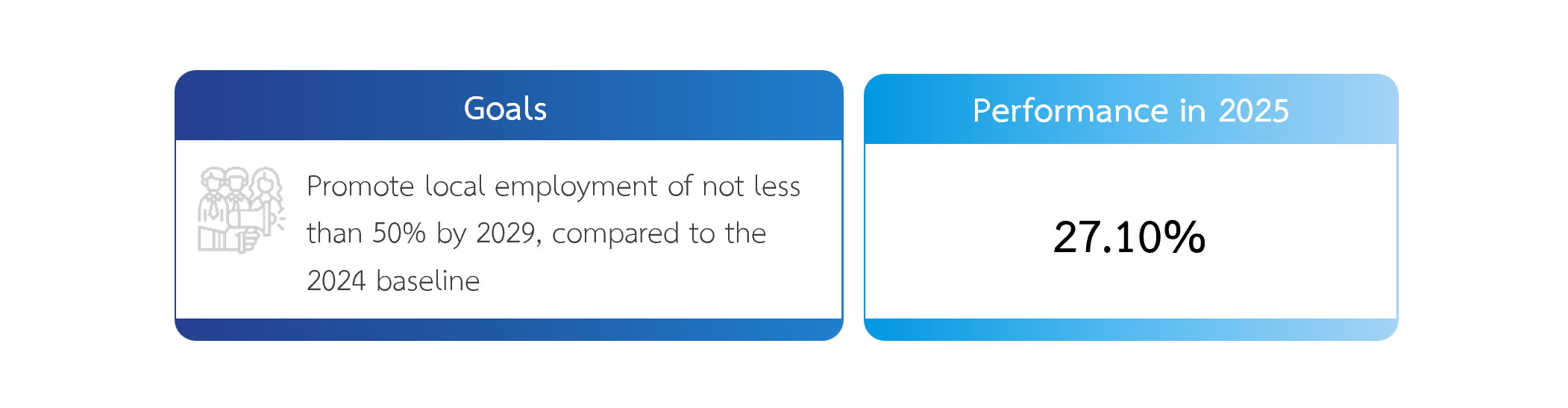
"Old Calendars, We Request" Project.
The company donated unused calendars to the "Foundation for the Blind in Thailand under the Royal Patronage" to be converted into Braille materials for visually impaired individuals. This initiative enhances learning and self-development opportunities for the visually impaired, enabling them to live quality lives with equality in society. It also promotes environmental sustainability by recycling unused materials for educational purposes.

Hat Yai Flood Relief Project.
Following the widespread flood situation in Hat Yai District, Songkhla Province, the company expresses its concern for all employees and their families, and has provided assistance, promptly delivering essential items to employees and their families working in the affected area.
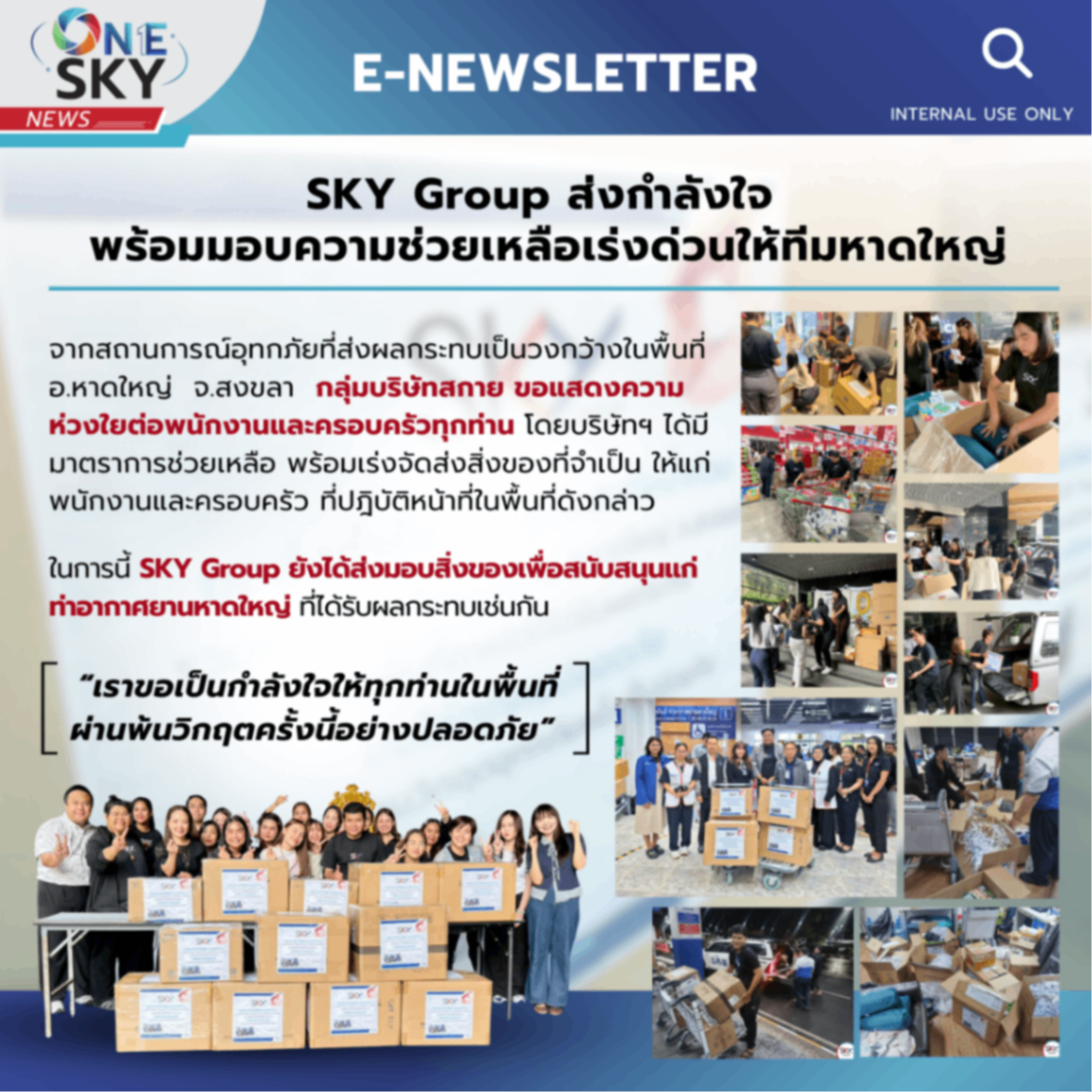
Project. SKY Group unites to donate blood, extending lives for fellow human beings.
The company, in collaboration with the National Blood Centre, Thai Red Cross Society, is part of the initiative to. Sharing happiness with society through blood donation to provide blood to patients in need of treatment, emphasizing the importance of blood donation to save human lives and being a selfless giver.

Support for vulnerable groups and local communities.
The company and its executives prioritize assisting vulnerable groups in society through activities such as.
Donation of clothing and essential items to organizations and agencies caring for the underprivileged.
Executives participate in merit-making on their birthdays to support orphans and the elderly.
Support legally registered foundations and associations.
These activities reflect the role of organizational leaders in setting an example for social responsibility.
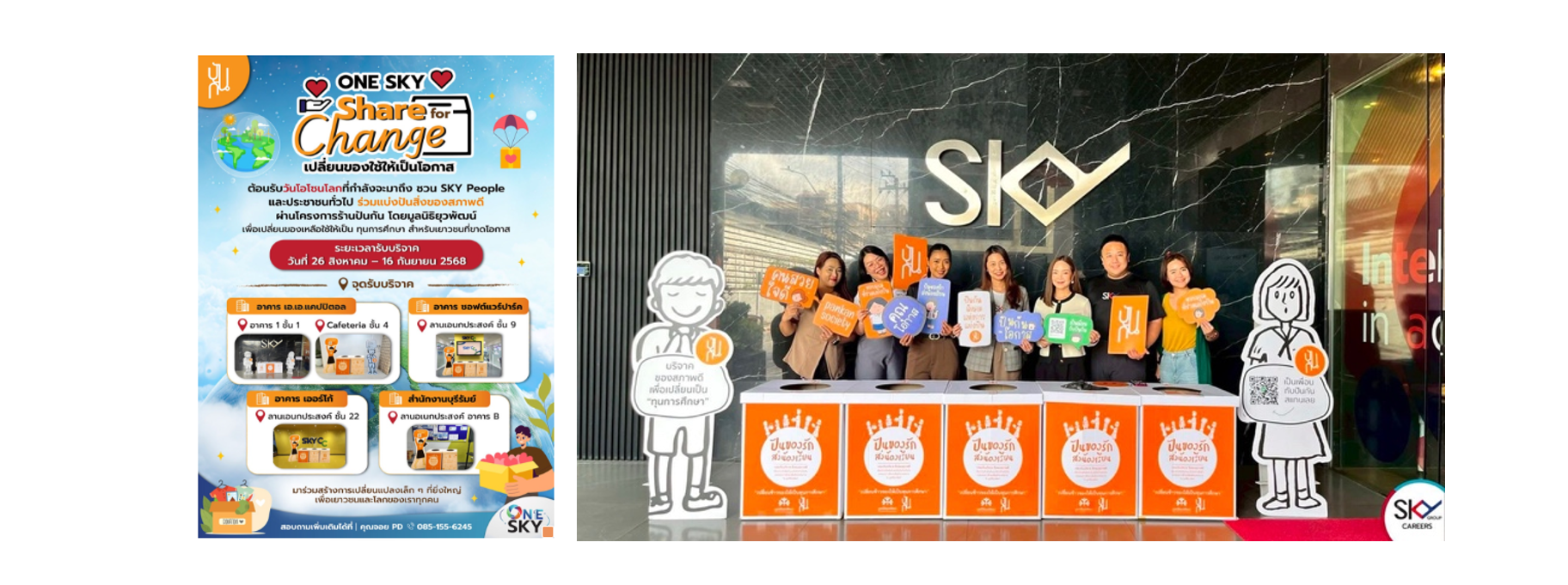
Support for local communities and economies.
The company prioritizes creating a positive impact on the local economy through concrete activities that distribute income to communities, such as.
Support for the Buriram Crane Conservation Center through monetary donations and purchasing goods from the community.
Support for Buriram Provincial Youth Football Team to promote the development of sports skills and creative activities among youth.
Development of areas surrounding the community.
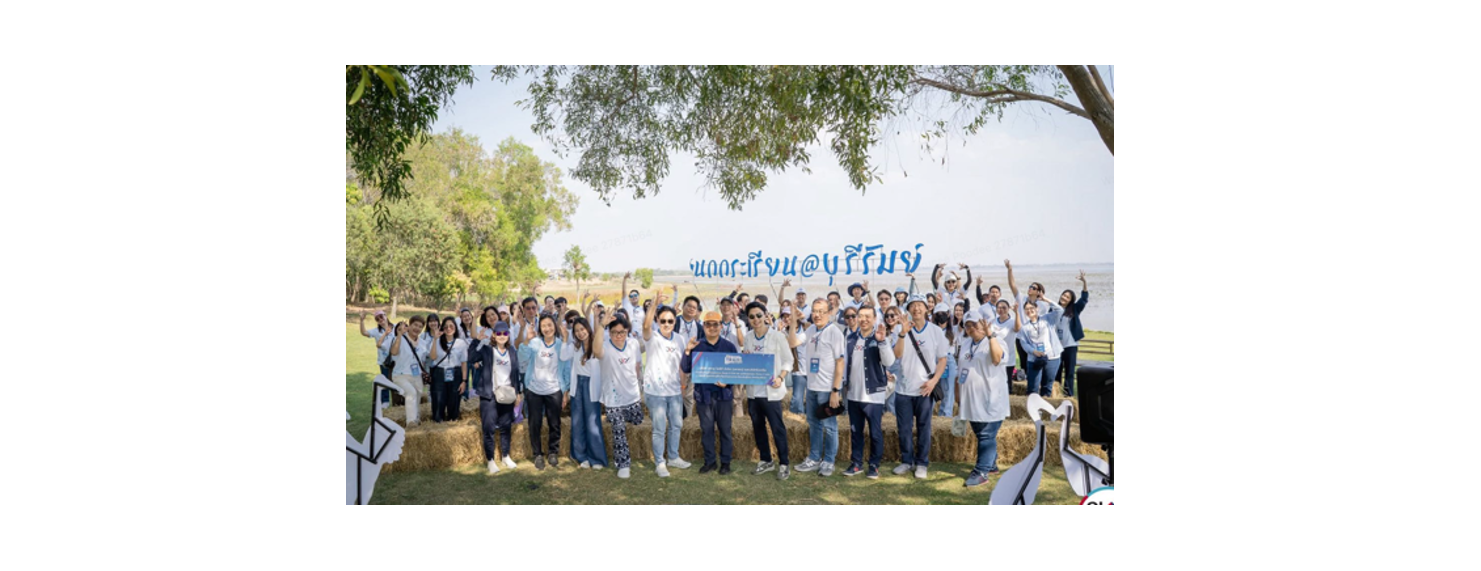
Income distribution to the community.
The company supports small entrepreneurs and community shops by offering opportunities for shops in nearby communities and throughout Bangkok to sell food in the company's canteen, which is provided as an employee welfare benefit. This initiative helps generate income for community entrepreneurs, supports the grassroots economy, and enhances food variety and employee quality of life.
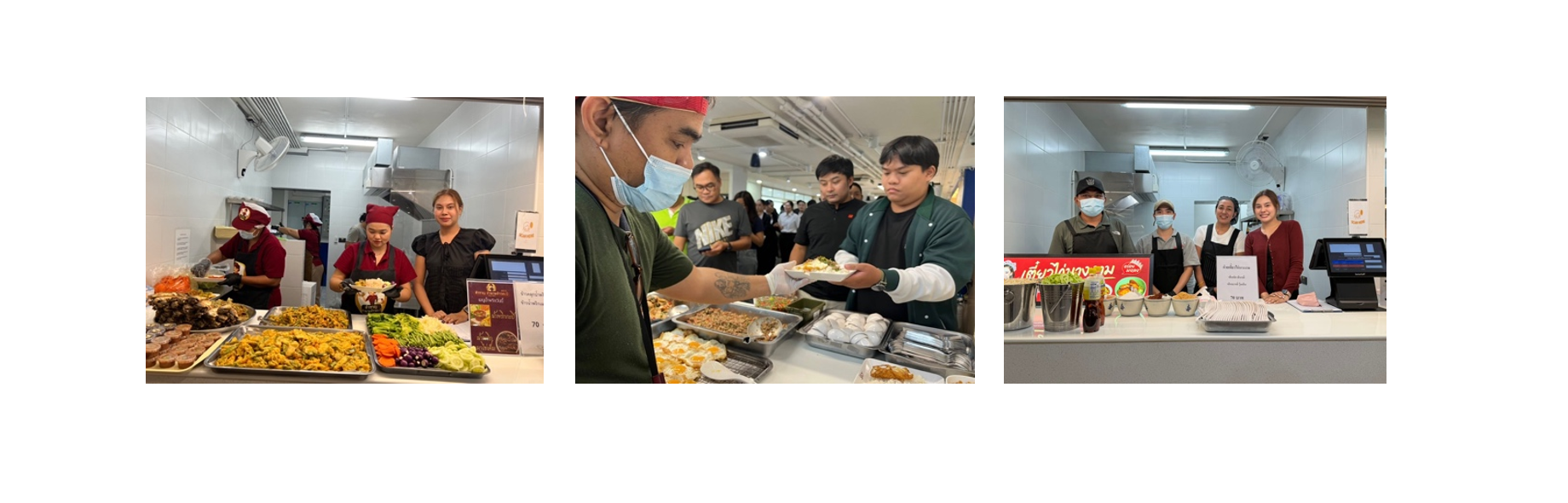
Community engagement through knowledge transfer at international academic forums.
The company emphasizes community engagement through sharing knowledge, experience, and professional perspectives to support long-term societal development. In the past year, the company's executives participated as speakers at the event. IPoE Forum 2025 under the topic “Innovations and Technological Advancements in Tourism, Hospitality, and Aviation” which was held at. Mae Fah Luang University, Chiang Rai Province.
This participation reflects the company's role in supporting the development of societal knowledge, fostering connections between businesses and educational institutions, and promoting lifelong learning, which is a form of community engagement through knowledge transfer and sustainable shared value creation.
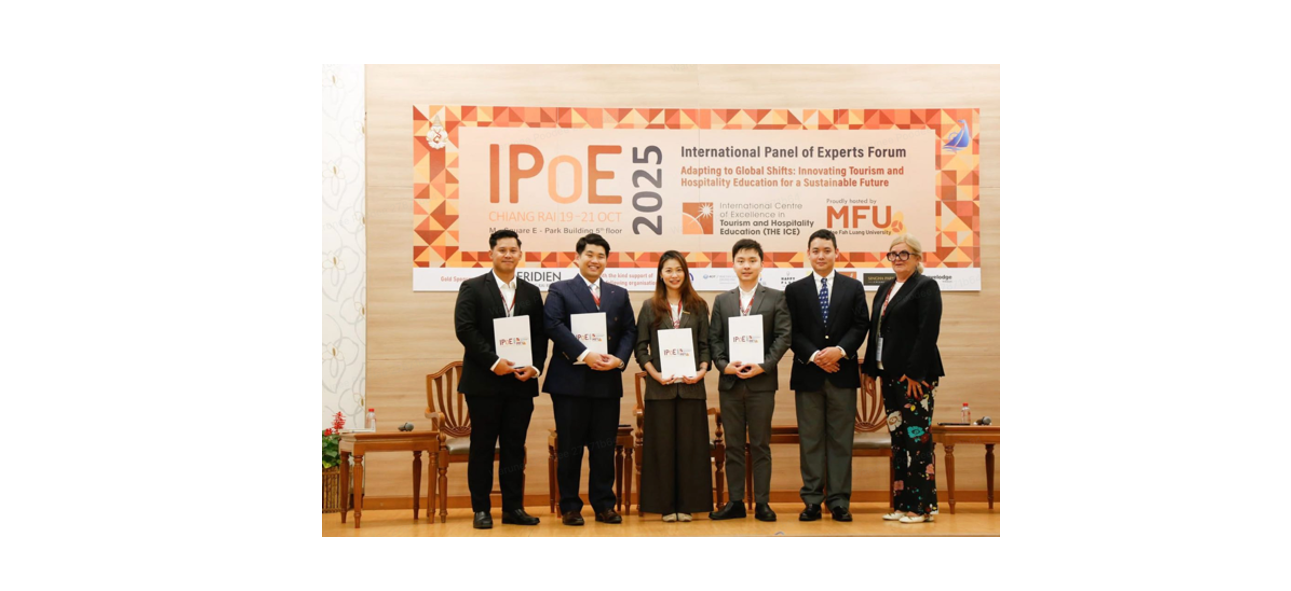
Investment in community development and human resource potential through educational collaboration.
The company places importance on human resource development and strengthening educational potential within communities, which are crucial foundations for the country's aviation and tourism industry development. In the past year, the company collaborated with the Department of Aerospace Engineering, Faculty of Engineering, Kasetsart University, to establish the project. SKY – KU Aviation Lab to support practical learning and the development of personnel with genuine knowledge and understanding of aviation technology.
The project is an aviation laboratory that simulates real airport operations, featuring the installation of international airport technology systems, such as.
System. CUPPS (Common Use Passenger Processing System)
System equipment. CUTE (Common Use Terminal Equipment)
Automated check-in system. CUSS (Common Use Self Service)
Automated baggage handling system. CUBD (Common Use Bag Drop)
Systems and gates. e-Gate For identity verification and access control.
The system is a technology actually used in major airports of the country, such as Suvarnabhumi Airport. This allows students and visitors to learn about airport system operations in depth through practical experimentation and various simulations, enhancing their understanding of operational processes, safety, and the efficiency of passenger service systems.
The SKY – KU Aviation Lab project is integrated into the curriculum, both in foundational courses for first-year students and specialized courses for third- and fourth-year students. Experts from the company and both domestic and international partners are invited to share knowledge and real-world experience to prepare personnel for future careers in the aviation and tourism industries. SKY – KU Aviation Lab is expected to be completed by February 2026.
Social benefits.
Promote knowledge and skills in aviation technology among youth and interested individuals.
Support the development of quality human resources for the aviation and tourism industries.
Bridge the gap between theoretical learning and practical work in the industry.
Business benefits.
Support the development of personnel aligned with long-term industry needs.
Enhance the company's image as an organization involved in educational and social development.
Enhance future workforce readiness, reducing training burdens upon entering actual employment.
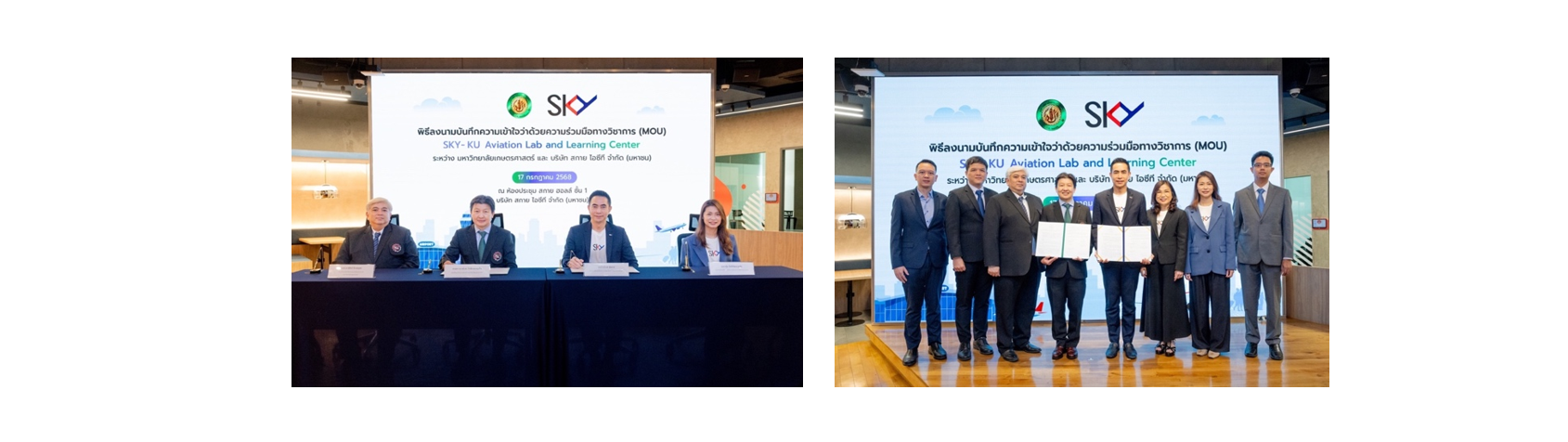
Social innovation.
“Easy Check-in, Fast Baggage Drop at 6 Airports via Automated Kiosks." CUPPS available today."
Transform chaotic travel into an easy and highly convenient experience with. With CUPPS, there's no more long waiting or wasted time on check-in and baggage drop procedures. This automated check-in system is now available at 6 major airports across Thailand. In just a few minutes, you can check in and drop your bags yourself, ensuring a smooth departure and saving more time. Experience the new era of travel that is easy, convenient, and fast with CUPPS.
The company has introduced automated kiosks. CUPPS (Common Use Passenger Processing System), an automated check-in and baggage drop system compatible with multiple airlines, installed at the 6 main airports of Airports of Thailand Public Company Limited (AOT), namely Suvarnabhumi Airport, Don Mueang Airport, Chiang Mai Airport, Mae Fah Luang Chiang Rai Airport, Phuket Airport, and Hat Yai Airport.
By kiosks. This CUPPS is designed to enhance traveler convenience by allowing self-check-in and baggage drop, reducing queue times at counters and making travel smoother.
Benefits of automated kiosks. CUPPS features are as follows:
Save time. Self-check-in and baggage drop can be completed in minutes without waiting for staff.
Enhance convenience, enabling smooth travel and allowing everything to be done at a single point.
Reduce congestion, reduce queues at check-in counters, and streamline traditional procedures.
Supports multiple airlines, compatible with various airlines operating at the airport, increasing check-in flexibility.

“System. Biometric: Convenient, Comfortable, Contactless."
Facilitate passengers by providing convenience, speed, and reduced waiting times.
Currently, leading airports in many countries worldwide have begun to adopt identity verification systems (. Automated Biometric Identification System: Biometric) to enhance security and facilitate passengers, such as Changi Airport in Singapore, Dubai Airport in the United Arab Emirates, Hartsfield-Jackson Atlanta International Airport in the United States, Sydney Airport in Australia, and Haneda Airport in Japan. Thailand is also among the first countries in the world to implement this system in its airports.
The company has developed and installed the system. Biometric for use at 6 airports of Airports of Thailand Public Company Limited (AOT), namely Suvarnabhumi Airport, Don Mueang Airport, Chiang Mai Airport, Mae Fah Luang Chiang Rai Airport, Phuket Airport, and Hat Yai Airport, which can facilitate both tourists and airport staff by reducing various procedures and increasing speed, as tourists no longer need to carry passports and Boarding Passes to verify their identity to officials.
In addition to speed, it also directly contributes to cleanliness (. Hygienic) as it helps reduce contact within the airport. As is well known, airports are gathering points for tourists from all over the world, especially Thailand, which is a target country for global tourists.
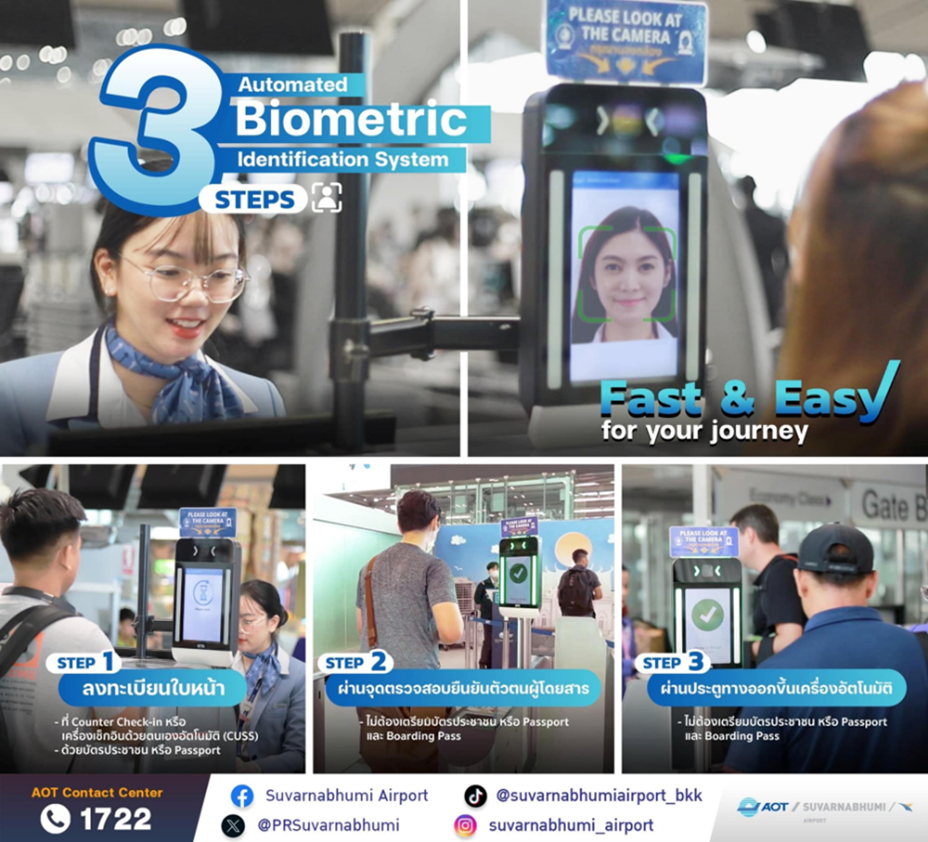
Public Internet Service Points (USO Net).
In an era of rapid transition to a digital society, information and communication technology has become a crucial fundamental factor in national development across economic, social, educational, and quality of life dimensions. Access to the internet and digital knowledge is therefore not merely about infrastructure, but about "opportunities" to learn, grow, and build a more secure future.
As a Thai technology organization with comprehensive expertise in information systems, digital infrastructure, big data analytics, resource management systems, and modern learning and working solutions, the company recognizes that the technology we develop should not be confined to major cities or large businesses, but should be accessible to "everyone" in the country.
With the concept of "Technology for All Lives," the company is committed to driving sustainable change, in line with its organizational vision: "To be the key driving force in transforming society through intelligent technological solutions that truly enhance lives." This is achieved by promoting access to the internet, knowledge, and digital tools for people in all regions, including children, youth, working-age individuals, the elderly, the underprivileged, low-income earners, those in remote areas, or small entrepreneurs, enabling them to use technology for learning, career development, and improving their quality of life equally.
We believe that strengthening Thailand must begin with creating equal opportunities for all citizens, and technology is one of the most crucial keys to unlocking those opportunities. With its expertise, the company is ready to leverage its digital capabilities to elevate the country, not just economically, but also by fostering a learning society where everyone participates.
Therefore, the company, in collaboration with the NBTC Office, has implemented the Public Internet Service Points (USO Net) project, which has been driving the mission of providing high-speed internet services in remote areas (Broadband Internet Service), by defining 5 types of service models, namely.
Provision of public village Wi-Fi services in remote areas.
Provision of public internet centers (USO Net Centers).
Provision of public internet rooms (USO Wrap).
Provision of high-speed internet services for schools.
Provision of high-speed internet services for Sub-district Health Promoting Hospitals (Tambon Health Promoting Hospitals).
The classification of the aforementioned operational groups is similar to projects in marginalized villages, enhancing operational efficiency and contract management, as well as aligning with the expectation for the project to achieve rapid success.
Objectives.
To provide high-speed internet services (Broadband Internet Service) in remote villages.
Support digital economy and society policies, upgrade telecommunications infrastructure to drive the country's economy, and advance the mission of providing universal basic telecommunications services and social services by the National Broadcasting and Telecommunications Commission.
To enable government and private sector agencies located in unserved or underserved areas to access efficient telecommunication services and utilize them as tools for enhancing the quality of public services through telecommunication and information networks.
To provide knowledge on using technology correctly, safely, and with quality.
To enhance technological capabilities and service access for all groups in society, including the general public, children, and individuals with disabilities or impairments.
Expected benefits.
Promote access to the internet and digital knowledge to enable people in all areas, especially remote and underserved communities, to genuinely use technology for learning, career development, and improving their quality of life.
Utilizing the comprehensive technological capabilities of Sky ICT Public Company Limited to develop systems supporting learning and work, such as e-Learning platforms, Knowledge Management systems, and internet infrastructure, to meet the daily usage needs of the public.
Support sustainable national development by integrating cooperation with government, private sector, and communities to drive digital economy policies, reduce inequality, and enhance the country's global competitiveness.
Foster a learning and participatory society by enabling people of all ages to learn anywhere, anytime, through accessible, secure, and efficient technology, thereby creating a new culture of lifelong learning.
Helping Thailand and Thai people keep pace with the digital world, with the intention of a Thai organization that not only develops technology for the market but also aims to genuinely improve the quality of life for Thai people through technology.
Direct social returns generated by the project.
Number of communities served: 120 communities in 12 provinces (remote and low-income areas).
Number of direct project participants: General public attending training: 4,800 people, and disabled individuals receiving technology assistance devices: 750 people.
Local government agencies that have started using accessible Call Center systems: 20 agencies.
Technology equipment installed: High-speed Wi-Fi sets in communities: 120 points; Public learning computers: 480 units.
Number of online courses (e-Learning) published: 16 courses.
Views of e-Manual system and knowledge base: more than 90,000 times within the first 6 months.
Final outcomes for communities and society.
Average income of local small entrepreneurs increased by 15–25% within 8 months after receiving training in online sales, digital marketing, and social media for business.
Youth unemployment rate in the area decreased by 12%, particularly among those who completed high school or vocational education and accessed online learning in digital skills.
Disabled individuals with increased income from online work, rising from 0-18% of the target group participating in the project.
Self-learning engagement rate via e-Learning system increased threefold within 1 year.
Economic returns for the company.
Number of new customers generated from increased brand awareness:
Businesses/government agencies coordinating with the company for extended services: 35 entities.
Schools and community centers subscribed to the knowledge base system and PaaS (Platform as a Service) system: 60 units.
Direct income from value-added services in Cloud, e-Training, and specialized Call Center systems:
Accumulated income within 1 year: 6.5 million Baht.
Increased market value and organizational reputation (Brand Value) based on invitations to showcase projects at public policy events and collaborative activities at more than 8 national forums.
Project monitoring.
Real-time monitoring system via a Dashboard that reports.
Number of daily/monthly users.
User satisfaction score.
Course-specific learning engagement level.
Quarterly evaluation covering aspects:
Changes in user income.
Frequency of use for various devices and systems.
Career/business advancement from acquired knowledge.
In-depth interviews and follow-up workshops with community leaders and disabled individuals in the area (conducted in collaboration with local partners).
Summary of overall benefits.
Benefits. | Social aspect. | Economic aspect. ( society). | Economic aspect. ( Company). |
Increased access to technology. | 5,000+ people. | Average increase in community income. 20% | Supplementary income from services. 6.5 million Baht/year. |
Reduce inequality. | Disabled group. 750 People have tools to use. | Unemployment rate decreased. 12% | New corporate clients. 95 Agencies. |
Create learning opportunities. | e-Learning Usage. 90,000 times. | Entrepreneurs start selling online. | Brand exposure Increased at the policy level. |
Conclusion.
The company's goal is not merely to develop modern technology, but to develop technology that "everyone can use" and "everyone benefits from" in a true sense. We believe that access to technology is at the heart of an equally progressive society, and we are ready to be a part of driving Thailand towards that point with a desire to see all Thais advance together.
Law Violation Incidents
Law Violation Incidents
| Metric | Current Year | Previous Year | Two Years Ago |
|---|---|---|---|
| The total number of cases or incidents of significant violations of laws or regulations regarding social and human rights (Cases) | 0 | 0 | 0 |
| The total number of cases or incidents that cause significant labor disputes (Cases) | 0 | 0 | 0 |
| The total number of cases or complaints related to consumer rights violations (Cases) | 0 | 0 | 0 |
| The total number of cases or complaints related to partner rights violations (Cases) | 0 | 0 | 0 |
| The total number of cases or incidents that cause disputes with the community/society (Cases) | 0 | 0 | 0 |
| The total number of cases or incidents related to cyber security or customer data breaches (Cases) | 0 | 0 | 0 |
| The total number of cases or incidents related to safety and occupational health at work (Cases) | 0 | 0 | 0 |