

Board Performance · 2025
In this section14 topics
- Compliance Monitoring — Overview2 items
- Prevention of Conflicts of Interest3 items
- Prevention of the Use of Inside Information3 items
- Anti-Corruption4 items
- Whistleblowing3 items
- Selection of Directors & Chief Executives5 items
- Selection of Independent Directors2 items
- Director Development3 items
- Evaluation of Board & Subcommittee Performance2 items
- Subcommittees1 item
- Meeting Attendance & Remuneration3 items
- Supervision of Subsidiaries & Associated Companies4 items
- Audit Committee Duty Performance1 item
- Executive Committee Duty Performance1 item
Compliance Monitoring — Overview
Compliance Monitoring — Introduction
The Company recognizes the importance of good corporate governance and conducting business ethically, respecting rights, and being responsible towards society, the environment, and various stakeholders. Possessing an efficient, transparent, and auditable management system will help build trust and confidence with all relevant parties. Therefore, the Company has adopted the Good Corporate Governance principles for listed companies (Good Corporate Governance) of 2017, as prescribed by the Stock Exchange of Thailand, to establish guidelines for the Company's business operations to have a sound management system and foster competitiveness, which will lead to the Company's sustainable growth.
Monitoring of Compliance with Other CG Policies & Guidelines
Maintaining Financial Credibility
The Company has separated its accounting and finance departments to ensure operational efficiency, managing employee numbers to adequately meet various workloads. Furthermore, the Chief Financial Officer and the Head of Accounting Control possess full qualifications in accordance with the regulations of the Stock Exchange of Thailand, as well as other specified regulations, and have completed the required training hours set by the Stock Exchange of Thailand to enhance their accounting knowledge.
The Board of Directors ensures that disclosures, including financial statements, annual registration statements (Form 56-1 One Report) can adequately reflect the financial position and operating results. It also supports the Company in preparing Management's Discussion and Analysis (MD&A) to accompany quarterly financial disclosures, enabling investors to better understand the changes in the Company's financial position and operating results each quarter, beyond just the figures in the financial statements. Additionally, the Board of Directors monitors the adequacy of financial liquidity and debt-paying ability. In cases where the business shows signs of inability to repay debt or financial problems, the Board closely monitors and ensures the business operates with caution.
From 2018 to the present, the Stock Exchange of Thailand has required listed companies to have a Chief Financial Officer ( CFO) and a qualified Head of Accounting Control to ensure that listed companies have quality financial reports and to disclose changes and report information regarding the CFO/Head of Accounting Control. The Company has therefore announced the names of those who meet the full qualifications as follows:
Ms. Kulnada Orararaktham: Chief Financial Officer ( CFO)
Mr. Thanawut Tiparos: Head of Accounting Control
Furthermore, over the past three years, no director or senior executive of the Company has been an employee or partner of the external audit firm currently engaged by the Company.
Treatment of Shareholders and Stakeholders
The Company recognizes and prioritizes the fundamental rights of shareholders and will not engage in any actions that violate or diminish these rights. It will also encourage shareholders to exercise their rights, such as the right to buy, sell, or transfer their held securities; the right to receive a share of the Company's profits; the right to receive sufficient Company information; various rights at shareholder meetings; the right to express opinions; and the right to participate in important Company decisions, such as dividend allocation, appointment or removal of directors, appointment of auditors, approval of significant transactions affecting the Company's business direction, amendment of the Memorandum of Association, and Company Articles of Association, etc.
In addition to the fundamental rights mentioned above, the Company has also undertaken various actions to promote and facilitate the exercise of shareholders' rights, as follows:
The Company arranges for the Annual General Meeting of Shareholders within 4 months from the end of the Company's accounting period, and to prepare a notice of meeting specifying the location, date, time, agenda, and matters to be proposed to the meeting, along with reasonable details, clearly indicating whether the matter is for acknowledgment, approval, or consideration, as the case may be, including the Board of Directors' opinion on such matter. This notice shall be sent to shareholders and the registrar no less than 7 days before the meeting, and the notice of meeting shall be advertised in a newspaper for 3 consecutive days. For each agenda item, the Board of Directors' opinion will be included, and such information will be published on the Company's Website to allow shareholders sufficient time to study the information in advance of the meeting.
In the past year 2025, the Company held its Annual General Meeting of Shareholders 2025 on April 25, 2025, at 2:00 PM, exclusively via electronic means (e-AGM), in accordance with the Royal Decree on Electronic Meetings B.E. 2563 (2020) and other relevant laws and regulations. The record date for shareholders entitled to attend the meeting was set for March 21, 2025. The Company published the notice of the Annual General Meeting of Shareholders 2025 on its website on April 3, 2025, and dispatched the notice of the Annual General Meeting of Shareholders 2025 to shareholders by post on April 10, 2025, 14 days prior to the meeting.
The Company encourages the Board of Directors, executives, relevant departments, and auditors to attend shareholder meetings collectively.
In cases where shareholders are unable to attend the meeting in person, the Company allows shareholders to appoint an independent director or any other person to attend on their behalf, using one of the proxy forms provided by the Company along with the notice of meeting.
Prior to the meeting date, the Company allows shareholders to submit comments, suggestions, and questions in advance.
At the meeting, the Company provided equal opportunities for shareholders to express opinions, offer suggestions, or ask questions freely on various agenda items before any resolution was passed. Directors and relevant executives attended the shareholder meeting to answer questions, and important questions and comments were recorded in the meeting minutes for shareholders' review.
In the meeting for the election of directors, the Company allows shareholders to cast votes for each director individually. Shareholders have the right to elect representatives whom they deem qualified to serve as directors to protect their own interests, which will foster diversity and truly represent the shareholders.
After the meeting concludes, the Company will prepare meeting minutes, ensuring accurate and complete information for shareholders' review, and will publish the meeting minutes via the Company's Website within 14 days from the meeting date.
Equal Treatment of Shareholders
The Company has a policy of treating all shareholders and groups equally, whether they are major or minor shareholders, or executive or non-executive shareholders. The Company provides opportunities for shareholders to participate by proposing matters deemed important and suitable for inclusion in the agenda of the Company's Annual General Meeting of Shareholders, and by nominating individuals with appropriate knowledge, abilities, and qualifications for consideration as directors in advance of the Annual General Meeting. This allows the Board of Directors to review, screen, and prepare to include the proposed agenda items in the Company's Annual General Meeting of Shareholders.
The Shareholders entitled to propose agenda items for the Annual General Meeting of Shareholders and/or nominate individuals for consideration as company directors must be shareholders of the Company (whether a single shareholder or multiple shareholders) holding shares totaling not less than 5% of the total voting shares of the Company. and continuously hold shares for at least 6 months prior to the date of proposing the agenda item, and must hold shares on the date of proposing the agenda item. Shareholders must propose agenda items for the Annual General Meeting of Shareholders in advance of the Annual General Meeting (which the Company typically holds in April of each year). The Company will allow shareholders to propose agenda items from December 1st to December 31st of each year. Furthermore, The Company reserves the right to refuse the inclusion of any matter as an agenda item for the meeting and/or the nomination of any individual for consideration as a company director if the shareholders do not comply with the established criteria. The Company will inform shareholders of such matters through the Stock Exchange and Company Website
Furthermore, When proposing an agenda item for the Annual General Meeting of Shareholders, shareholders must specify the objective and details of the proposed matter, along with beneficial information for consideration. For the Nominations for individuals to be considered for election as company directors must include details of such individuals and other beneficial information, as well as their consent. Individuals nominated for consideration to serve as company directors must possess full qualifications in accordance with the Public Limited Company Act, the Securities and Exchange Act, as well as the regulations of the Securities and Exchange Commission, the Stock Exchange of Thailand, and the Company's Articles of Association.
Article proposed for inclusion as an agenda item for the Annual General Meeting of Shareholders and/or any individual nominated for election as a company director, the independent directors will review, screen, and present it to the Board of Directors for consideration and a conclusive opinion on its inclusion in the meeting agenda. By The opinion of the Board of Directors shall be considered final.
In each meeting, the Company will provide equal opportunities to all shareholders. Before the meeting commences, the Chairman will explain the voting rights and methods for counting votes for each agenda item. All attendees will also be given adequate time to express opinions, provide suggestions, and ask questions on each agenda item. The Chairman will conduct the meeting according to the agenda. The Company will not infringe upon shareholders' rights to study the Company's information that must be disclosed according to various regulations and to attend shareholder meetings, for example, by not distributing additional important documents suddenly at the meeting, to allow shareholders to study the information related to the agenda before making decisions. and will not adding agenda items or changing significant information without prior notification to shareholders. including not restricting the right of late-arriving shareholders to attend the meeting, etc.
The Company has established transparent and auditable guidelines for managing conflicts of interest, particularly in considering transactions between the Company and interested or related parties. In such cases, the interested party must immediately inform the Company and refrain from participating in the consideration or voting on the matter. Furthermore, guidelines have been established to prevent directors or executives with conflicts of interest or related parties from participating in the decision-making process for such transactions. In voting at Board of Directors meetings, a director with an interest in a matter has no right to cast a vote on that matter.
The Company Strict oversight of insider information usage by relevant parties is in place to prevent the misuse of inside information for personal or others' undue benefit ( Abusive self-dealing) to ensure fairness to all stakeholders. Written guidelines for prevention have been established. In cases where employees or executives disclose or use information for their own or related parties' undue benefit, it will be considered an offense, subject to appropriate disciplinary action, such as verbal warning, written warning, probation, or termination of employment due to dismissal, discharge, or resignation, as the case may be. Furthermore, in cases where directors or executives buy, sell, transfer, or receive transfers of the Company's securities, they must report changes in securities holdings. in their own company, spouse, and minor children, in accordance with Section 59 of the Securities and Exchange Act B.E. B.E. 2535 (1992) within 3 business days from the date of such purchase, sale, transfer, or receipt of transfer of securities, to the Securities and Exchange Commission for public dissemination.
Role of Stakeholders
The Company prioritizes the rights of all stakeholder groups, whether internal stakeholders such as the Company's executives and employees, or external stakeholders such as creditors, customers, etc. The Company recognizes that support and feedback from all stakeholder groups are beneficial for the Company's operations and business development. Therefore, the Company will comply with relevant laws and regulations to ensure that the rights of these stakeholders are well protected. Furthermore, in its business operations, the Company considers the rights of all parties involved, following these guidelines:
Shareholders | The Company is committed to fostering growth to ensure good returns for shareholders, as well as respecting shareholders' rights to information. The Company will disclose information for evaluating its operations and accurate financial performance and position. The Company has a policy of accurate accounting records, in compliance with accounting standards and relevant laws, and subject to review by the Company's internal auditors, audit committee, and independent auditors. |
Executives | The Company recognizes the importance of its executives as key individuals in managing and overseeing the Company's operations to achieve the goals set by the Board of Directors. Therefore, the Company offers appropriate and fair executive compensation as a reward and incentive for executives to dedicate themselves to the Company's management and achieve the established business objectives. |
Employees | The Company recognizes that employees are one of the key resources vital for organizational growth. The Company will ensure a safe working environment for employees' lives, as well as the safety of the Company's and employees' assets. The Company will strictly comply with all laws and regulations related to employees, including appointments, transfers, rewards, and disciplinary actions, which will be conducted with equality, integrity, and fairness. Furthermore, the Company will promote comprehensive and continuous development of employees' knowledge and abilities and provide fair compensation. |
Customers | The Company is committed to building customer satisfaction and confidence, providing attentive and responsible service. Customers must receive good quality products/services at appropriate prices, and the Company will strictly adhere to terms and agreements with customers, maintaining good and sustainable relationships. Furthermore, customer information will not be used for the benefit of the Company or related parties. |
Business Partners | Furthermore, the Company aims to provide products and services in a standardized and ethical manner, under the following principles:
|
Competitors | The Company will treat trade competitors within the framework of honest and fair competition under the law. It will not seek confidential information from trade competitors through dishonest or inappropriate means, nor will it make malicious accusations against trade competitors without factual basis. |
Creditors | The Company will uphold its commitments and strictly adhere to contractual terms and obligations towards creditors, including business creditors and financial institution creditors. It will not use dishonest methods to conceal information or facts that could harm creditors. The Company will treat creditors fairly, including timely repayment and management of collateral. Creditors will be notified in advance if contractual obligations cannot be met, and solutions will be sought collaboratively. |
Public sector | emphasizes transparency and integrity in transactions with government officials or agencies to avoid actions that may lead to impropriety or conflict with good governance principles. |
Society, Community, and Environment | The Company prioritizes social, community, and environmental aspects, and will comply with applicable environmental laws and regulations. The Company will promote environmental awareness and responsibility among its employees. Furthermore, the Company will exchange knowledge and experience with other individuals and organizations to continuously and consistently ensure an appropriate working environment and practices, and respect local customs and cultures. Additionally, the Company will cooperate in various community activities where it operates. The Company has initiated projects that consider society, community, and the environment, such as the project to donate computers and equipment in collaboration with customer groups to assist schools in rural provinces across the country that lack computers, enabling students to conduct further research and broaden their horizons, as they are the future of the nation. This project will continue on an ongoing basis. |
Information Disclosure and Transparency
The Board of Directors emphasizes the disclosure of information that impacts the decisions of investors and stakeholders of the Company, ensuring accuracy, completeness, transparency, reliability, and accessibility for both financial and general information, in accordance with the criteria of the Securities and Exchange Commission and the Stock Exchange of Thailand, as well as other significant information affecting the Company's stock price, all of which influence the decision-making process of investors and stakeholders. The Company disseminates its information to shareholders, investors, and the public through various channels and media of the Stock Exchange of Thailand and the Company's website, and also prepares the Company's annual registration statement / annual report (Form 56-1 One Report).
Regarding the disclosure of the Company's financial information, the Board of Directors is responsible for the consolidated financial statements of the Company and its subsidiaries, and the financial information presented in the Company's annual registration statement / annual report (Form 56-1 One Report). Such financial statements are prepared in accordance with generally accepted accounting standards in Thailand, and sufficient information is disclosed in the financial statements. In this regard, the Audit Committee will review the quality of financial reports and internal control systems, including the adequate disclosure of significant information in the notes to the financial statements, and report to the Board of Directors.
Defining the Company's Vision, Mission, and Strategy
In 2025, at the Board of Directors Meeting No. 1/2025 on February 27, 2025, the strategic plan was reviewed, and the budget plan for 2025 was approved. The Chief Executive Officer and the Chief Financial Officer reported to the Board of Directors for consideration. In the meetings to approve quarterly financial statements, the Chief Executive Officer and the Chief Financial Officer presented reports comparing the Company's actual performance with the budget plan targets every quarter.
Prevention of Conflicts of Interest
Has the Company Acted to Prevent Conflicts of Interest?
Yes
Operations in the Past Year
The Board of Directors has established a policy regarding conflicts of interest, stipulating that directors, executives, employees, and their related parties shall not seek personal benefits that conflict with the company's interests. They should avoid actions that create conflicts of interest, and those involved or related to a transaction under consideration must inform the company of their relationship or connection to that transaction and must not participate in the decision-making process or have the authority to approve such transactions.
Directors and executives must disclose information regarding their own interests and those of related parties that have or may create a conflict of interest with the company, annually and whenever there is a change.
Initial report: Within 15 days of assuming the position of director or executive.
Report on changes in interest information: To be reported within 3 business days from the date of information change, along with specifying the sequence number of the change.
The Company Secretary shall compile reports on the interests of directors and executives and submit copies of the interest reports to the Chairman of the Board and the Chairman of the Audit Committee within 7 business days from the date the company receives such reports.
The Audit Committee will present to the Board of Directors related party transactions and transactions with conflicts of interest, which have been carefully considered for their appropriateness. The company has also strictly complied with the regulations of the Stock Exchange of Thailand regarding the pricing and conditions for individuals who may have conflicts of interest, treating them as if they were transactions with external parties, and submitting reports within the timeframe specified by the Stock Exchange of Thailand. These will be disclosed in the company's financial statements, annual information statement / annual report (Form 56-1 One Report).
The company has provided knowledge to its directors, executives, and employees regarding the conflict of interest policy through email, the company's shared drives, and annual training. In the past year 2025, the company found no actions that violated the conflict of interest policy.
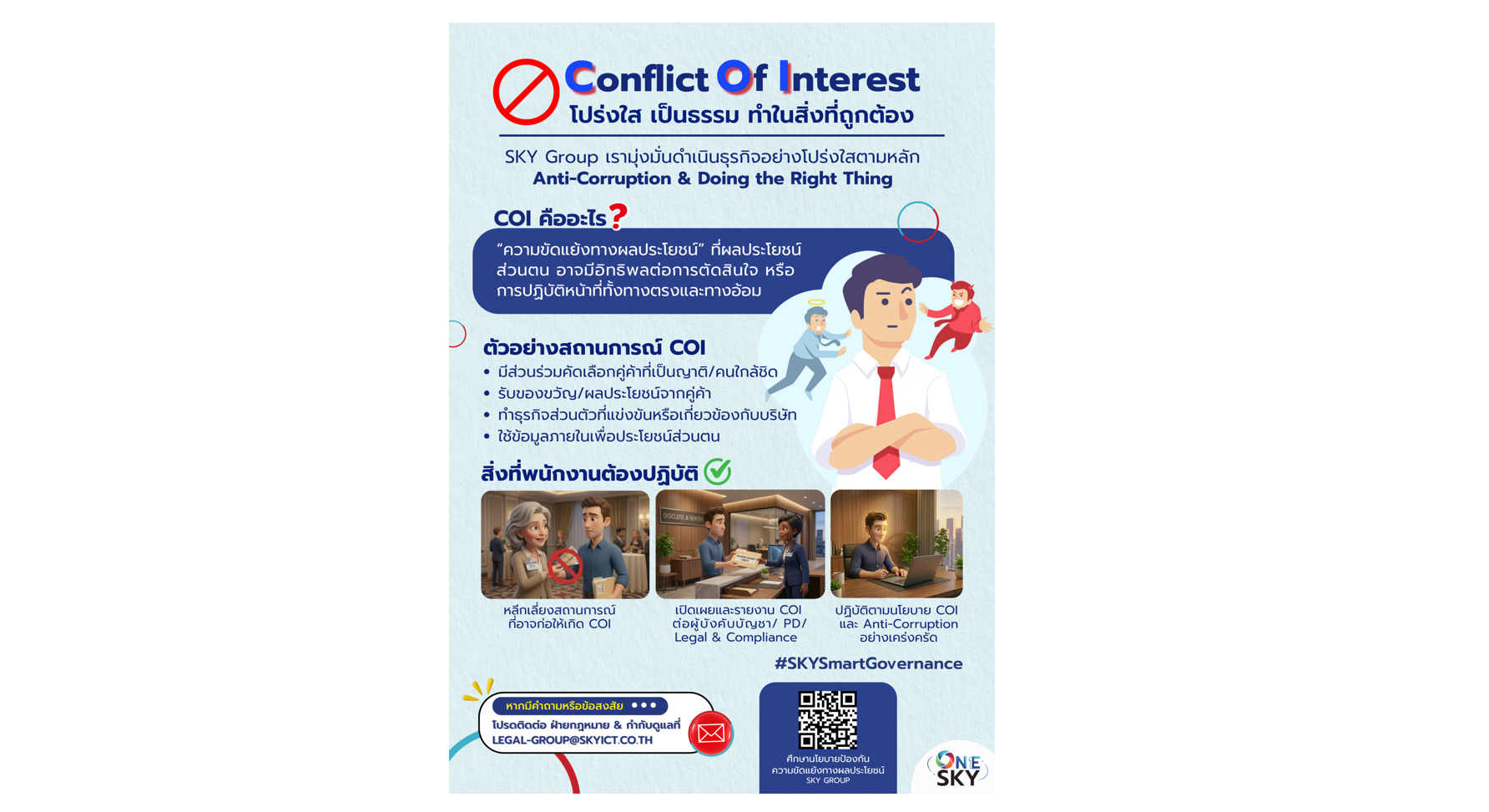
Number of Conflict-of-Interest Cases
| Metric | Current Year | Previous Year | Two Years Ago |
|---|---|---|---|
| Total number of cases or issues related to conflicts of interest (cases) | 0 | 0 | 0 |
Prevention of the Use of Inside Information
Has the Company Acted to Prevent the Use of Inside Information?
Yes
Operations in the Past Year
The Board of Directors recognizes the importance of preventing the use of the Company's material and non-public inside information for personal gain. Therefore, to protect the interests of shareholders and retail investors, promote transparency in the use of inside information, and prevent personal profiteering from such inside information, the Company has established guidelines for its directors, executives, and employees to adhere to, as follows:
Directors, executives, and employees of the Company must maintain the confidentiality of and/or the Company's inside information and must not disclose it or use it for their own benefit or for the benefit of others, whether directly or indirectly. They must also not buy, sell, transfer, or accept the transfer of the Company's securities using confidential and/or inside information of the Company, and/or enter into any legal transaction using confidential and/or inside information of the Company that may cause damage to the Company, whether directly or indirectly.
Directors, executives, and employees in departments that receive the Company's inside information must not use such information before it is disclosed to the public. Furthermore, they must not buy, sell, transfer, or accept the transfer of the Company's securities during the one-month period prior to the public disclosure of quarterly and annual financial statements, and for at least 24 hours after such information has been disclosed.
Furthermore, all directors and executives have signed to acknowledge their duty to report their securities holdings in the Company, including those of their spouses and minor children, as well as to report changes in such holdings to the Securities and Exchange Commission (SEC) and the Stock Exchange of Thailand (SET), in accordance with Section 59 and the Notification of the Securities and Exchange Commission No. Sor Jor. 12/2552 regarding the preparation and disclosure of securities holding reports by directors, executives, and auditors, as well as penalties under Section 275 of the Securities and Exchange Act B.E. 2535 (1992). In the past year 2568, the Company found no violations related to the use of inside information. Moreover, the Company communicates and raises awareness regarding the use of inside information among its directors, executives, and employees through email, the Company's shared drives, and annual training.
These regulations also extend to the spouses and minor children of the Company's directors, executives, and employees. Any person who violates these regulations shall be subject to disciplinary action and/or legal penalties, as the case may be.
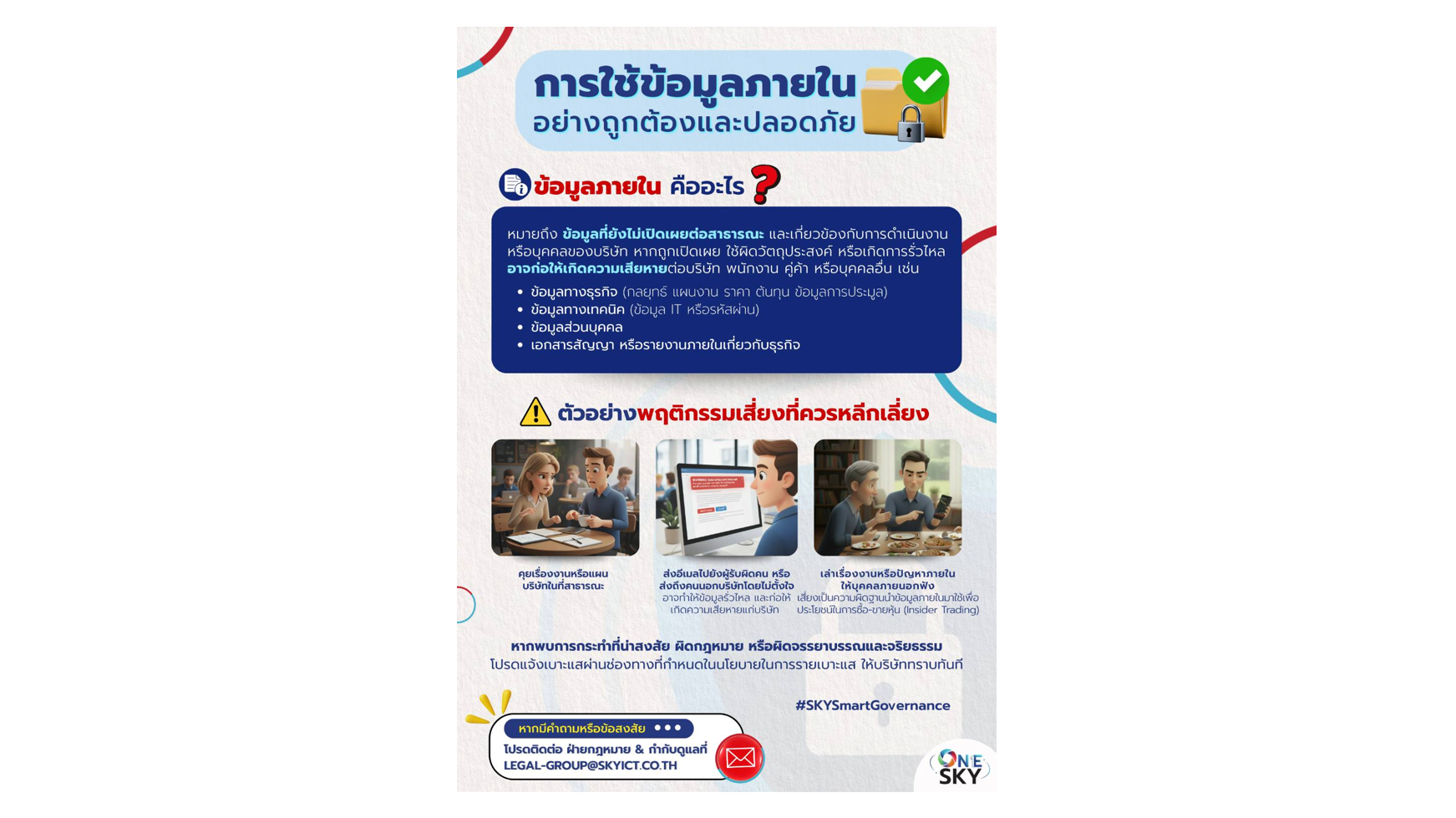
Number of Inside-Information Cases
| Metric | Current Year | Previous Year | Two Years Ago |
|---|---|---|---|
| Total number of cases or issues related to the use of inside information to seek benefits (cases) | 0 | 0 | 0 |
Anti-Corruption
Has the Company Acted on Anti-Corruption?
Yes
Operations in the Past Year
The Company conducts its business with transparency, adheres to integrity, and prioritizes anti-corruption. At the Board of Directors Meeting No. 4/2559 on April 8, 2016, a resolution was passed to approve the Anti-Corruption Policy. This policy has been continuously reviewed and updated to ensure its suitability, supporting activities that promote and instill in directors, executives, and employees compliance with relevant laws and regulations. The Company does not support achieving work success through corrupt means. Therefore, the Board of Directors has an Anti-Corruption Policy to establish clear guidelines for conducting business in accordance with good corporate governance principles, the company's code of conduct, regulations, requirements, and relevant laws. The Company requires personnel at all levels to refrain from engaging in, or being involved in, any form of corruption, whether directly or indirectly, and to strictly comply with the practices prescribed in the policy. These include, but are not limited to, the giving and receiving of gifts, charitable donations, hospitality, political contributions, procurement, and the hiring of public officials. This is to ensure clarity in operations and to raise employee awareness, so that such channels are not used as a means of providing improper benefits or giving rise to conflicts of interest.
The Company organizes internal communication and public relations activities, such as annual employee training, new employee orientation, emails, shared drives, and the company's website. This is to ensure that directors, executives, and employees within the organization are aware of and understand corruption prevention and anti-corruption measures, thereby continuously adhering to the organization's Anti-Corruption Policy. In the past year 2025, 100% of directors, executives, and employees participated in the training.
Furthermore, the Company encourages customers, business partners, competitors, creditors, debtors, and other stakeholders to participate in anti-corruption efforts. It also has measures to protect and maintain the confidentiality of whistleblowers, and processes for inspection, monitoring, and control in accordance with the Anti-Corruption Policy. In the past year 2025, there were no instances of corruption offenses within the Company.
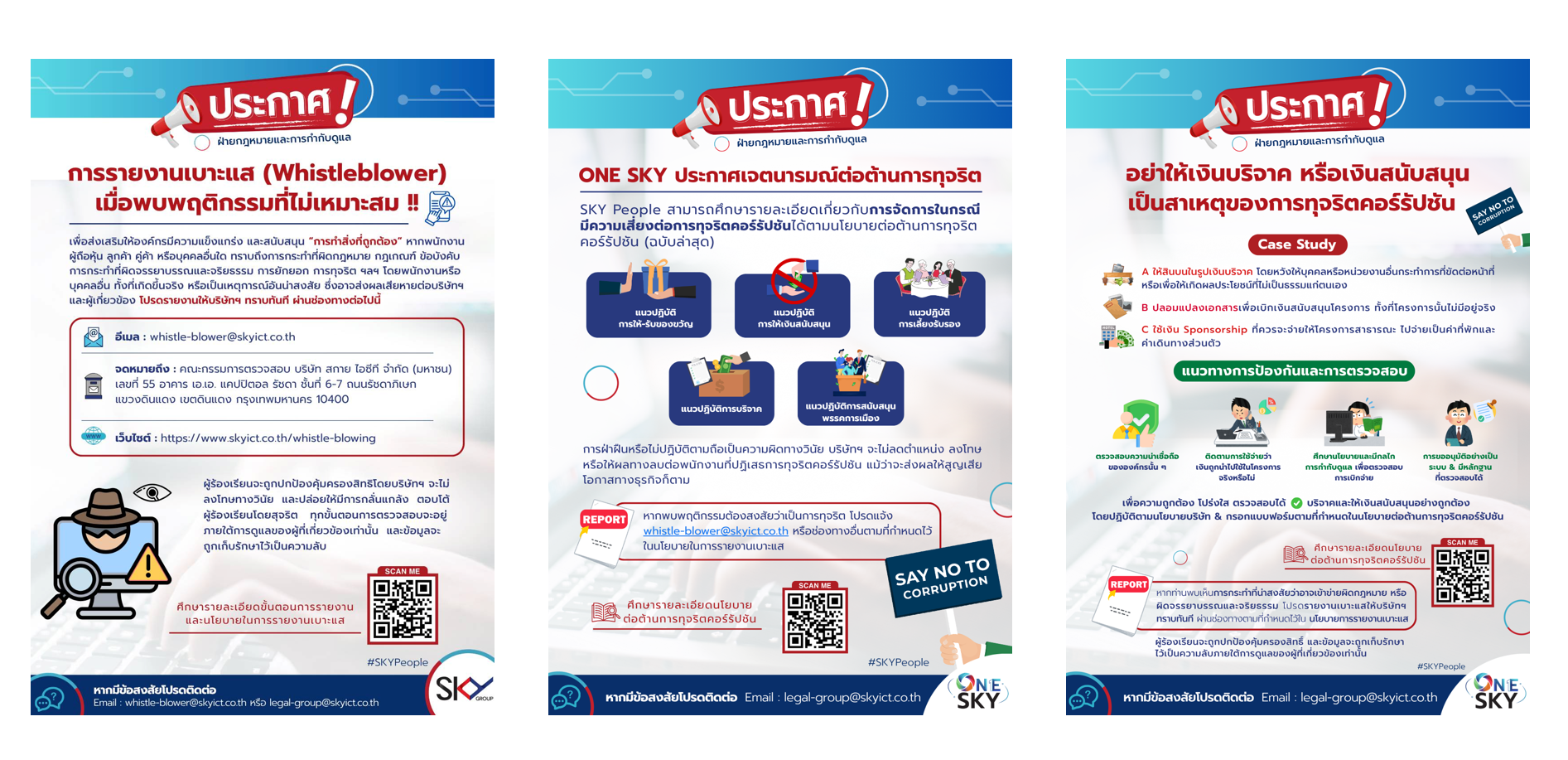
Form of Anti-Corruption Operations
| Operation |
|---|
| The participation in anti-corruption projects |
| Review of appropriateness in anti-corruption |
| Assessment and identification of corruption risk |
| Communication and training for employees on anti-corruption policy and guidelines |
| The monitoring of the evaluation of compliance with the anti- corruption policy |
| Review of the completeness and adequacy of the process by the Audit Committee or auditor |
Number of Corruption Cases
| Metric | Current Year | Previous Year | Two Years Ago |
|---|---|---|---|
| Total number of cases or issues related to corruption (cases) | 0 | 0 | 0 |
Whistleblowing
Has the Company Implemented Whistleblowing Procedures?
Yes
Operations in the Past Year
The Board of Directors will receive whistleblowing reports and complaints regarding actions that may raise suspicion of corruption occurring within the Company, whether directly or indirectly, through the channels specified in the Whistleblower Policy, as follows:
-
By electronic mail, by sending to Email: whistle-blower@skyict.co.th
-
By mail, by sending a letter to the Audit Committee of Sky ICT Public Company Limited, No. 55, A.A. Capital Ratchada Building, 6th-7th Floor, Ratchadaphisek Road, Din Daeng Sub-district, Din Daeng District, Bangkok 10400.
-
Online, by submitting to https://www.skyict.co.th/whistle-blowing
The Company has a complaint handling policy and has established a complaint receiving system to receive opinions, suggestions, questions, and complaints related to good corporate governance, business ethics, and compliance with relevant laws, rules, and regulations of the Company from both internal and external stakeholders. The Company's complaint handling system complies with international standards, focusing on three key principles: protection of complainants and those complained against, response to complainants, and investigation and remedy.
For complaints received by the Company through channels other than the complaint handling system, the Company has conducted investigations and established appropriate action plans to resolve the issues. Furthermore, the Company has implemented appropriate measures to prevent future violations in various potential cases.
Furthermore, all complaints will be treated with utmost confidentiality, and complainants may submit complaints through more than one channel and are not required to disclose their identity. However, if they choose to reveal their identity, the Company will be able to inform them of the investigation results or provide further details regarding the complaint. In the year 256 8, the Company did not receive any whistleblowing reports or complaints.
Regarding monitoring and oversight, the Company Secretary will be responsible for collecting all information and operational results related to complaints, preparing a summary report of the investigation results and related corrective actions, to present the report to the independent directors or relevant committees for acknowledgment and oversight to ensure appropriate, transparent, and good corporate governance practices.
Protection and Confidentiality Measures
To protect the rights of complainants and informants acting in good faith, the Company will conceal the name, address, or any information that could identify the complainant or informant, and will keep the information of the complainant and informant confidential, with access to such information restricted solely to those responsible for investigating the complaint.
The Company will not demote, punish, or negatively impact employees who refuse corruption, even if such refusal results in the Company losing business opportunities.
Number of Whistleblowing Cases
| Metric | Current Year | Previous Year | Two Years Ago |
|---|---|---|---|
| Total number of cases or issues received through whistleblowing channels (cases) | 0 | 0 | 0 |
Selection of Directors & Chief Executives
Selection — Introduction
The Company has a Nomination and Remuneration Committee, which establishes criteria and processes for nominating individuals with suitable qualifications and in line with the Company's business strategies for appointment as directors and top executives. It also selects company directors to serve on sub-committees, considering elements based on the Board Skill Matrix to assess the necessary qualifications, skills, knowledge, and experience of the directors to be nominated. This includes considering the form and criteria for remuneration payment and conducting the selection of individuals according to the established nomination process, for submission to the Board of Directors for consideration and approval as required by law.
Are Directors Selected Through the Nomination Committee?
Yes
Are Chief Executives Selected Through the Nomination Committee?
Yes
Rights of Minority Shareholders on Director Appointment
The Company prioritizes the protection of minority shareholders' rights and encourages all shareholders to participate in corporate governance through a transparent, fair, and verifiable director appointment process, aiming to foster good governance and long-term investor confidence.
Minority investors, as shareholders of the Company, have the right to participate in determining the direction and governance of the Company through the exercise of their right to appoint directors, in accordance with the rights stipulated by law, the Company's articles of association, and resolutions of shareholders' meetings. Key rights include:
Right to nominate individuals for consideration as directors
Minority shareholders have the right to nominate qualified individuals for consideration as company directors, in accordance with the criteria and deadlines clearly stipulated by the Company in advance. The Company provides equal and fair opportunities for all shareholders to exercise this right.
Right to vote for the election of directors
Minority shareholders have the right to cast votes for the election of directors at the shareholders' meeting, based on the principle of "one share, one vote," whether attending in person or by proxy. The Company arranges for individual voting for each director to enable shareholders to exercise their rights transparently.
Right to receive sufficient information for decision-making
Minority investors have the right to receive complete and sufficient information about nominees for directorships in advance of the shareholders' meeting, such as their background, qualifications, experience, independence, and positions held in other companies, to facilitate careful consideration when exercising their voting rights.
Right to ask questions and express opinions at the shareholders' meeting
Minority investors have the right to ask questions, express opinions, or seek clarification from the Board of Directors and management regarding the proposed appointment of directors at the shareholders' meeting. The Company encourages constructive and fair exchange of views.
Right to object to or disapprove the appointment of directors
Minority shareholders have the right to vote against the appointment of any director if they deem the individual unsuitable or potentially involved in a conflict of interest. The voting results will be recorded and disclosed in accordance with the principle of transparency.
Method of Director Appointment
| Method |
|---|
| Method whereby each director requires approval votes more than half of the votes of attending shareholders with voting rights |
Selection of Independent Directors
Criteria for Selecting Independent Directors
The Board of Directors or the Shareholders' Meeting (as the case may be) appoints independent directors to serve on the Board of Directors. The Company has a policy to appoint independent directors comprising no less than one-third of the total number of directors.
The criteria for selecting independent directors are based on the criteria for selecting company directors. The qualifications of a person to serve as an independent director are considered based on the qualifications and prohibited characteristics of directors under the Public Limited Company Act and the Securities and Exchange Act, including related notifications, regulations, and/or rules. Independent directors shall possess educational qualifications, specialized expertise, work experience, and other suitable attributes combined, for submission to the Shareholders' Meeting for consideration and appointment as directors of the Company. In the event that any independent director vacates their position before the end of their term, the Board of Directors may appoint an independent director with the aforementioned qualifications to fill the vacancy. The independent director appointed as a replacement shall serve only for the remaining term of the independent director they replace. The Board of Directors has stipulated the qualifications for independent directors as follows:
-
Holds no more than 1.0% of the total voting shares of the company, its parent company, subsidiaries, associated companies, major shareholders, or controlling persons of the company. This includes the shareholding of related persons of that independent director.
-
Is not or has not been an executive director, employee, salaried advisor, or controlling person of the company, its parent company, subsidiaries, associated companies, fellow subsidiaries, major shareholders, or controlling persons of the company, unless such characteristics have ceased for at least 2 years prior to the date of appointment as an independent director.
-
Has no blood relationship or legal registration as a father, mother, spouse, sibling, or child, including the spouse of a child, of an executive, major shareholder, controlling person, or a person to be nominated as an executive or controlling person of the company or its subsidiary.
-
Has no or has not had a business relationship with the company, its parent company, subsidiaries, associated companies, major shareholders, or controlling persons of the company in a manner that may interfere with their independent judgment. This includes not being or having been a significant shareholder or controlling person of any entity having a business relationship with the company, its parent company, subsidiaries, associated companies, major shareholders, or controlling persons of the company, unless such characteristics have ceased for at least 2 years prior to the date of appointment as an independent director.
-
Is not or has not been an auditor of the company, its parent company, subsidiaries, associated companies, major shareholders, or controlling persons of the company, and is not a significant shareholder, controlling person, or partner of an audit firm where an auditor of the company, its parent company, subsidiaries, associated companies, major shareholders, or controlling persons of the company is affiliated, unless such characteristics have ceased for at least 2 years prior to the date of appointment as an independent director.
-
Is not or has not been a professional service provider of any kind, including providing services as a legal advisor or financial advisor, who has received service fees exceeding 2 million Baht per year from the company, its parent company, subsidiaries, associated companies, major shareholders, or controlling persons of the company, and is not a significant shareholder, controlling person, or partner of such professional service provider, unless such characteristics have ceased for at least 2 years prior to the date of appointment as an independent director.
-
Is not a director appointed to represent the directors of the company, major shareholders, or shareholders who are related to major shareholders.
-
Does not engage in businesses of the same nature that are in significant competition with the business of the company or its subsidiaries, or is not a significant partner in a partnership, or is an executive director, employee, salaried advisor, or holds more than 1.0% of the total voting shares of another company that engages in businesses of the same nature and is in significant competition with the business of the company or its subsidiaries.
-
Possesses no other characteristics that prevent them from providing independent opinions regarding the company's operations.
Independent directors shall verify and certify their own independence qualifications at least once a year. This will be reported along with the director's profile information at year-end for the preparation of the Company's Annual Information Form / Annual Report (Form 56-1 One Report).
Did Any Independent Director Have a Business or Professional Relationship?
No
Director Development
Director Development — Introduction
The Board of Directors places importance on the development of directors, executives, and the company secretary, by requiring new directors to complete at least one training course related to their duties as directors. 1 course from the Thai Institute of Directors (IOD), specifically the Directors Accreditation Program (DAP), which most of the Company's directors have already completed DAP training. The Company has also supported directors, executives, and the company secretary to participate in seminars organized by the Stock Exchange of Thailand, the SEC Office, and related institutions to continuously enhance their knowledge in performing their duties.
Furthermore, the Board has a policy to promote and facilitate training and knowledge provision for directors involved in the Company's corporate governance system, such as directors, audit committee members, executives, and the company secretary, among others, to ensure continuous improvement in their performance. In the event of a change in directors or new directors, the company secretary will provide documents and information beneficial for the new directors' performance of duties, including an introduction to the Company's business nature and operational guidelines for new directors.
Development of Directors in the Past Year
In the year 256` 8, there were directors who attended various training courses and seminars as follows:`
Qualifications for Director Selection — Introduction
The Board of Directors shall consist of individuals with knowledge, skills, diverse professional backgrounds, and experience that can benefit the Company. They shall play a role in setting the organization's policies and overall direction, as well as business operational plans. Furthermore, they shall have a crucial role in overseeing, inspecting, and evaluating the Company's performance to ensure it aligns with the established plans. They shall also conduct the Company's business in accordance with laws, regulations, and resolutions of shareholders' meetings, with integrity, ethics, and under the business code of conduct. This includes overseeing that the management's administration adheres to the defined goals and guidelines, and generates maximum benefit for the Company and its shareholders. The Company has established the qualifications for the Board of Directors as follows:
-
Possess full qualifications and not have any prohibited characteristics under the Public Limited Company Act B.E. 2535 (1992) or other relevant laws, as well as the regulations of the Stock Exchange of Thailand and the Securities and Exchange Commission ("SEC"). This also includes the Company's Articles of Association. Furthermore, they must not possess characteristics indicating a lack of suitability to be entrusted with managing a public company, as prescribed by the SEC.
-
Shall not engage in business, become a partner, or hold shares in other legal entities of the same nature that compete with the Company's business, unless approved by the shareholders' meeting, or unless the shareholders' meeting is informed prior to the resolution for appointment. A company director must promptly inform the Company if they have a direct or indirect interest in any contract made by the Company, or if their shareholding or debenture holding in the Company or its subsidiaries increases or decreases.
-
Possess leadership, vision, and independence in decision-making for the utmost benefit of the Company and its shareholders as a whole.
-
Possess knowledge, capabilities, and experience from diverse professions that are beneficial to the Company's business operations.
-
Possess integrity and honesty.
-
Be able to fully dedicate time to performing duties as a company director. A company director should not hold directorships in more than 5 listed companies.
-
The Chairman of the Board shall not be the same person as the Chief Executive Officer, to ensure a balance of power and oversight of management. The Company has clearly defined the scope, authority, duties, and responsibilities of the company directors, the Chairman of the Board, the Executive Committee, and the Chief Executive Officer.
In cases where the person holding the position of Chairman of the Board is not an independent director, the Board of Directors shall appoint one independent director to co-consider and determine the agenda for Board meetings. This is to comply with good corporate governance principles.
Evaluation of Board & Subcommittee Performance
Criteria for Evaluating Board Performance
The Board performance evaluation is conducted in 3 ways as follows:
-
Overall Board Performance Evaluation Evaluated in various aspects, namely:
-
Structure and Qualifications of the Board of Directors
-
Roles, Duties, and Responsibilities of the Board
-
Board Meetings
-
Performance of Directors
-
Relationship with Management
-
Director Self-Development and Executive Development
-
Individual Board Performance Evaluation Evaluated in various aspects, namely:
-
Readiness of Directors
-
Strategy Formulation and Business Planning
-
Risk Management and Internal Control
-
Preventing Conflicts of Interest
-
Monitoring Financial and Operational Reports
-
Board Meetings
-
Others
-
Performance Evaluation of Each Sub-Committee Comprises
-
Audit Committee
-
Risk Management Committee
-
Nomination and Remuneration Committee
-
Corporate Governance and Sustainability Committee
The evaluation criteria are calculated as a percentage of the full score for each item, as follows:
-
More than 90% = Excellent
-
More than 80% = Very Good
-
More than 70% = Good
-
More than 60% = Fair
-
Less than 60% = Needs Improvement
Evaluation of Board Performance in the Past Year
The Board of Directors mandates an annual self-assessment (Board Self-Assessment) for individual members and the entire Board. This serves as a framework for reviewing the Board's performance to ensure adherence to approved corporate governance policies and/or good practices, thereby improving the Board's operations in line with established policies and addressing issues and obstacles encountered during the past year.
The Company Secretary will distribute the Board performance evaluation forms to all Board members for their annual assessment, both collectively and individually, at the end of each year. After each director completes their evaluation, the forms will be returned to the Company Secretary to compile the individual scores and summarize the analysis of the Board's performance for the year. This report will then be submitted to the Board of Directors for consideration to achieve the aforementioned objectives.
The evaluation results are summarized as follows:
|
Evaluation |
Evaluation Results |
Level |
|
Board of Directors (Collective) |
96.98% |
Excellent |
|
Individual Board Members |
97.40% |
Excellent |
|
Audit Committee |
98.98% |
Excellent |
|
Risk Management Committee |
98.57% |
Excellent |
|
Nomination and Remuneration Committee |
95.83% |
Excellent |
|
Corporate Governance and Sustainability Committee |
94.29% |
Excellent |
Chief Executive Officer Performance Evaluation
The Board of Directors is responsible for setting annual and long-term performance targets for the Chief Executive Officer, as well as evaluating said performance against these targets annually. The results of this evaluation will be used in the consideration of the Chief Executive Officer's remuneration.
The Chief Executive Officer's performance evaluation utilizes an assessment form covering various topics as follows:
Governance and Economic Aspects
1. Total Revenue and Growth Rate
2. Gross Profit Margin
3. EBITDA Ratio
4. Economic Value Added (EVA)
5. Risk Monitoring and Management
6. Board Meetings
7. Number of Complaints and Ethical Violations
Social Aspects
8. Customer Satisfaction Level
9. Employee Training Hours
10. Employee Engagement Score
11. Number of Work-Related Accidents, Illnesses, or Fatalities
12. Number of Human Rights Violation Complaints
Environmental Aspects
13. Reduction in Greenhouse Gas Emissions
14. Reduction in Electricity and Water Consumption
15. Number of Environmental Law Violations
Competency Aspects
16. Leadership Aspects
17. Strategy and Strategy Implementation
18. Financial Planning and Performance
19. Relations with the Board
20. External Relations
21. Administration and Personnel Relations
22. Succession Planning
23. Product and Service Knowledge
24. Personal Attributes
The evaluation results are summarized as follows:
In summary, the evaluation results of the Chief Executive Officer's performance for the year 2025 across all 4 categories indicate that most operations were performed excellently, with an average score of 97.61%.
Subcommittees
Subcommittees
| Results of the Subcommittee's Duty Performance | Meetings — Introduction |
|---|---|
| The Risk Management Committee has the duties and responsibilities for managing the company's risks to be appropriate, systematic, and continuous. Therefore, it has established risk management policies and frameworks, as well as defining acceptable risk levels in alignment with the company's business objectives. During the year 2025, the Risk Management Committee fully performed its duties as stipulated in its charter, holding a total of 4 meetings. The Chairman of the Risk Management Committee, an independent director, and two executive directors attended all meetings without exception. A summary of the key activities of the Risk Management Committee for the year 2025 is as follows: |
| The Nomination and Remuneration Committee is responsible for recruiting and selecting qualified individuals to be appointed as directors of the Company, members of the Company's sub-committees, representatives of the Company to serve as directors of subsidiaries, executive directors of the Company, and the Company's chief executive officer. This also includes considering the form and criteria for remuneration in accordance with the established recruitment process, for submission to the Board of Directors for consideration and approval as required by law. During 2025, the Nomination and Remuneration Committee fully performed its duties as stipulated in the charter. A total of 4 meetings were held, with the Chairman of the Nomination and Remuneration Committee, who is an independent director, and all members of the Nomination and Remuneration Committee attending every meeting. A summary of the key operations of the Nomination and Remuneration Committee for the year 2025 is as follows: |
| The Good Corporate Governance and Sustainability Committee is responsible for promoting the operations of the Group of Companies in accordance with the principles of Good Corporate Governance (GCG), as well as for achieving the established corporate governance and business ethics policies. This is to enhance confidence among shareholders, investors, and all stakeholders, and to increase value and foster the sustainable growth of the Group of Companies. During the year 2568, the Good Corporate Governance and Sustainability Committee fully discharged its duties as stipulated in its charter. A total of 2 meetings were convened, with the Chairman of the Good Corporate Governance and Sustainability Committee, an independent director, and all members of the Good Corporate Governance and Sustainability Committee attending every meeting. A summary of the key operations of the Good Corporate Governance and Sustainability Committee for the year 2568 is as follows: |
Meeting Attendance & Remuneration
Meeting Attendance — Introduction
The Company's management structure comprises the Board of Directors, Audit Committee, Risk Management Committee, Nomination and Remuneration Committee, and Good Corporate Governance and Sustainability Committee. The list of directors, their positions, and meeting attendance details for 2568 are as follows:
List of Directors | Number of meetings attended /Number of meetings held | ||||||||
Board of Directors | Executive Committee | Audit Committee | Nomination and Remuneration Committee | Risk Management Committee | Good Corporate Governance Committee | Annual General Meeting of Shareholders | |||
Total | Physical Meeting | e-meeting | |||||||
Mr. Somkit Lertpaithoon* | 10/10 | 4/4 | 6/6 | 1/1 | |||||
Mr. Somchai Poolsavasdi | 10/10 | 4/4 | 6/6 | 1/2 | 1/1 | ||||
Mr. Vipootha Trakulhoon | 10/10 | 4/4 | 6/6 | 6/6 | 2/2 | 1/1 | |||
Mr. Thitisak Skulkroo | 10/10 | 4/4 | 6/6 | 6/6 | 4/4 | 1/2 | 1/1 | ||
Mr. Sarut Vanichpun | 10/10 | 4/4 | 6/6 | 6/6 | 4/4 | 1/1 | |||
Mr. Raj Tanta-nanta | 10/10 | 4/4 | 6/6 | 2/4 | 1/2 | 1/1 | |||
Mr. Sithidej Mayalarp | 10/10 | 4/4 | 6/6 | 13/13 | 4/4 | 4/4 | 2/2 | 1/1 | |
Ms. Kulnada Orararaktham | 10/10 | 4/4 | 6/6 | 13/13 | 2/4 | 4/4 | 2/2 | 1/1 | |
Note
*Chairman
At the Board of Directors Meeting No. 2/2568 on April 25, 2568, a resolution was passed to appoint Mr. Raj Tanta-nanta, an independent director, as a member of the Nomination and Remuneration Committee, replacing Ms. Kulnada Orararaktham, who resigned from the Nomination and Remuneration Committee.
At the Board of Directors Meeting No. 2/2568 on April 25, 2568, a resolution was passed to appoint Mr. Raj Tanta-nanta, an independent director, as Chairman of the Good Corporate Governance and Sustainability Committee, replacing Mr. Vipoota Trakulhoon, and to additionally appoint Mr. Somchai Poolsavasdi and Mr. Thitisak Skulkroo as members of the Good Corporate Governance and Sustainability Committee.
The Company schedules meetings in advance throughout the year, specifying important agendas and meeting dates, and informs the Board of Directors to schedule meetings in November of each year.
The Company distributes meeting documents at least 5 business days in advance.
The minimum quorum for directors to cast votes at a meeting must be no less than two-thirds of the total number of directors.
For the past fiscal year 2568, the Company held one meeting of non-executive directors without management present on February 27, 2569. The Company Secretary conveyed the opinions received from the meeting to the management for further action.
Types of Remuneration of the Board of Directors
The Company has a policy to provide attractive and appropriate remuneration to directors and executives, taking into account the Company's performance and alignment with the same business/industry, as well as the suitability of the duties and responsibilities of each director and executive. The Company determines remuneration based on the appropriateness of authority according to the criteria and policies set by the Board of Directors and for the maximum benefit of the Company, at a competitive rate within the same business group, in order to attract and retain quality executives. Remuneration is set as salary, bonuses, and long-term incentive compensation aligned with the Company's performance and the individual performance of each executive. Executives assigned additional duties and responsibilities will receive appropriate additional compensation commensurate with their increased duties and responsibilities.
At the Annual General Meeting of Shareholders 2025 held on April 25, 2025, a resolution was passed to determine the remuneration for directors for the year 2025, whereby the Company shall pay directors' remuneration as monthly remuneration and meeting allowances, with details as follows:
|
Meeting |
Remuneration (Baht) |
Meeting Allowance (Baht) |
||
|
|
Monthly |
Per meeting attended |
||
|
Year 2024 |
Year 2025 |
Year 2024 |
Year 2025 |
|
|
Board of Directors / Shareholders |
|
|
|
|
|
Chairman |
26,000.00 |
26,000.00 |
25,000.00 |
25,000.00 |
|
Vice Chairman |
22,000.00 |
22,000.00 |
19,000.00 |
19,000.00 |
|
Director |
18,000.00 |
18,000.00 |
14,000.00 |
14,000.00 |
|
Audit Committee |
|
|
|
|
|
Chairman |
- |
- |
20,000.00 |
20,000.00 |
|
Director |
- |
- |
14,000.00 |
14,000.00 |
|
Risk Management Committee |
|
|
|
|
|
Chairman |
- |
- |
20,000.00 |
20,000.00 |
|
Director |
- |
- |
14,000.00 |
14,000.00 |
|
Nomination and Remuneration Committee |
|
|
|
|
|
Chairman |
- |
- |
20,000.00 |
20,000.00 |
|
Director |
- |
- |
14,000.00 |
14,000.00 |
|
Good Corporate Governance and Sustainability Committee |
|
|
|
|
|
Chairman |
- |
- |
20,000.00 |
20,000.00 |
|
Director |
- |
- |
14,000.00 |
14,000.00 |
The total monthly remuneration and meeting allowances for the year 2025 shall not exceed 4,700,000 Baht per year. Furthermore, directors who are employees of the Company are not entitled to receive meeting allowances for sub-committees.
Remuneration or Benefits Payable to the Board
| Metric | Amount (Baht) |
|---|---|
| Remunerations or benefits pending payment to the board of directors over the past year (baht) | 0 |
Supervision of Subsidiaries & Associated Companies
Does the Company Have Subsidiaries or Associated Companies?
Yes
Is There a Mechanism for Overseeing Subsidiaries and Associated Companies?
Yes
Mechanism for Overseeing Management of Subsidiaries
The Company has established a policy for the supervision and management of its subsidiaries and/or joint ventures with the objective of defining direct and indirect measures and mechanisms to enable the Company to supervise and manage the operations of its subsidiaries and/or joint ventures, including monitoring and ensuring that the subsidiaries and/or joint ventures comply with the established measures and mechanisms as if they were units of the Company itself, and in accordance with the Company's policies, including the Public Limited Company Act, the Civil and Commercial Code, the Securities and Exchange Act, as well as various notifications, regulations, criteria, and other relevant laws. This is to protect the investment interests of the Company in such subsidiaries and/or joint ventures. The details are as follows:
-
The Company will appoint individuals as its representatives to serve as directors in its subsidiaries and/or joint ventures, in proportion to its shareholding in each company, to oversee that the subsidiaries and/or joint ventures operate in compliance with laws, good corporate governance policies, and other policies of the Company. However, the appointment of the Company's representatives as directors in subsidiaries and/or joint ventures must be considered and approved by the Company's Board of Directors meeting, taking into account the suitability of each company.
-
If a subsidiary and/or joint venture enters into any transaction or undertakes any action that falls under or constitutes an acquisition or disposal of assets according to the Capital Market Supervisory Board's notification regarding the acquisition or disposal of assets, or a connected transaction according to the Capital Market Supervisory Board's notification regarding connected transactions, which would require the Company to seek approval from the Company's Board of Directors meeting, approval from the Company's shareholders' meeting, or approval from relevant legal authorities before entering into such a transaction, the subsidiary and/or joint venture may only enter into such a transaction or undertake such action after it has received approval from the Company's Board of Directors meeting, or the Company's shareholders' meeting, or the relevant authorities (as the case may be).
Furthermore, if a subsidiary and/or joint venture enters into a transaction or if certain events occur which obligates the Company to disclose information to the Stock Exchange of Thailand according to specified criteria, the directors of such subsidiary and/or joint venture are obliged to immediately notify the Company's management as soon as they become aware that the subsidiary and/or joint venture plans to enter into such a transaction or that such an event will occur.
-
The Company has a policy requiring directors and executives of its subsidiaries and/or joint ventures to disclose and submit information regarding their interests and those of related persons to the Company's Board of Directors. This is to ensure awareness of relationships and transactions with the Company that may give rise to conflicts of interest, and to avoid engaging in transactions that may create conflicts of interest with the Company.
-
The Company has a policy requiring its subsidiaries and joint ventures to establish their own internal audit and control systems to prevent potential fraud within the subsidiaries and/or joint ventures, with due regard to good governance principles and the Company's management policies. The internal audit and control systems of the subsidiaries and joint ventures must be sufficiently effective to prevent and control risks that may arise for the subsidiaries and joint ventures.
-
The Company will require its subsidiaries and joint ventures to establish their own performance reporting systems, with due regard to good governance principles and the Company's management policies. The performance reporting systems of the subsidiaries and joint ventures must be sufficiently effective to enable the Company to efficiently monitor and evaluate the performance of its subsidiaries and joint ventures.
Furthermore, the Company will closely monitor the performance and operations of such subsidiaries and/or joint ventures and present analysis results, including opinions or recommendations, to the Company's Board of Directors and the boards of directors of those subsidiaries or joint ventures, to be used in considering policy formulation or improvements to enhance the efficiency of the businesses of the subsidiaries and/or joint ventures.
Oversight Mechanisms
| Mechanism |
|---|
| Sending representatives to act as directors, executives or controlling persons in proportion to shareholdings |
| Transactions between the Company and related persons |
| Defining the scope of powers, duties and responsibilities of directors and executives who represent the company in setting important policies |
| Disclosure of financial information and operating results |
| Other important transactions |
| Acquisition or disposal of assets |
| Internal control system of the subsidiary operating the core business is appropriate and sufficient in the subsidiary operating the core business |
Audit Committee Duty Performance
Results of the Audit Committee's Duty Performance in the Past Year
The Audit Committee has the duty and responsibility to oversee corporate governance in alignment with business strategies and policies, ensure compliance with relevant regulations and laws, prepare financial reports, select appropriate accounting policies, implement internal controls and internal audits, and consider the selection and appointment of the Company's auditors. It also reviews the Company's information disclosure to ensure accuracy, completeness, and independent operation.
During 2025, the Audit Committee held a total of 6 meetings. The auditor from PricewaterhouseCoopers ABAS Ltd., the Chief Financial Officer who oversees the Company's accounting department, and the internal auditor from Ascent Advisory Co., Ltd. attended 6 relevant sessions. Additionally, one meeting was held with the auditor and internal auditor without management present. The key points are summarized as follows:
Reviewed the quarterly financial statements and the annual financial statements for 2025. In doing so, inquiries were made and explanations were received from the Chief Financial Officer regarding accuracy, completeness, compliance with generally accepted accounting principles, the selection of accounting policies, and adequate disclosure of information. Observations and problem-solving approaches beneficial to the Company were also acknowledged. The Audit Committee's opinion aligns with that of the auditor, stating that the financial statements are materially accurate in accordance with financial reporting standards.
Reviewed the internal audit performance for the past year and supervised internal audit work, including monitoring the progress of the annual audit plan on a quarterly basis. The Audit Committee appointed the Company's Internal Audit Department, with Ms. Kannika Paewattanalert, Director of Internal Audit, as the Head of the Internal Audit Unit, to perform internal audits. The objective is to review operations, reporting, and compliance with policies, operational procedures, laws, regulations, and various related rules, to ensure the effectiveness of the Company's internal controls. However, from the assessment of the adequacy of the internal control system, it was found that, overall, the Company has an adequate internal control system.
Considered, proposed, appointed, and recommended the remuneration for the auditor for the year 2025, to be presented to the Board of Directors for approval at the Annual General Meeting of Shareholders for 2025. The Audit Committee, having considered the performance, independence, and appropriateness of the remuneration, deemed it appropriate to propose the appointment of Ms. Nantika Limviriyalert, Certified Public Accountant No. 7358, and/or Mr. Paiboon Tankul, Certified Public Accountant No. 4298, and/or Ms. Thitinan Waenkaew, Certified Public Accountant No. 9432, on behalf of PricewaterhouseCoopers ABAS Ltd., as the Company's auditor. Any one of them shall conduct the audit and express an opinion on the Company's financial statements, and the auditor's remuneration for the year 2025 shall be set at an amount not exceeding 3,700,000.00 Baht (Three Million Seven Hundred Thousand Baht Only) per year. This expense does not include other expenses beyond the contract.
Considered and provided opinions on the acquisition and disposal of assets, connected transactions, or transactions that may involve conflicts of interest for the Company and its subsidiaries, adhering to principles of prudence, reasonableness, and considering the interests of the Company's stakeholders, as well as ensuring adequate disclosure of information in accordance with the conditions set by the Stock Exchange of Thailand.
The Audit Committee is of the opinion that the connected transactions were conducted under normal commercial terms, without conflicts of interest, were fair and reasonable, and fully complied with the criteria set by the Stock Exchange of Thailand. No unusual transactions were found, and information was disclosed completely and adequately.
Monitored, analyzed, and reported changes in laws and regulations related to the Company, and ensured the Company's correct compliance with such laws and regulations. The Audit Committee continuously monitored this through reviews of various related tasks, including the Securities and Exchange Act, announcements and regulations of the Capital Market Supervisory Board, the SEC Office, and the Stock Exchange of Thailand, as well as agencies involved in the Company's business operations. The Audit Committee found that the Company has complied with the laws and regulations applicable to it and effective in 2025.
The Audit Committee held one meeting with the auditor and internal auditor, without management present, to allow for independent discussions on key issues regarding the review of financial statements and internal controls of the Company. Key issues discussed included:
Sufficiency and effectiveness of the Company's internal control system.
Financial Risk Assessment and Accounting Reporting
Accuracy and completeness of financial statements before submission to the Board of Directors.
Compliance with laws, regulations, and requirements of regulatory bodies.
Independence of the internal audit department and external auditors, including guidelines for developing and improving audit quality in the following year.
In summary, the Audit Committee is of the opinion that for the year 2025, the Company has appropriate corporate governance and internal control systems. The financial reports fully present material facts, are accurate according to financial reporting standards, and disclose information in compliance with relevant laws and regulations. No material errors that would affect the Company's financial position were found. Furthermore, the Company continuously develops and improves its operational systems to ensure quality and suitability for the business environment.
Executive Committee Duty Performance
Results of the Executive Committee's Duty Performance in the Past Year
Establish the company's business strategies, plans, and budget for submission to the Board of Directors for consideration and approval.
Consider the company's organizational structure. (Organization Chart) and operational authority before submitting for approval to the Board of Directors.
Manage the risks of the company's various operational activities by establishing risk management policies, including monitoring and evaluation, for submission to the Board of Directors.
Approve, make decisions, and issue orders within the scope of authority delegated by the Board of Directors, in accordance with the regulations on approval and operational authority approved by the Board of Directors' meeting.
Approve, amend, and modify work regulations, orders, requirements, and various criteria related to operations, control, and management in all departments.
Report important operational results of the Executive Committee to the Board of Directors regularly.